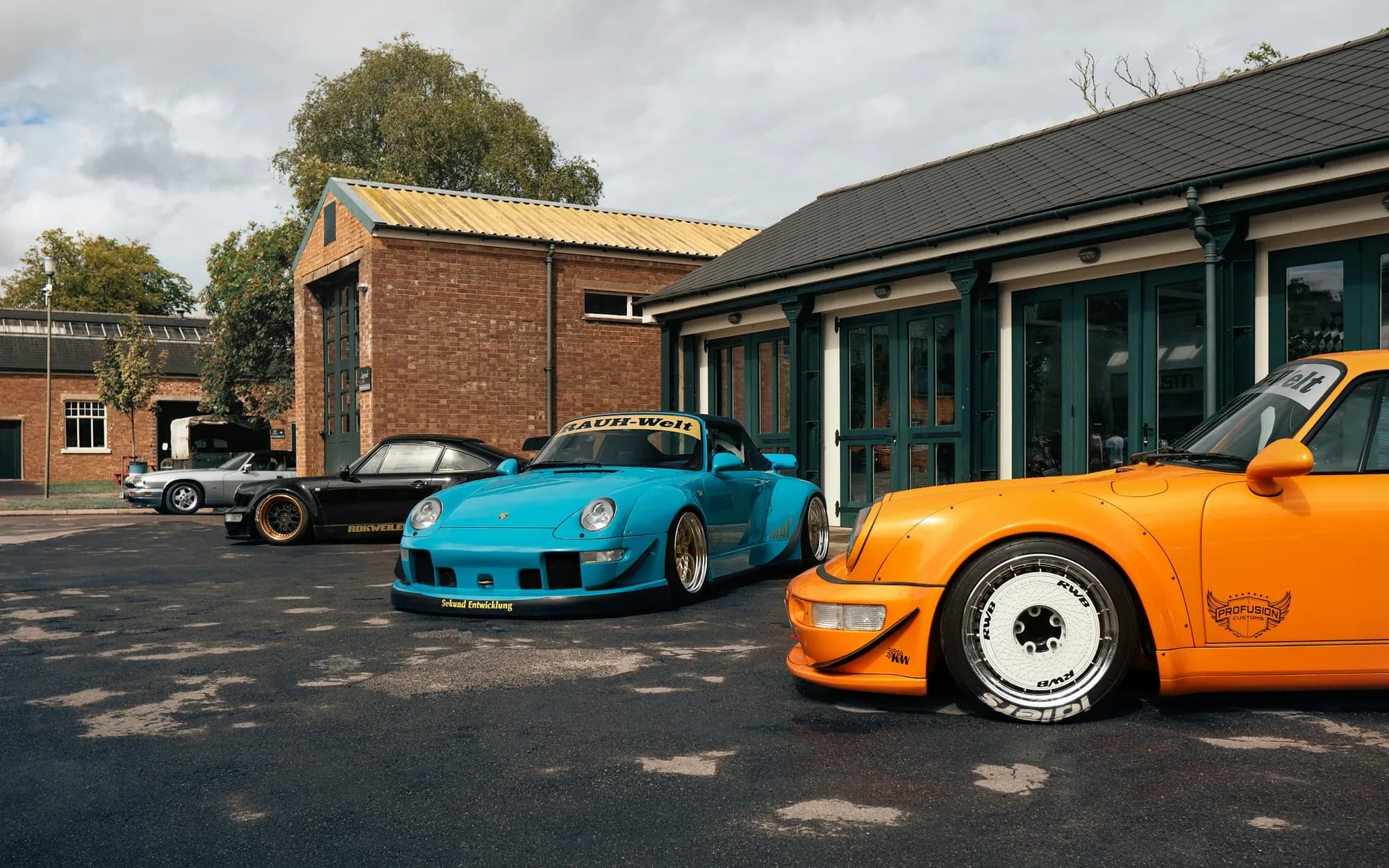
Photo: Abhinand Venugopal / Unsplash. RWB Porsche 911s at Bicester Heritage, England.
At a 2024 build in Connecticut, Akira Nakai arrived with an assistant and a beagle named Bagel, and Motor1 notes that he travels with rattle cans and basic air tools. Give him about two days and a 911 rolls out with new hips, a big wing and a name. That is an RWB build, and Nakai has done it everywhere from Moscow and Warsaw to Siloam Springs, Arkansas.
From drift crew to Chiba body shop
Before the Porsches, Nakai drifted an AE86 with a street crew called Rough World. Excellence reported that many credit him as one of the first in that scene to slam the car and run extreme negative camber, known as oni-kyan. In the late 1990s he got his first chance to work on Porsches at a local body shop, and at 28 he bought a 930 for himself, Excellence wrote. He named it Stella Artois, after his favorite beer, and it became the car RWB fans try to copy.
The crew lent the company its name: Rauh-Welt Begriff translates roughly to rough world concept, Petrolicious explains. The shop is in Kashiwa, Chiba, and RWB's own site says it began as a small countryside body shop. Nakai owns the look, while co-founder Tetsuro Yamazaki handles mechanicals and tuning, Top Gear reported.
930, 964, 993 and the odd 997
RWB Japan's price page lists wide-body kits for the 930, 964 and 993, and MotorTrend adds the water-cooled 997 to the eligible list. The New York International Auto Show booked him for a live build on a 2006 Carrera S in April 2025 and billed it as his first at an auto show.
The air-cooled cars made the name, though. A 1991 964 commissioned by Hoonigan co-founder Brian Scotto was one of the first RWBs built in the US, according to MotorTrend, and Hagerty credits a 2011 Hoonigan collaboration with putting RWB in front of American enthusiasts. Hagerty puts the total at more than 1,000 builds. The community-run RWB Worldwide Registry listed 626 cars in 38 countries in October 2026, including Inoshishi, an Arena Red 993 Carrera 2 finished on September 27, 2026.
The travel adds up. In 2017, The Drive reported that Nakai was flying 60 times a year to build 60 cars.
Tape, saw, rivets
On paper, the process is simple. You find a suitable Porsche, order the kit through RWB or an authorized partner, and wait; MotorTrend says more than a year can pass before Nakai has an opening. The Connecticut owner Motor1 visited had bought his kit four years earlier, with COVID scrambling the schedule.
Then it moves fast. Each new fiberglass fender gets held up to the car and outlined in tape, and Nakai saws freehand below that line with a small air tool, Motor1 reported. Top Gear describes him riveting the arches on and filling the gaps with rubber. The owner of a 964 finished in Moscow in 2012 told Petrolicious that Nakai completed the job over two days and smoothed sealant into the seams with his finger. In Connecticut, the body shop that prepped the car had already put about 360 hours into it before the saw came out.
At home in Chiba, the rhythm was different. Excellence found that a full transformation at the shop could take anywhere from a few months to a year, with Nakai shaping and sanding the bodywork by hand, often sleeping at the workshop, and sending powertrain, suspension and brake work to specialists.
Every car gets a name
Nakai names every car, and the names mean something. According to Excellence, he interviews owners before a build and picks a name that reflects them. In Warsaw, a red 993 became 79, its owner's birth year, and a friend's car became Yoroi, the Japanese word for armor, Petrolicious reported. A 993 commissioned by McGrath Keen and his racing-driver son, Leh, was named after a samurai sword.
Color can be his call, too. Excellence says matte finishes are the most requested but Nakai makes the final choice, and MotorTrend reports that he painted his own 930, Battle Knight, purple simply because he likes purple. Asked by Excellence to sum up his approach, he kept it short: "Style is everything."
Built to be raced
The width has a job. Motor1 notes that Nakai's style draws on air-cooled 911 race cars, the same family tree as Porsche's own Cup cars, and Excellence found him racing Stella Artois at Idlers meetings, an amateur series that visits circuits such as Tsukuba and Twin Ring Motegi.
The Idlers Club was founded by Atsushi Seike, editor of the Idlers magazine and a Japanese 911 magazine, and its 12-hour race at Motegi has run since 2000 with grids of about 100 cars, Jalopnik reported. The Drive counted seven cars and 50 drivers in one RWB effort at the Idlers 12 Hours. Top Gear says Idlers events draw a higher share of RWB cars than anywhere else, and that RWB runs a dedicated race shop, Rauh-Welt Republik, to prepare them.
How to get one
Start with the car: a 930, 964 or 993 per RWB's price list, or a 997 per MotorTrend. Then contact RWB Japan or one of the regional outposts its site lists, from the US, Canada and the UK to Taiwan, Thailand and the Philippines. Budget US$35,000 for the kit and US$5,500 each for RWB's SSR wheels and Aragosta suspension package, per the price page. MotorTrend warns that shipping, paint prep and paint can add about $25,000 more, and that the owner also covers Nakai's airfare and hotel.
And you get exactly one. RWB builds one car per customer, a rule MotorTrend says money does not bend. More 911 stories live in Porsche, and the wider widebody scene is in our comparison.
Sourced from RWB Japan's site, the community-run RWB Worldwide Registry and the reporting linked above. Prices are RWB's listed figures as of October 2026.