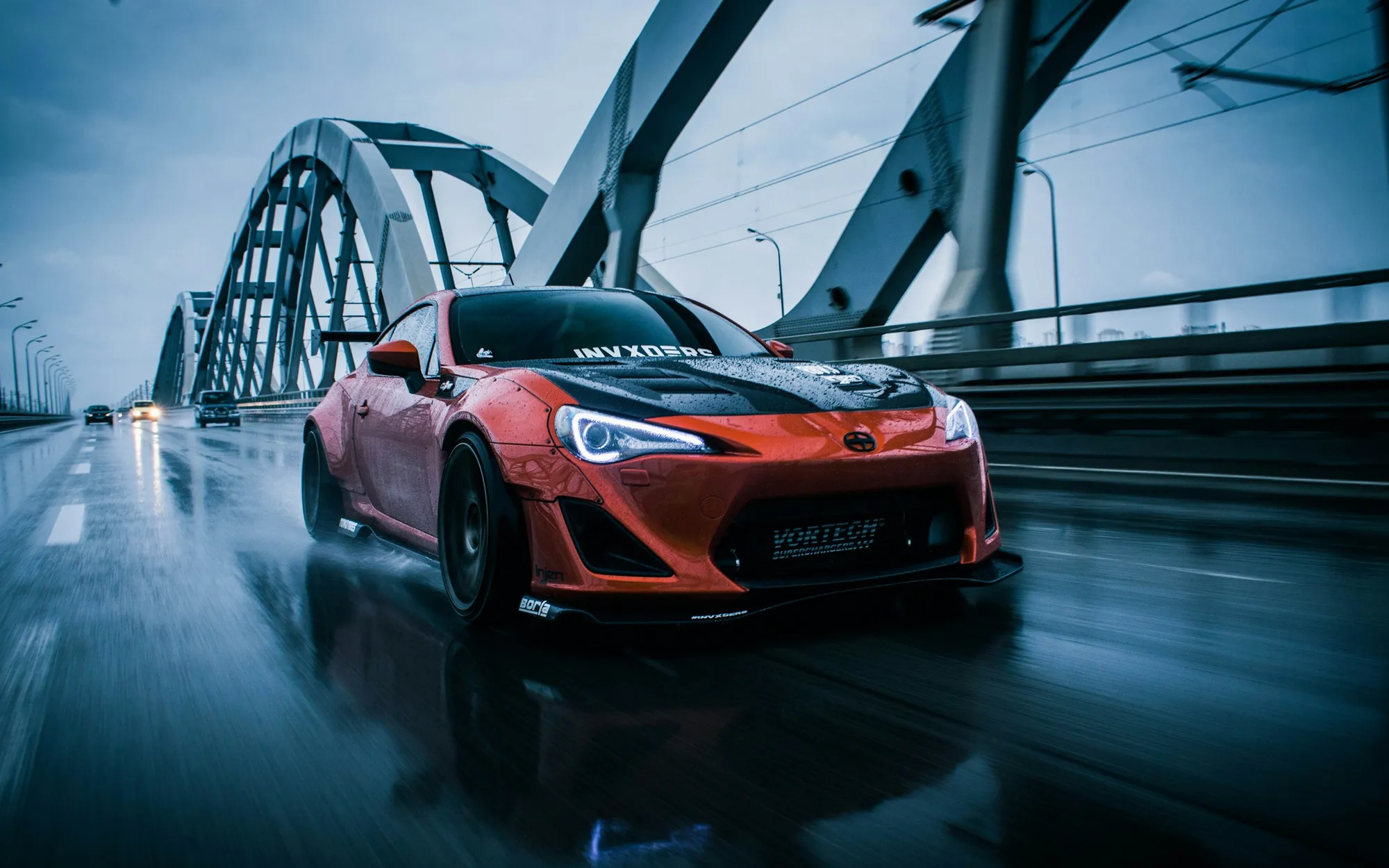
Photo: Vlad Grebenyev / Unsplash. A Rocket Bunny Toyota GT86 in Kyiv.
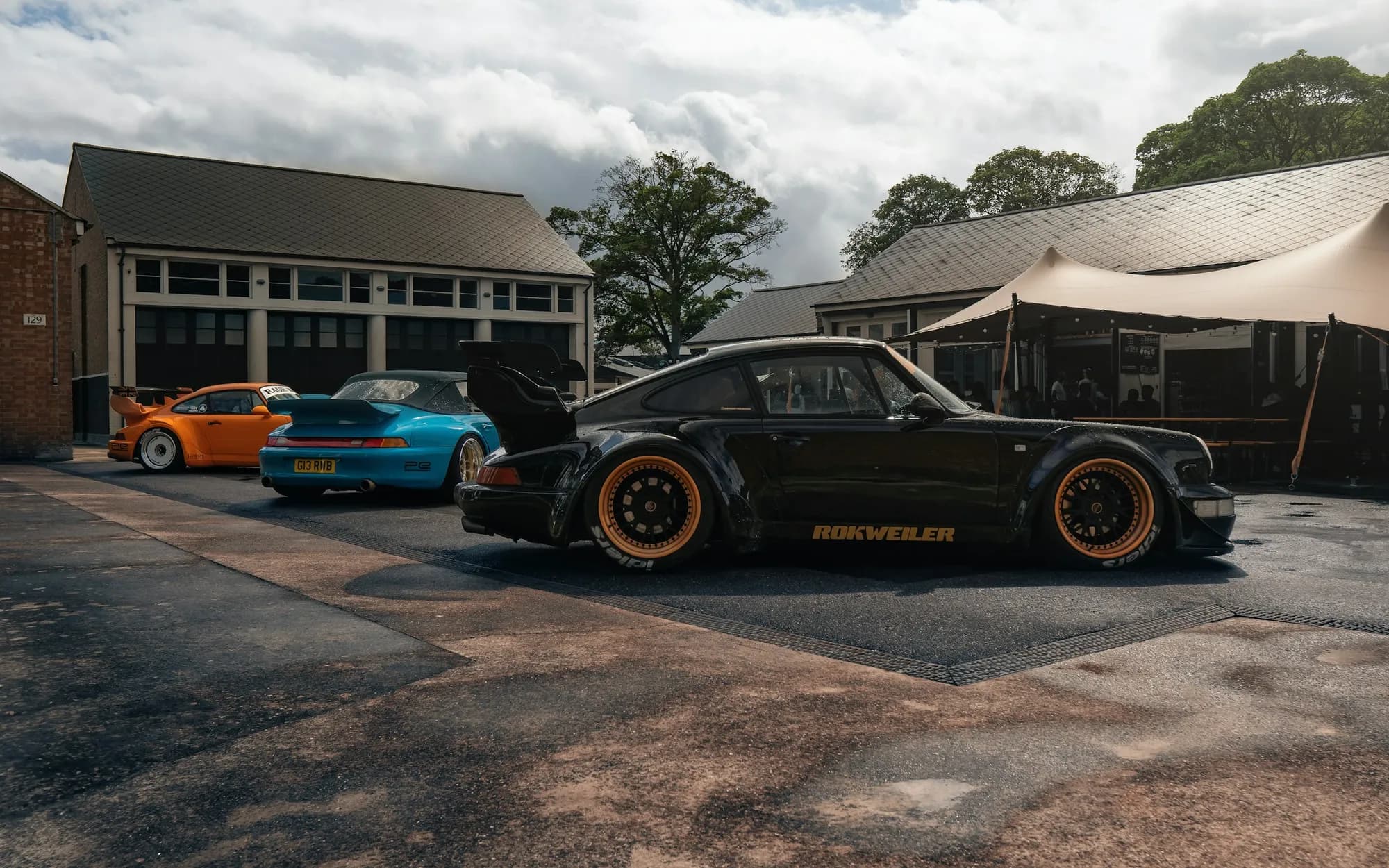
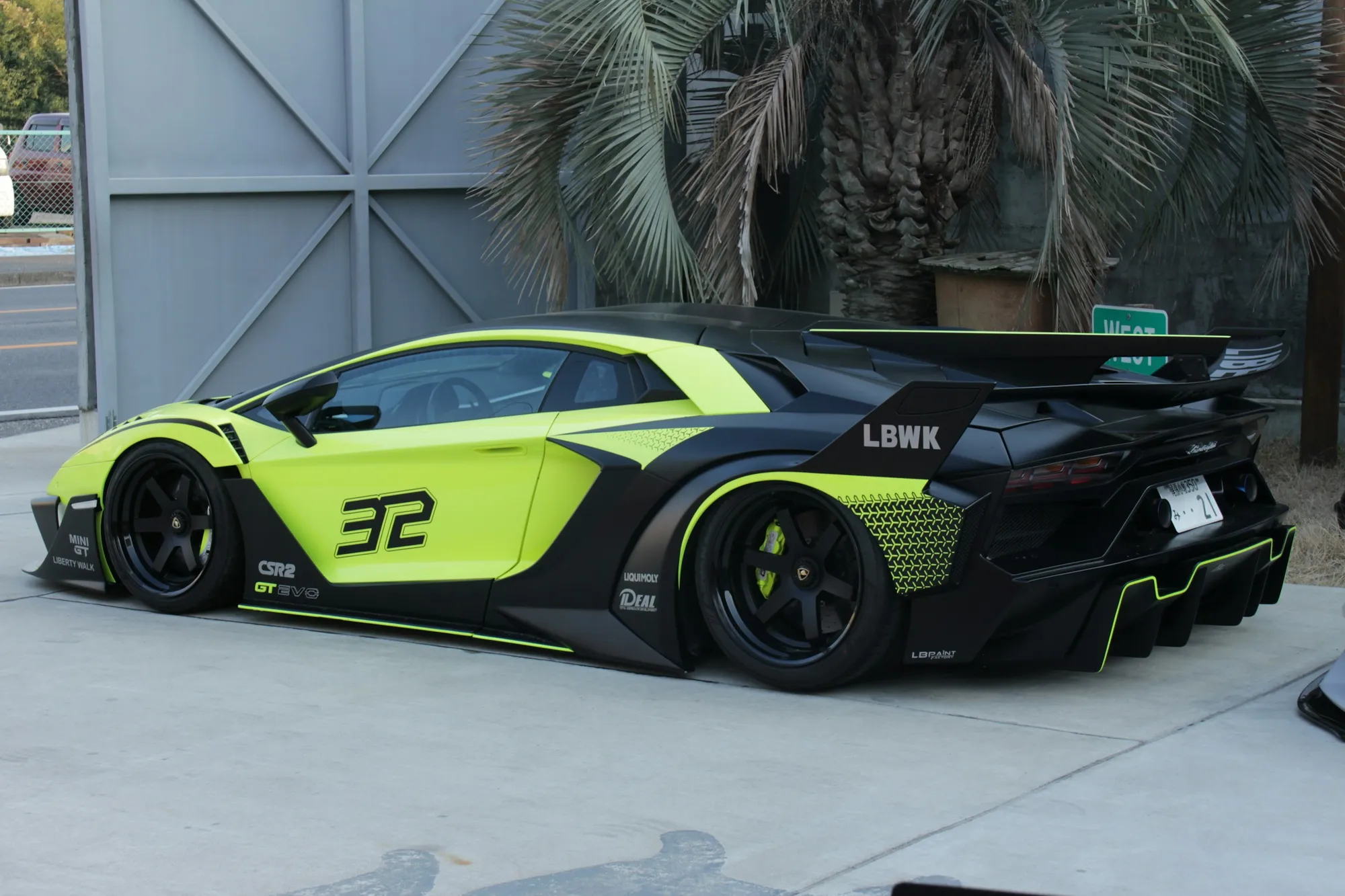
Liberty Walk, RWB and Rocket Bunny are the Japanese widebody names everyone knows, and all three begin with the same uncomfortable moment: a saw goes into a factory fender. Liberty Walk has done it to a Lamborghini Murciélago and to a genuine Ferrari F40. Akira Nakai does it to air-cooled 911s, by hand. TRA Kyoto's Pandem kit for the GR86 asks your body shop to do it to a Toyota. What happens around that cut is where the three names split, and it decides how you buy in.
Liberty Walk: the supercar provocateur
Wataru Kato's Liberty Walk was founded in 1993 and is based in Owariasahi, Aichi Prefecture. Its signature LB-Works look debuted at the 2012 SEMA Show on a Murciélago whose bodywork had been cut with an electric cutter and fitted with riveted overfenders. The company frames the style as the defiant spirit of Showa-era kaido racers moved onto very expensive cars; our kaido racer explainer covers that root. By Liberty Walk's own count, about 200 LB-Works cars are in Japan and another 300 to 350 are spread around the world.
For buyers, Liberty Walk works like a parts company. It sells kits through distributors from Europe and the US to Thailand, Australia and South Africa, and it publishes prices: the complete LB-Works F40 kit is listed at $127,600 in FRP, before shipping, paint and fitting. Kato's full story is in our Liberty Walk feature.
RWB: one man, one saw, one 911
RWB, short for Rauh-Welt Begriff, is Akira Nakai's Porsche shop in Kashiwa, Chiba. Its price page lists wide-body kits for the 930, 964 and 993 at US$35,000 each. What you are really buying is Nakai's time: you order the kit, wait, and he travels to the car. At a 2024 build in Connecticut, Motor1 watched him tape the outline of each new fender onto the body and cut below it freehand with a small air saw, and reported that he books about two days per car.
RWB also sticks to one RWB Porsche per customer, and Nakai names every car himself. The whole process is in our RWB story.
Rocket Bunny and Pandem: width for everyday platforms
Rocket Bunny and Pandem are trademarks of TRA Kyoto, a parts maker in Kumiyama, Kyoto Prefecture, run by CEO Kei Miura. The company positions Rocket Bunny as its aggressive widebody line, a regular in drift and time attack, and Pandem as the more refined, motorsport-inspired one. The design work is digital. GReddy, the authorized North American distributor, says each kit starts with a laser scan of the stock car, which Miura reshapes on the computer before an in-house CNC mill cuts the master molds for the fiberglass parts.
In November 2012, GReddy dealer Evasive Motorsports opened orders for the Rocket Bunny kit for the Scion FR-S, saying it had been a favorite of that year's SEMA Show. The GR86 kit is $6,200 with a wing, with front fenders listed at +65 mm, rears at +85 mm and a note that body cutting is required. The catalog runs from the AE86 Corolla to the mid-engine C8 Corvette, whose kit The Drive reported at $7,000 in 2020.
Here, you are the builder. The parts arrive in raw gel coat that needs paint prep, special orders take two to four months, and your shop makes the cut.
The real split is labor
Strip away the logos and the difference comes down to who holds the saw. Liberty Walk and Rocket Bunny sell parts that a dealer or your own shop installs. RWB sells an appointment with one man, for one model line. Liberty Walk also overlaps with Rocket Bunny more than its Lamborghinis suggest: its lb★nation brand launched in 2018 with kits for everyday cars, including the Copen and the 86/BRZ, according to its company history.
The argument about cutting
The cut is also why all three start fights. When Liberty Walk showed its F40 at the 2023 Tokyo Auto Salon, auto motor und sport confirmed that it was an original car, not a fiberglass replica, and that it had been cut up, widened and lowered. Motor1 opened its report by calling tuning an F40 "probably the last thing you should do."
RWB faces the same charge over clean air-cooled 911s. In 2017, The Drive took it for granted that its readers already had strong views on Nakai irreversibly modifying pristine 964s. The defense comes from Warsaw, where Porsche specialist Jarek Sekuna told Petrolicious that the donors for the Warsaw cars are often accident-damaged or tired high-mileage examples, and that each one gets a rebuilt engine, new suspension and a new interior. The same piece states the obvious: once the arches are cut, the car does not go back to stock without major surgery.
On a modern GR86, the cut costs a set of factory fenders rather than a piece of history. The math changes on an AE86, and Pandem's kit for it carries the same body-cutting requirement.
Which door is yours
If you want a supercar dressed like a kaido racer, Liberty Walk has the catalog. If you own an air-cooled 911 and want to watch Nakai cut it himself, RWB is the only way in, and you only get one. If you want width on a car you can afford to drive hard, Rocket Bunny and Pandem are the obvious place to start. More builds live in Builds.
Sourced from Liberty Walk, RWB, TRA Kyoto and GReddy's own pages and the reporting linked above. Prices are the companies' listed figures as of October 2026.