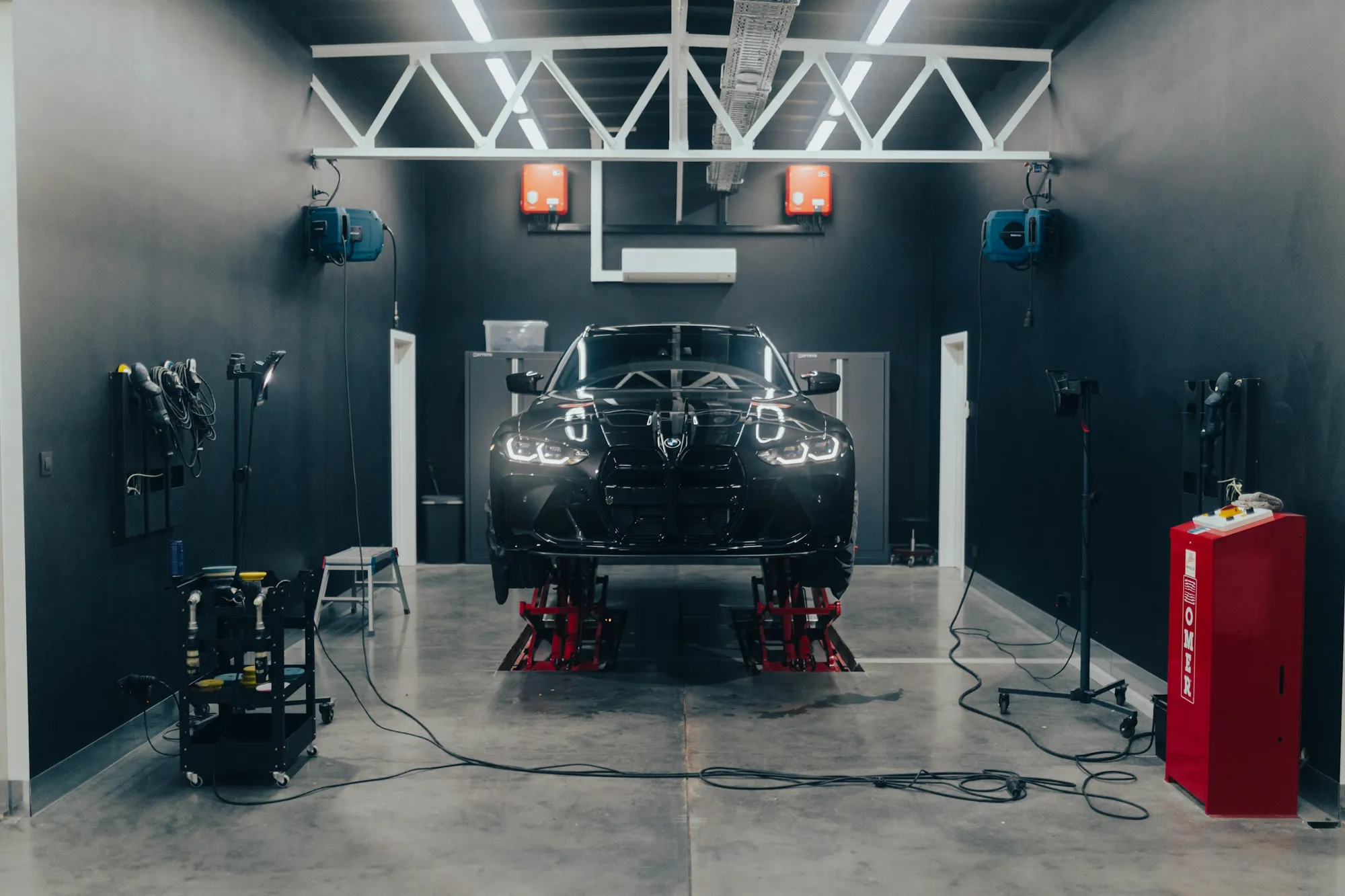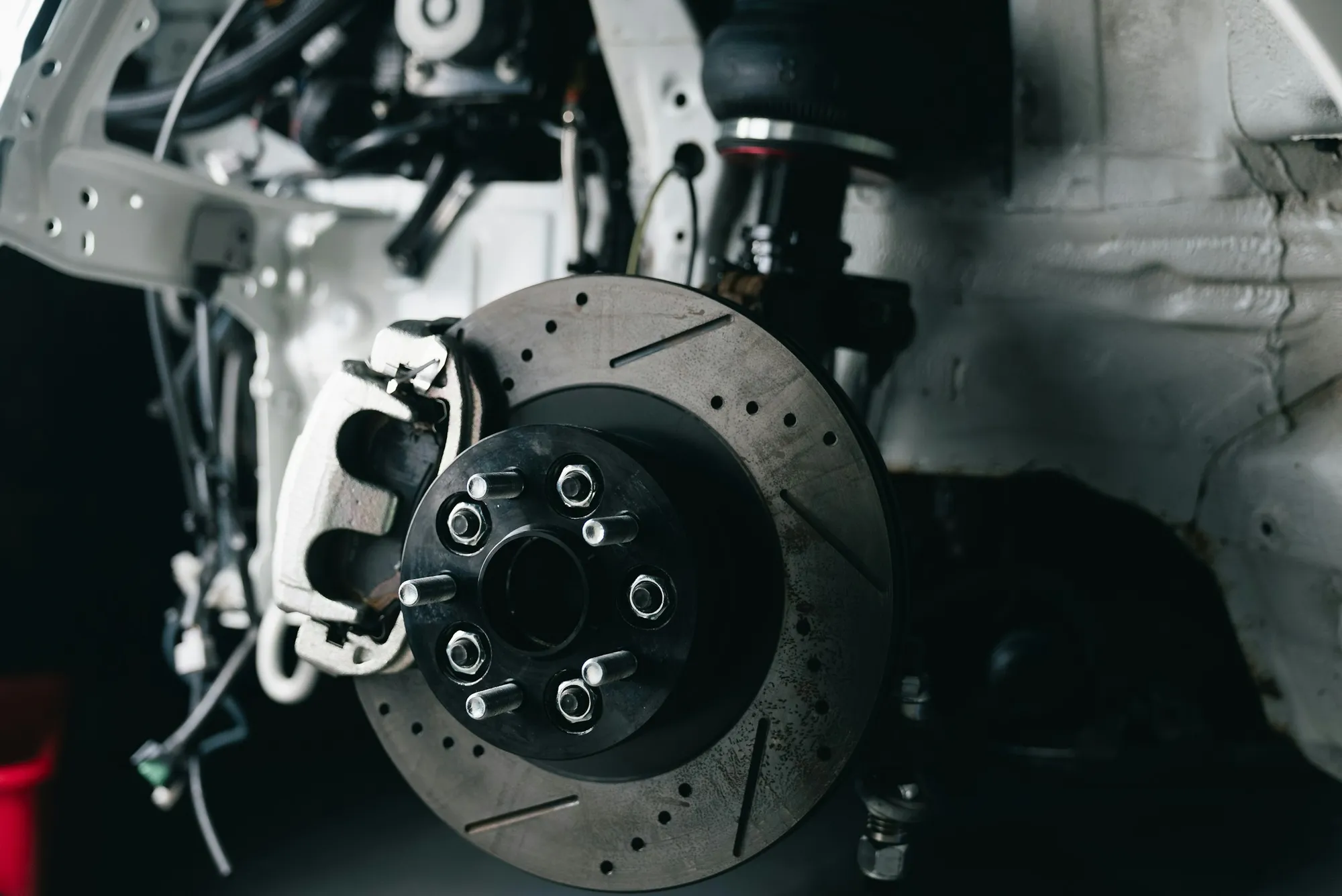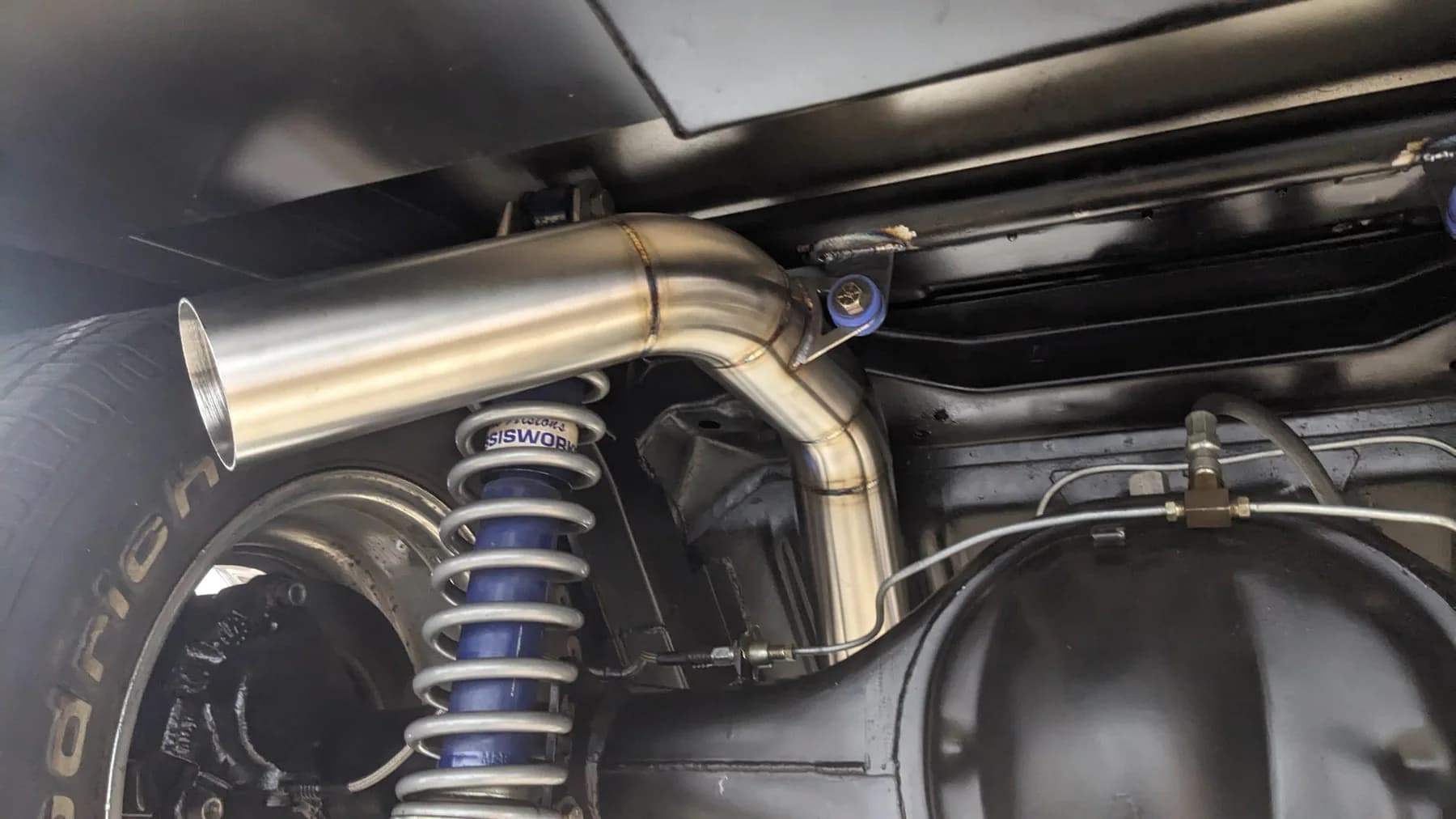
Photo: Olivie Zemanova / Unsplash. A red sports car on mesh wheels in Prague.
Fitment talk runs on shorthand: flush, poke, tucked, "fits with a roll." That works in a photo caption, but it is a poor way to order a set of wheels. The arithmetic behind offset and tire size takes a few minutes, and it turns opinions into millimeters you can check against your own car.
Know what the numbers describe
Forgeline defines offset as the distance from the wheel's mounting surface to its centerline, and backspace as the distance from the mounting surface to the inside edge. When the mounting surface sits outboard of the centerline, offset is positive; when it sits inboard, offset is negative. Offset is conventionally quoted in millimeters. The stated width is measured between the flanges where the tire seats, and Forgeline's rule of thumb is that the overall width runs about an inch more. Forgeline on backspace and offset
A tire size such as 255/35R19 has its own grammar. Michelin explains that 255 is the nominal section width in millimeters, 35 is the sidewall height as a percentage of that width, R stands for radial construction and 19 is the wheel diameter in inches. Michelin on tire markings Under FMVSS No. 139, section width is measured on an inflated tire fitted to a specified measuring rim. FMVSS No. 139 The number on the sidewall describes the tire on that rim, which may not be the width of your wheel.
Where the wheel actually moves
For a positive-offset wheel, the outer bead seat sits half the stated width, minus the offset, outboard of the hub face. The inner bead seat sits half the width, plus the offset, inboard. That is all the geometry you need.
Take a 9.5-inch-wide wheel at ET35. Half its width is 120.65 mm, so the outer bead seat sits 85.65 mm outboard of the hub face and the inner one 155.65 mm inboard. A 10-inch ET25 wheel puts those points at 102 mm and 152 mm. The outside moves 16.35 mm, about 0.64 inch, toward the fender, while the inside gains 3.65 mm of clearance from the suspension. The flanges add roughly half an inch to each side of both wheels, so the comparison still holds.
Two rules fall out of that math. Every millimeter of offset you remove moves both edges a millimeter outward. Every extra half inch of width at the same offset adds 6.35 mm on each side. A spacer moves the mounting face outward by its own thickness, so a 10 mm spacer on an ET35 wheel puts the edges where an ET25 wheel would sit, with hardware requirements set by the spacer's maker.
Tire size changes diameter, too
Sidewall height is section width multiplied by the aspect ratio, and overall diameter is the wheel diameter plus two sidewalls. A 255/35R19 has an 89.25 mm sidewall and an overall diameter of about 661 mm, or 26.03 inches. A 275/35R19 works out to about 675 mm, or 26.58 inches, roughly 2.1 percent taller. It travels that much farther per revolution, so a speedometer that was accurate on the smaller tire would show 60 mph when the car is doing about 61.3. Choose a 255/30R20 instead and the nominal diameter stays within a fraction of a millimeter of the original 255/35R19.
Factory setups follow the same logic. BMW's M2 Competition uses 19-inch wheels, 9 inches wide in front and 10 inches at the rear, with 245/35 R19 and 265/35 R19 tires. BMW's 2019 M2 Competition release By the same arithmetic, the rear tire is about 2 percent taller than the front.
Width and diameter are not the only numbers on the sidewall. Michelin says a replacement tire's load rating must meet or exceed the vehicle manufacturer's specification, its speed rating should as well unless the tire is winter-capable, and factory XL tires call for XL replacements. Michelin on load and speed ratings The manufacturer's recommended size and inflation pressure are on the sticker inside the driver's door jamb and in the owner's manual. Michelin Tires 101
Check the car, then order
Arithmetic cannot see everything. Spoke shape over a large caliper, the inner barrel near a strut, and the tire's shoulder at full steering lock and full compression all need a physical check on the actual car, with its actual suspension and ride height.
Put the numbers on one page before you spend anything: current and proposed width and offset, how far each edge moves in millimeters, the change in overall diameter as a percentage, and the load index and speed rating against the door-jamb sticker. Hand that sheet to the wheel supplier and the installer, and ask them to confirm the setup on your car rather than someone else's.
If you cannot say how many millimeters the wheel moves in each direction, and how much taller or shorter the tire gets, you are not ready to order yet.
Fitment explainer. Worked examples use nominal dimensions; actual tire dimensions vary by model and rim width, so confirm with the manufacturer's published data.