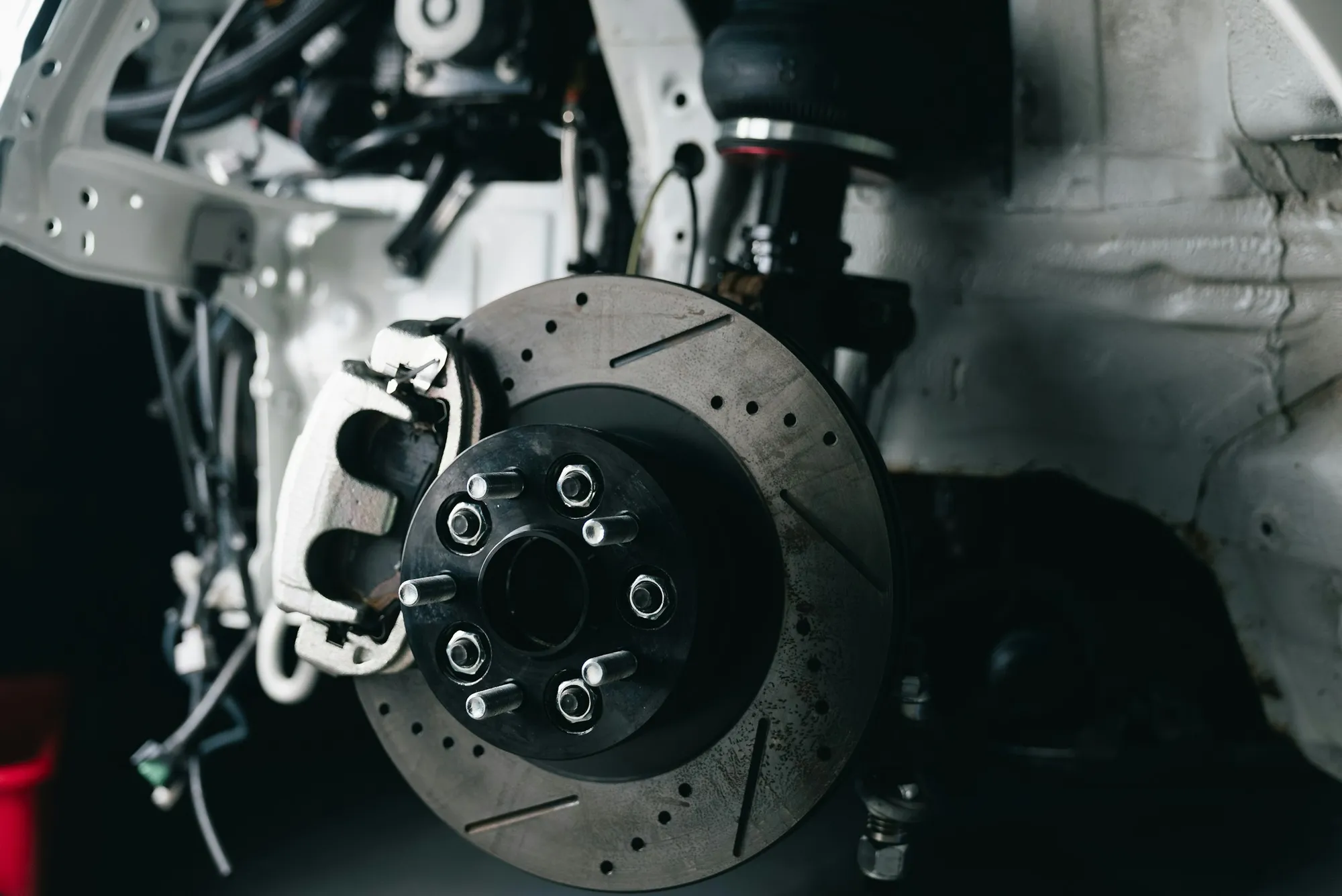
Photo: Erik Mclean / Unsplash. A performance brake caliper and rotor.
A big brake kit is easy to see. For a car heading to its first track days, the brake decisions that matter first are less visible: what temperature the fluid is rated to survive, what temperature the pads are designed to work at, and how both have been looked after. Get those right and you will know whether bigger hardware would solve a real problem.
Read the fluid label as a temperature rating
The federal brake fluid standard, FMVSS No. 116, sets minimum boiling points by grade. New, or "dry," fluid must reach at least 205°C (401°F) for DOT 3, 230°C (446°F) for DOT 4 and 260°C (500°F) for DOT 5. The wet minimums are 140°C (284°F), 155°C (311°F) and 180°C (356°F). For the wet test, the fluid is humidified alongside a reference fluid until that reference holds about 3.7 percent water by weight. FMVSS No. 116
The same standard hints at why the wet number deserves attention. Containers must state the minimum wet boiling point, and one of the required warnings tells owners to keep the container tightly closed so the fluid does not absorb moisture. FMVSS No. 116 Our reading: the dry figure describes fluid fresh from a sealed bottle, while the wet figure is a better guide to fluid that has spent time in a car.
Names can mislead, too. DOT 5 fluid must be labeled as either silicone base or, for DOT 5.1, non-silicone base. Silicone DOT 5 is dyed purple, while DOT 3, DOT 4 and DOT 5.1 are colorless to amber. The first required label warning tells owners to follow the vehicle manufacturer's recommendations when adding fluid. FMVSS No. 116 Start with the type your car's maker specifies, then compare boiling points within it.
Change it on a schedule an organizer would recognize
Club paperwork shows what that looks like in practice. The sample pre-event tech form in the BMW CCA's Driving Events Operations Manual asks for brake fluid changed at least every six events or once a year, with the date written on the form. It also asks for at least 50 percent pad material, more when a co-driver shares the car, brake lines without cuts or abrasions and rotors without cracks running to the edge. BMW CCA Driving Events Operations Manual
Keep a simple log that answers the inspector's questions before they are asked: which fluid, when it was bled and how many events it has seen since. If the pedal feels different during a session, come in and find out why before going back out.
Choose pads by their temperature window
Published compound data shows how differently pads are designed. Hawk lists its HPS street compound at an operating range of 100 to 700°F, with 100 to 500°F optimal. Hawk HPS HP+, which Hawk describes as ideal for autocross, lists 100 to 800°F, with 300 to 600°F optimal. Hawk HP+ The DTC-60 race compound, designed for extremely high deceleration rates, lists 400 to 1,600°F, with 700 to 1,100°F optimal. Hawk DTC-60
Read those as windows rather than grades. The street pad's listed range ends at 700°F, right where the race compound's optimal window begins, and the race pad's range does not start until 400°F. If one compound cannot cover both your coldest and your hottest driving, a second set reserved for track days is the honest answer. Check rotor compatibility as well: Hawk says its pads are designed for iron rotors and are not compatible with carbon-ceramic discs. Hawk HP+
Do not shop by a pad's SAE J866 friction code, either. That system classifies lining friction from a standardized test, and SAE states that the codes cannot reliably predict brake system performance, because system design and operating environment also matter. SAE J866
Bed them in, then judge them
Disc Brakes Australia, which makes rotors and pads, explains that friction comes either from adhesion, where the pad lays an even transfer layer onto the rotor, or from abrasion between the two surfaces. Bedding brings temperatures up gradually and lets the parts cool, so new components are ready for use. DBA bedding-in bulletin
DBA's procedure for its own pads is about ten slowdowns from 30 mph to 5 mph with medium pedal pressure, without coming to a stop, and 30 seconds of cooling between them. After that it recommends normal driving and no excessive heavy braking for the first 120 miles, to avoid glazing. Coated rotors need the coating cleared with light braking first. DBA bedding-in bulletin That procedure is written for DBA's pads, so follow the one published for the pad you actually bought.
Do the unglamorous work first: fluid with a known wet rating on a fixed schedule, pads whose window matches how you drive, a proper bed-in and a written record. If the brakes still fade after that, you will have the evidence to choose the right upgrade.
Technical guide based on the federal standard, the BMW CCA manual and manufacturers' published data. TUNERS has not tested these fluids or pads.