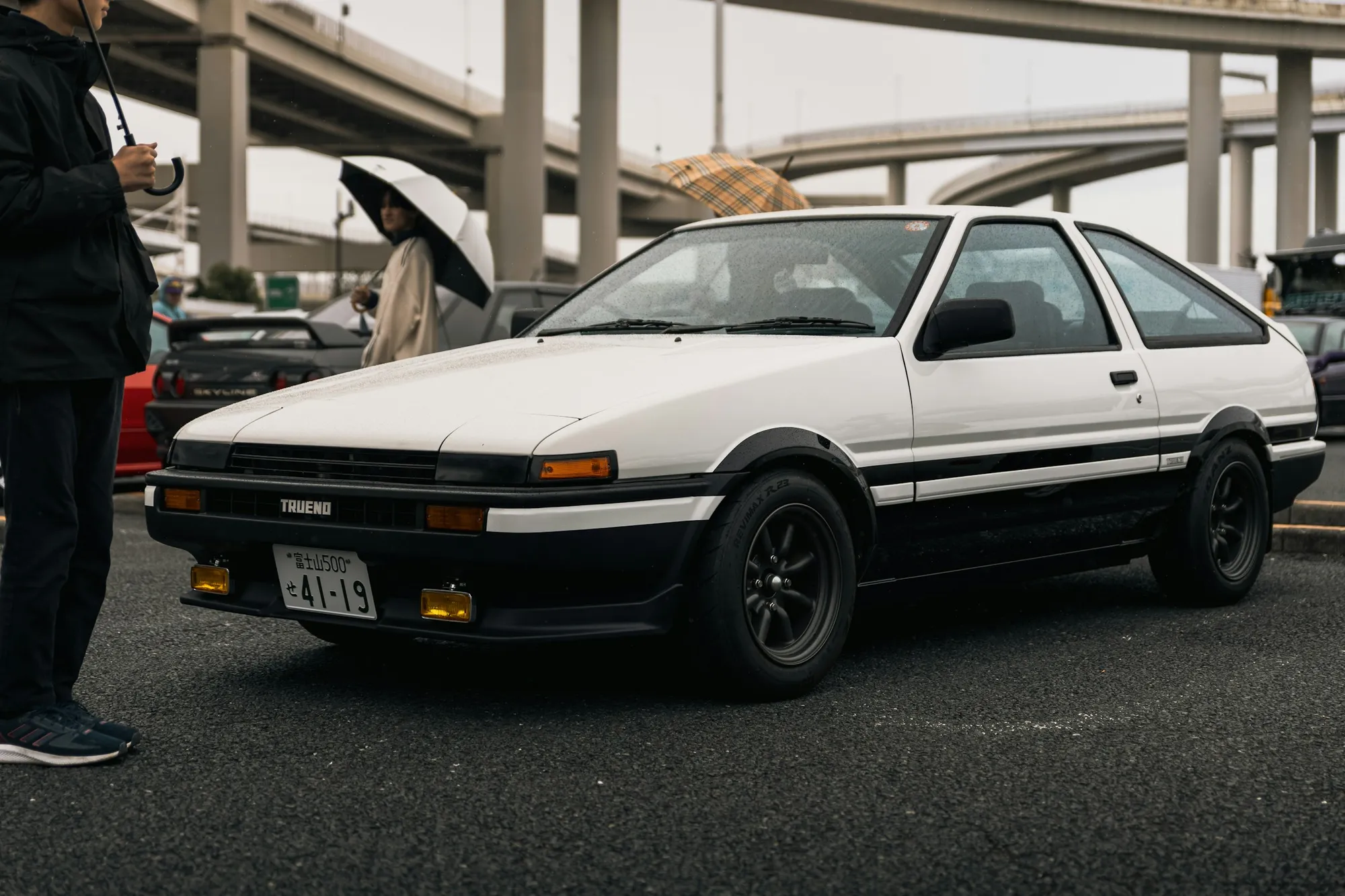
Photo: Shoham Avisrur / Unsplash. An AE86 Toyota Sprinter Trueno.
In 1983 Toyota moved the everyday Corolla to front-wheel drive. The sporty coupes stayed rear-drive, and that single decision goes a long way toward explaining why a four-decade-old Corolla derivative still has a devoted following, a drift reputation and a parts program run by Toyota's own performance division.
A Corolla that kept its rear-drive layout
Toyota's lineage records date the fifth-generation Corolla Levin to May 12, 1983. The family Corolla and Sprinter switched to front engine and front-wheel drive, while the sports coupes kept front engine and rear-wheel drive. The Levin and Trueno names, previously reserved for twin-cam models, became the names for every Corolla and Sprinter coupe, offered as a two-door notchback or a three-door hatchback. Toyota's Corolla Levin lineage page
The newly developed 4A-GEU was a 1,587 cc DOHC 16-valve four, which Toyota's records list at 130 PS at 6,600 rpm. GT models came with a five-speed manual, and the same records give curb masses of 940 to 960 kg for the 1600 GT grades, with MacPherson struts in front and a four-link rear suspension with coil springs and a lateral rod. Toyota's Corolla Levin lineage page The code itself has a specific meaning. Toyota says only cars with the 4A-GEU received the AE86 designation, and the 1.5-liter coupes were AE85. In Japan the car is still known affectionately as hachi-roku, Japanese for eight-six. Toyota's 2021 GR Heritage Parts release
How a racer made it a drift car
The AE86's drift identity runs through Keiichi Tsuchiya. In a 2016 interview published by Toyota, he recalls first racing an 86 in 1984 in the Fuji Freshman Race, then running it in Group A with Tsuchiya Engineering, where his engine failed in race after race until he won his final event, the Inter TEC at Fuji Speedway. He says drifting was hit-and-miss in a Nissan Sunny but came easily in the 86, crediting its stiff body, stable alignment and quick, easy countersteer, and says his Drift King nickname came from a Car Boy magazine editor after he drifted through Fuji's 100R corner in the rain. His one-line verdict on the car: "The 86 helps you become a better driver." Toyota's interview with Keiichi Tsuchiya
He also makes the case that the car rewards precision because it does not hide mistakes the way a modern car with electronic aids can. In our view, that idea explains the car's lasting pull on drivers learning car control better than any single number on its spec sheet.
Toyota still treats it as a living car
The AE86 is part of Toyota Gazoo Racing's GR Heritage Parts project, which reproduces discontinued parts and sells them as genuine Toyota parts. The first AE86 items, released from November 2021, were rear brake calipers, steering knuckle arms and rear driveshafts; Toyota said those listings applied to Japan and that availability varies by region. The same release describes the 86 of 2012 and the GR86 as carrying on the AE86's culture. Toyota's 2021 GR Heritage Parts release
In September 2025, TGR announced reproduced 4A-GE cylinder head and cylinder block sub-assemblies. They keep the original basic design and specifications but add extra machining of the combustion chambers to reduce engine-to-engine variation, coated intake ports, modern bore honing, a higher-rigidity iron block and bosses that allow transverse mounting. TGR said sales were planned for around May 2026, subject to development progress and order volume. TGR's 4A-GE parts announcement
Toyota has also used the car to talk about the future. At Tokyo Auto Salon 2023, its AE86 H2 Concept carried two hydrogen tanks from the Mirai to feed a hydrogen-burning engine, while the AE86 BEV Concept paired a Tundra hybrid motor and a Prius plug-in hybrid battery with a manual transmission. Toyota's Tokyo Auto Salon 2023 exhibits
What it means if you want one
The useful facts for a buyer come straight from that history. AE86 means a 4A-GEU car, so confirm the model code on the documents rather than trusting a Trueno nose or a sticker, and expect a light, simple rear-drive coupe from the early 1980s, not a modern chassis. Every example is comfortably past the 25-year line in federal import law. 49 U.S.C. 30112, via Cornell LII Toyota said its first AE86 parts listings were for Japan, and the 2025 engine parts opened for preorder at an event in Japan, so check what is actually available in your region before planning a restoration around them.
The deeper reason the AE86 still matters is the one Tsuchiya gives. It is light, it is rear-drive and it does not hide your mistakes. That makes it a useful benchmark for anyone choosing a first drift car, or weighing what a modern GR86 is meant to carry forward.