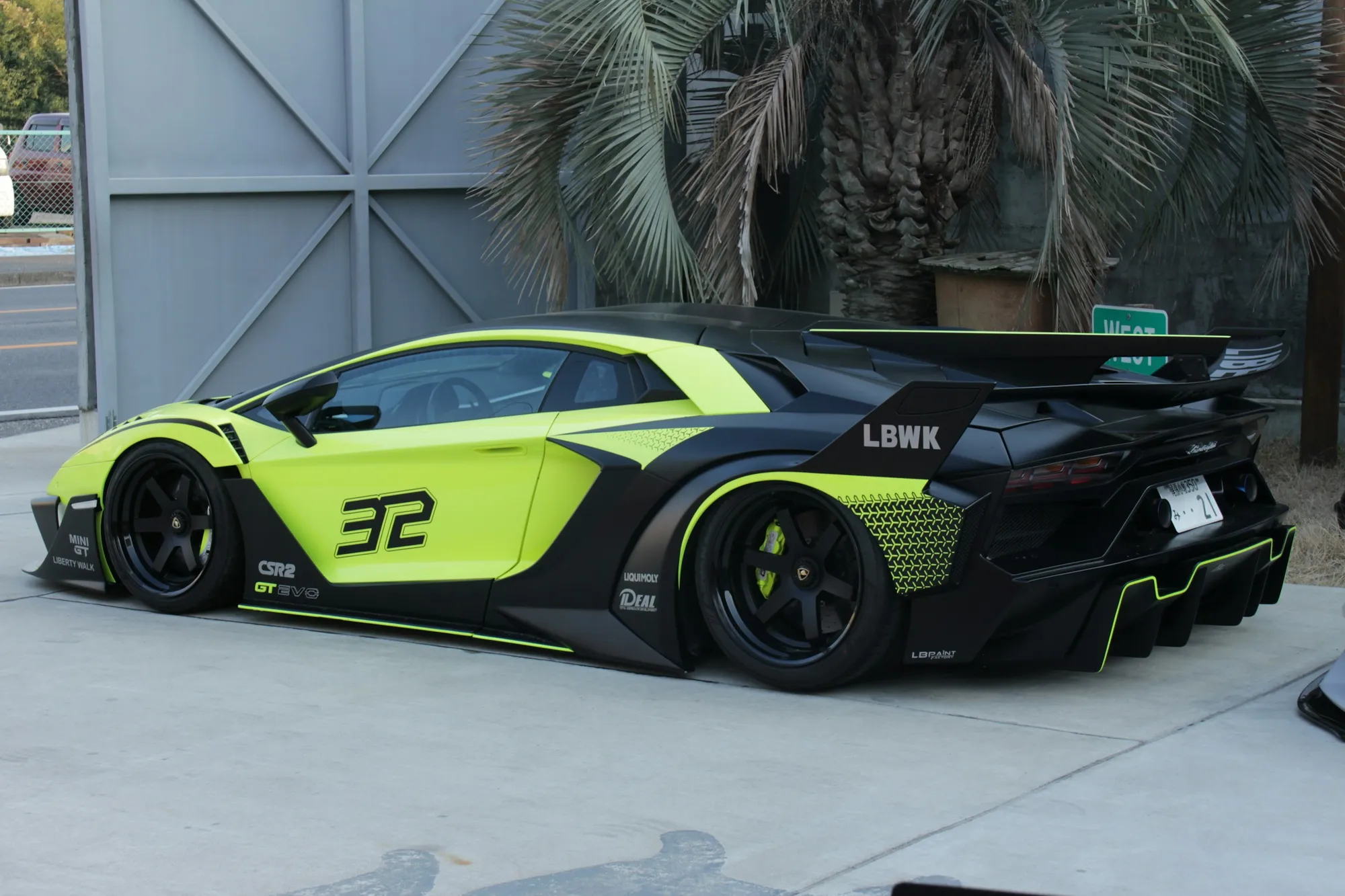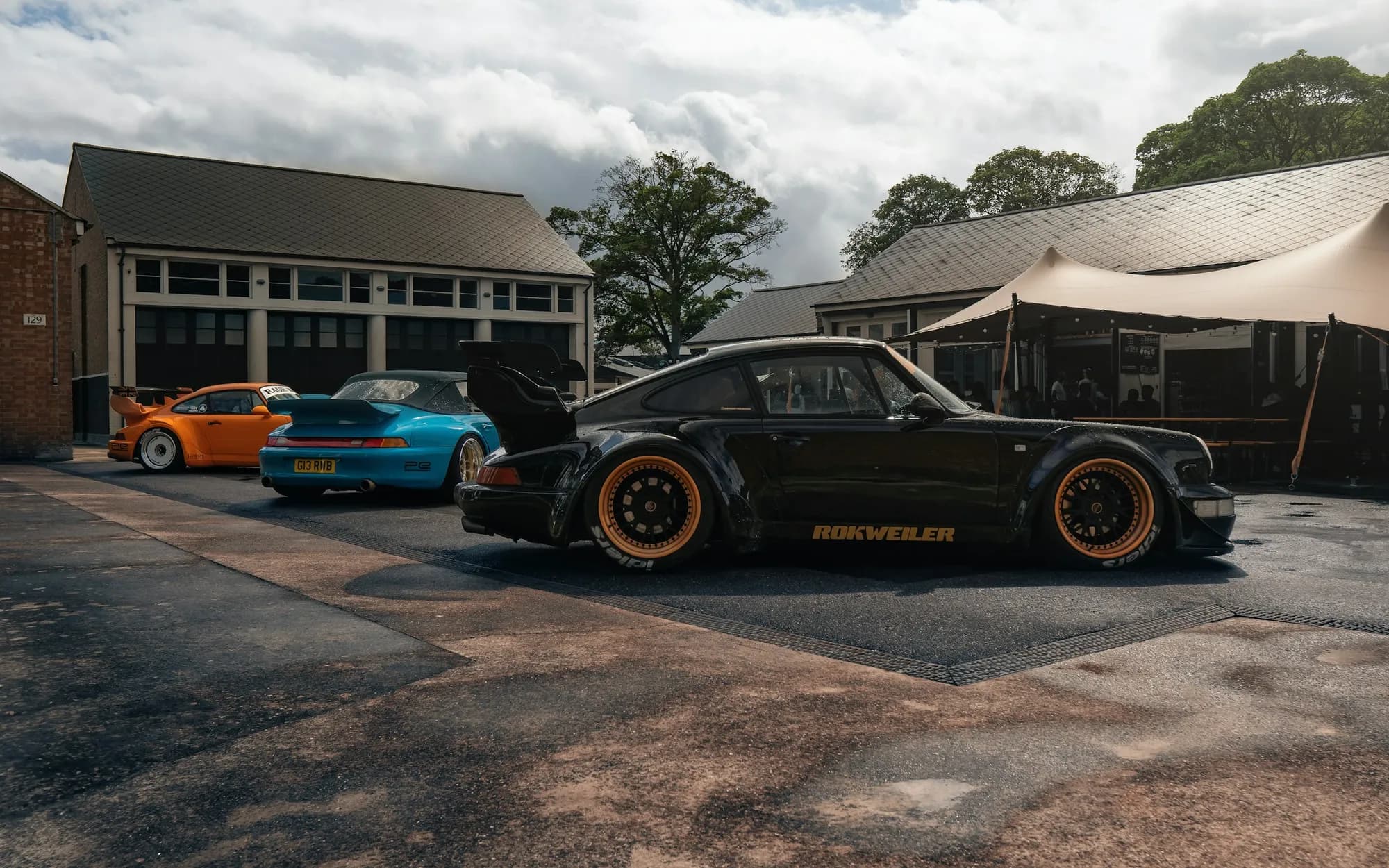
Photo: Abhinand Venugopal / Unsplash. An RWB Porsche 911 at Bicester Heritage, England.
A widebody 911 is a wheel-and-tire decision long before it is a bodywork decision, and Porsche's own history says so. The factory widened the G-series Carrera's rear fenders by 42 mm to make room for larger tires. When it sold the Turbo body on the Carrera 3.2, the car came with the Turbo's brakes and firmer suspension. The flares are the last thing you choose. Here is the order of operations.
Pick how the width gets there
There are three basic routes, and they are not equally reversible.
Cut and bolt. The arch is cut open and a wider fender is bolted or riveted over it. Yokogao Magazine describes Akira Nakai cutting into a 930's fenders freehand with an air saw, a job it says takes minutes per fender, then fixing the wide fenders with rivets he spaced by hand. Porsche used bolt-ons, too: the 993 GT2's plastic arch extensions were bolted on so they could be replaced after a collision on track. The catch is that the original steel is gone for good. On a classic 911, decide whether you can live with that before anyone picks up a saw.
Make the panel wider. This was the factory's way with the Turbo, whose bodywork was 12 centimeters wider than other 911s'. Welded or molded-in width leaves no seam, and it is the most permanent route, so budget for body and paint work to match.
Replace the skin. Singer reimagines the Turbo body in carbon fiber, and evo says Gunther Werks starts from a bare 993 chassis with every panel new, both as part of a full rebuild. It is the most complete route and the most expensive. Our Singer and Gunther Werks story has the details, and our Liberty Walk, RWB and Rocket Bunny comparison covers the big kit makers.
Track width comes first
The flare should follow the wheel, not the other way around. When Porsche widened the 992 Turbo S body by 45 mm at the front and 20 mm at the rear, it widened the track by 42 mm and 10 mm to match. On the 992 GT3 RS, a track 29 mm wider than the GT3's came with longer front wishbones, so the factory moved the hub as well as the wheel.
Most builds get their width from wheel offset or spacers instead. Forgeline defines offset as the distance from the wheel's mounting surface to its center, so every millimeter less offset puts that wheel a millimeter further out. Spacers such as H&R's Trak+ do the same job by moving the wheel outward, toward the fender. Our offset and tire-size math walks through the numbers.
Doing it at the wheel has a cost. Scrub radius is the front-view distance between where the steering axis meets the ground and the center of the tire's contact patch, and changing wheel offset changes it. The same explainer notes that a small scrub radius makes steering less sensitive to braking inputs, so moving the tire outward on a stock hub changes how the steering reacts under braking. Test before you commit.
Size wheels and tires to the job
Factory and builder setups give useful reference points. Porsche fitted the 993 GT2 with 9J x 18 front wheels on 235/40 tires and 11J x 18 rears on 285/35s. The 992 GT3 RS runs 275/35 R20 front and 335/30 R21 rear tires. The Gunther Werks Turbo uses 18 x 11 front and 18 x 13 rear wheels, with 295 front and 335 rear tires, according to evo. Singer's Classic Turbo runs 245/35 and 295/30 tires on 18s.
Whatever you choose, Michelin says a tire's load rating must meet or exceed the vehicle maker's figure, and replacement speed ratings should, too. Check clearance at full steering lock and full compression, not just with the car parked.
Ride height, bump steer and alignment
If the build also lowers the car, the steering geometry changes. Porsche specialist Elephant Racing defines bump steer as a change in toe as the wheel moves up and down, and says it becomes severe at lowered ride heights and extreme with spindle-height modifications. Its fixes for classic 911s range from a tie-rod spacer kit that adds 0.5 to 1.25 inches of spacing, at $465 to $490, to a $45 spacer that raises the steering rack 10 mm.
Michelin warns that poorly chosen wheels can disrupt suspension geometry and stress components, and advises rechecking alignment after any wheel or tire change. Align camber, caster and toe once the car sits at its final ride height, and keep the printout. Elephant also says any relocation of parts should come before corner balancing, so set the hardware first and the corner weights last.
Legal and insurance checks
Rules vary by country and state, so check yours before you cut. As one example of what an inspector looks for, Britain's MOT manual lists a tire fouling part of the vehicle as a major defect, along with a wheel and fixings that are not compatible. A body panel that is insecure, or likely to injure someone on contact, is also a major defect, and one likely to come off is rated dangerous.
Tell your insurer what you are changing before the car goes back on the road, and keep receipts, photos and alignment sheets with the car's paperwork.
What it costs
The spread is wide. Yokogao reports an RWB kit starts at $24,000 or more before Nakai's labor, flights and accommodation, with a waiting list of about three years; our RWB story covers the process. At the other end, evo lists Singer's Classic Turbo from $1.1 million plus taxes and the donor car and the Gunther Werks Turbo from £1.25 million. Whatever the kit, budget separately for wheels, tires, suspension, alignment and parts such as bump-steer kits.
Do the fitment math first and buy the flares last. For the factory precedents, read Porsche's own wide bodies, and find more projects in Builds.
Technical figures come from the manufacturers and outlets linked. Legal and insurance notes are general, not advice for any specific jurisdiction.