Photo: Abhinand Venugopal / Unsplash. The Singer DLS Turbo Study at Bicester Heritage, England.
Take an air-cooled 911 apart, then put it back together wider, lighter and faster. That is the core business at two California companies, and their turbocharged wide-body cars run to seven figures. Singer starts with the owner's Type 964. Gunther Werks builds on the 993, the last air-cooled 911. Neither cuts the old fenders and bolts on flares; both re-skin the car in carbon fiber and rebuild what sits underneath. evo lists Singer's Classic Turbo from $1.1 million and the Gunther Werks Turbo from £1.25 million.
Singer: the 964, restored
Singer was founded in California in 2009 and showed its first restoration at Monterey Car Week that year. evo says each donor car is taken back to the bare bones before it is rebuilt. In February 2024 Singer completed the 300th car through its Classic services, and said it employed more than 600 people in California and the UK.
The wide look is part of the brief. Singer's Classic Turbo services, presented in 2022, reimagine the Turbo body, whale tail and shark fin in carbon fiber around a 3.8-liter twin-turbo flat-six with electric wastegates. Singer quotes 450 hp as standard and more than 500 hp on request, with a six-speed manual and rear drive, and says prices depend on each owner's specification. In evo's review, the car made 510 bhp at 6,500 rpm, weighed around 1,280 kg and ran 245/35 front and 295/30 rear tires on 18-inch Fuchs-style wheels. evo's $1.1 million figure excludes local taxes and the donor car.
DLS and DLS Turbo: the engineering cars
DLS stands for Dynamics and Lightweighting Study, and Singer founder Rob Dickinson has named Williams Advanced Engineering as its engineering partner. Singer first presented the DLS services in 2018. The DLS engine, developed with Williams, is a naturally aspirated, air-cooled 4.0-liter flat-six with ram-air intakes, rated at 500 hp at over 9,000 rpm. The car Singer showed at Goodwood in June 2022 was the 11th restored through DLS.
DLS Turbo, presented in June 2023, celebrates the 934/5 racers of the 1970s. Its 3.8-liter flat-six has four valves per cylinder, twin turbochargers with electric wastegates and air-to-water intercooling, and Singer quotes more than 700 hp at over 9,000 rpm, sent through a six-speed manual to the rear wheels. The carbon bodywork was shaped with computational fluid dynamics, and rear fender intakes and NACA ducts cool the brakes and turbos. Owners choose a track setup with a high-downforce wing or a road setup with a ducktail, on forged magnesium center-lock wheels, 19 inches front and 20 rear. The first owner's car, Sorcerer, shown in January 2026, is rated at 710 hp (SAE net) and 750 Nm.
Singer's newest wide body
Singer's 2026 Cabriolet has wide front and rear carbon bodywork inspired by Porsche's 1980s Turbo-look Cabriolet, and Singer will build only 75. Its 4.0-liter flat-six, developed with Cosworth, makes 420 hp and revs past 8,000 rpm. Singer says it is the first engine it has restored with variable valve timing, and it pairs air-cooled cylinders with water-cooled heads.
Open cars need stiffness to match. For open-roof 964s in its Classic Turbo program, Red Bull Advanced Technologies designed 13 carbon fiber structures bonded to the monocoque, which Singer says raise torsional rigidity by 175 percent.
Gunther Werks: the 993, re-engineered
Gunther Werks is named after Gunther Wendt, the NASA engineer known for his exacting standards during Apollo. Founder Peter Nam wanted the analog feel of the air-cooled 911, and the company makes its carbon fiber, CNC-machined wheels and suspension parts, interiors and instrument clusters in-house. Its original Coupe and Speedster now appear as completed legacy programs. The firm works from Huntington Beach, California, and evo says it re-engineers bare 993 chassis with every panel new.
evo says the Turbo wears the most aggressive bodywork of the range, with extra cooling inlets. Gunther Werks lists a 4.0-liter twin-turbo flat-six with 850 bhp, a Getrag six-speed, rear drive, a widened racing-spec front track and 18-inch wheels, 11 inches wide in front and 13 at the rear, in a run of 75. evo, which drove one, cites a Rothsport Racing engine with 840 bhp, a 1,265 kg curb weight and 295 front and 335 rear tires. Its summary of the two firms: "if Singer is Pagani, this is more Koenigsegg."
The naturally aspirated GXR EVO, limited to 15, uses a 455 hp, Rothsport-developed 4.0-liter that revs to nearly 9,000 rpm. evo reports it was revealed at Monterey Car Week with double-wishbone front suspension, a carbon body with front-arch louvers and a big wing, and a dry weight of 1,082 kg. At the top sits the 26-car F-26, carbon-bodied over a braced 993 steel chassis, with a twin-turbo flat-six rated at 1,000 hp or more.
Not a cut-and-bolt job
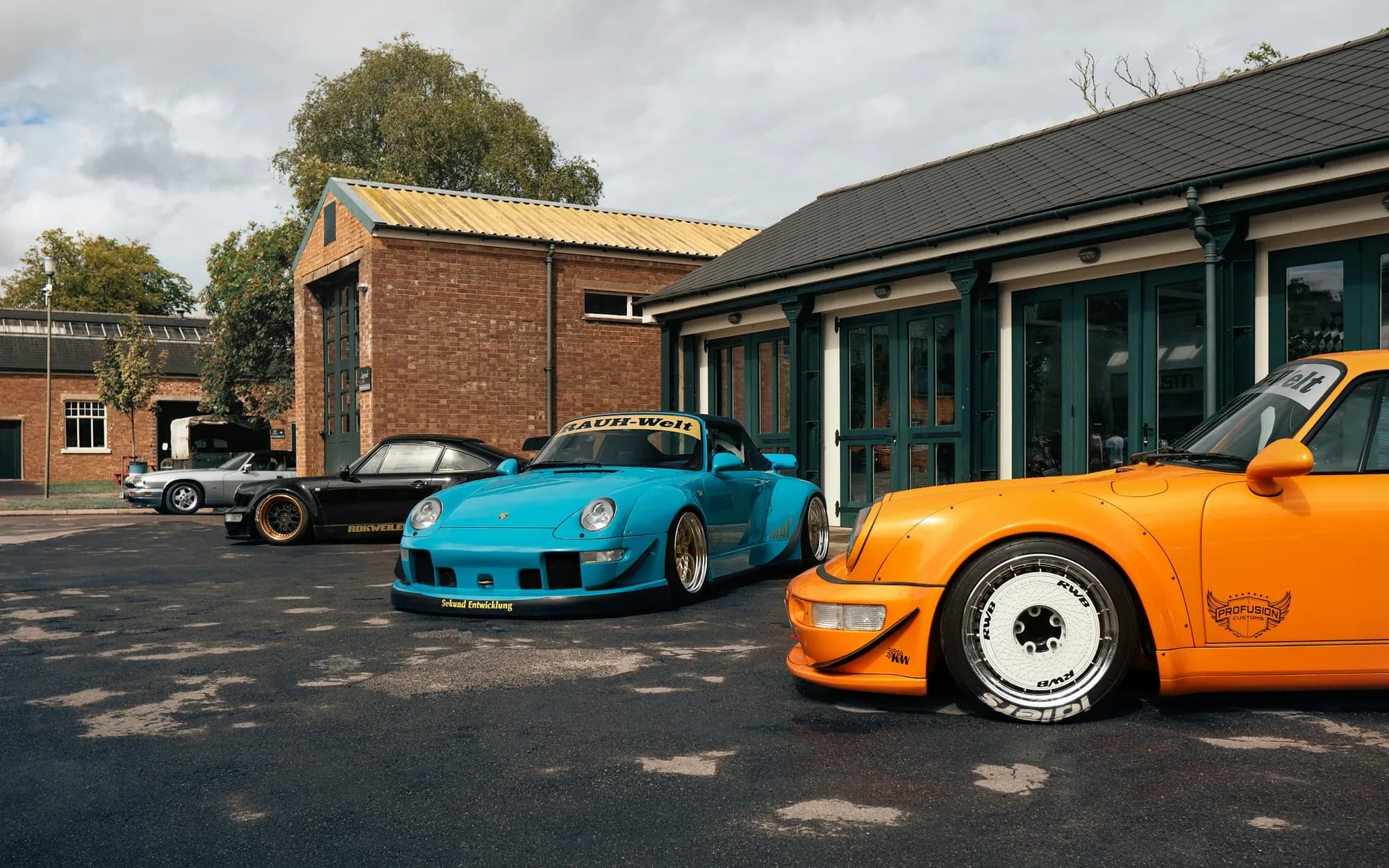
That is the difference from an RWB car. Yokogao Magazine describes Akira Nakai cutting into a 930's fenders freehand with an air saw and riveting wide fenders on, and says he travels to customers to do the work. A 2011 Excellence profile described him handling the body and look only, with specialists doing engines, suspension and brakes. Our RWB story covers that culture in depth.
Singer and Gunther Werks fold the width into a complete rebuild, with new panels, engine, suspension and brakes developed together. Neither gives an overall body width on the pages linked here, but the rear tires give a clue: a 295 on Singer's Classic Turbo, a 335 on the Gunther Werks Turbo. For the factory history behind the look, see Porsche's own wide bodies; for the engineering, read our widebody build guide. More in Porsche.
Specifications and prices are as published by Singer, Gunther Werks and the outlets linked, and are the companies' claims. No TUNERS drive is claimed.