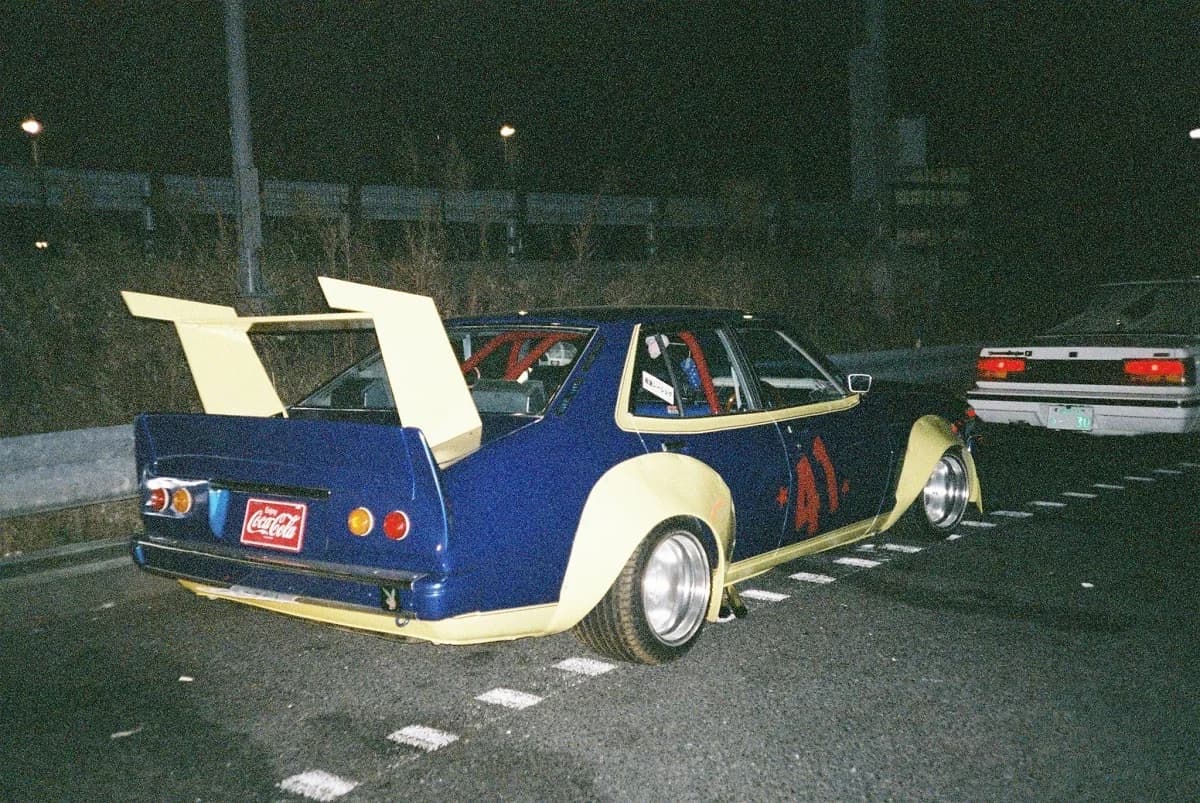
The first time you see a proper kaido racer, your brain files it under joke. Exhaust pipes taller than the roof. A front lip that scrapes speed bumps in the next county. Fenders bolted on with visible hardware, camber that looks like a suspension failure, and a paint scheme borrowed from a cigarette brand. It is not a joke. It is one of the most coherent design languages any car scene has produced.
It came from actual racing
In the late 70s, Japanese circuit racing was dominated by silhouette machinery: production shapes buried under enormous bodywork, huge over fenders, deep chin spoilers, oil coolers hanging in the breeze where a bumper used to be. The Fuji Grand Champion series was the theater, and it ran through the 70s and 80s in front of enormous crowds.
Kids who could not buy a race car bought a Laurel, a Cedric, a Skyline or a Mark II and copied the shapes with whatever they could weld. That is the whole origin story. The style is cargo-culted race car, built by teenagers with more welding time than money, and the reference is specific rather than random.
The vocabulary
Once you know the words, the cars stop looking chaotic.
- Shakotan means lowered, and it is the base state. Body on tire, no exceptions.
- Takeyari is the bamboo-spear exhaust, angled up and back, sometimes taller than the car.
- Deppa is the buck-tooth front lip that extends the nose forward and down.
- Oni-kyan is demon camber, the aggressive negative camber that makes people on the internet type "that's not even functional" as if that were the objection.
- Over fenders, fender mirrors, deep-dish Watanabes or SSR mesh, and a period-correct decal set complete the grammar.
Nothing there is accidental. Each element traces back to a specific racing car or a specific era, which is why builders argue about proportions the way other scenes argue about tuning software.
The bikes and the name
Bosozoku started on two wheels. The motorcycle gangs of the 70s and 80s built the aesthetic first, with swept-up seats, wild fairings and exhausts designed to make a neighborhood aware of them at 2am. The car style grew alongside it, and English-speaking forums eventually flattened both into one word, which is why purists correct you when you call a kaido racer a bosozoku car.
The scene carried real social baggage in Japan, and Japanese police attention was not theoretical. Some of that history is exactly as unromantic as it sounds. Ignoring it to sell the aesthetic as pure fun is dishonest, and so is pretending the cars are not brilliant.
The other night scene
Kaido racers were one branch. The Wangan crowd was another, chasing top speed on the Bayshore Route in cars built for nothing but a long straight, and the touge crowd was a third, running mountain passes where corner entry mattered more than power. The Mid Night Club is the famous name from the Wangan era, and it reportedly disbanded at the end of the 90s after a crash.
Three scenes, three completely different engineering priorities, all lumped together by the same overseas audience that thinks JDM is a styling category rather than a market.
Why it reads as ugly to you
Western car culture rewards restraint. The compliments we hand out are "clean", "OEM plus", "tasteful", which usually means a car that looks like the factory would have approved it. Kaido racer style is built on the opposite instinct: exaggerate the reference until nobody can miss it.
Judging it by clean-build standards is like reviewing a punk record for its production quality. You are measuring the wrong thing, and the thing you are measuring was never the point.
What it is worth to you
You do not have to build one. Most people should not, because doing it badly is worse than not doing it, and half-committing produces a car that just looks broken.
What is worth taking is the underlying idea. Every era of this hobby that produced something memorable did it by committing to a specific reference and following it past the point of comfort. The most boring cars at any meet are the ones built by consensus. The ugliest one in the corner, with the exhaust you can see from the road, is the only car there making an argument.