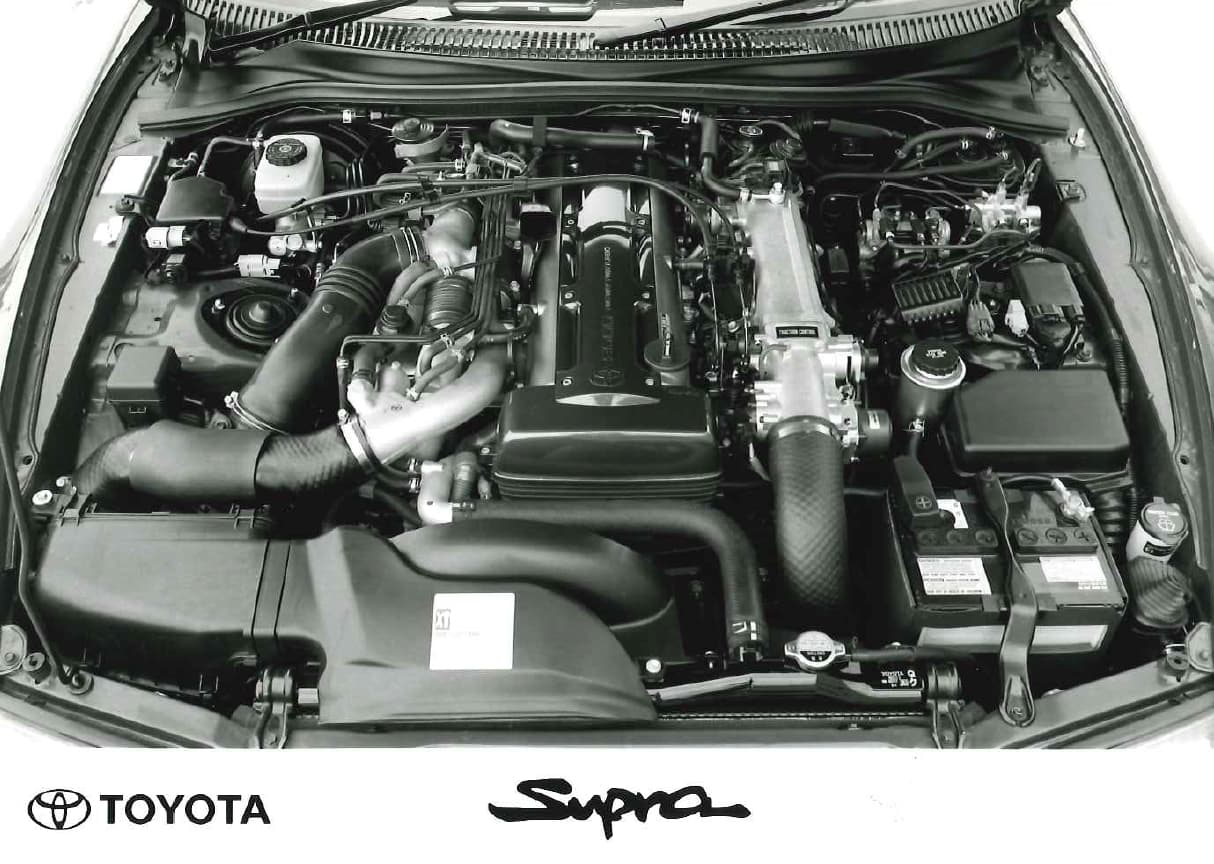
Photo: Toyota (GB) PLC. Factory A80 Supra engine bay, from the 1993–1996 UK press archive; shown as a stock technical reference.
The A80 Supra belongs at the center of a tuner site: long hood, distinctive rear wing and a straight-six that gives a build its own identity. The interesting question in 2026 is what you want your particular car to do. A reputation cannot tell you the condition of an engine, the quality of its wiring or the fuel behind a dyno number.
Start with the factory version
Toyota's Japanese launch release identifies the 1993 Supra RZ and GZ as 3.0-liter twin-turbo models, with the 2JZ-GTE rated at 280 PS. The naturally aspirated SZ used the 2JZ-GE. Toyota also offered different transmissions across the range, including a six-speed manual developed with Getrag for the RZ. Those distinctions matter when a seller describes a modified car simply as a “Supra turbo.” Toyota's 1993 Japanese launch specification.
The US-market Supra Turbo was rated at 320 hp; Toyota's UK archive lists 326 bhp. These are market-specific factory figures, not wheel-horsepower measurements or a rating for every engine carrying a 2JZ badge. Record the donor, production specification and present hardware before comparing numbers. Toyota USA chronology, Toyota UK model archive.
Give the build a brief
Our starting point would be a street car with a usable operating range and room for service access. Someone planning repeated circuit sessions or a dedicated drag car will write a different brief. Decide where the car will run, which fuel will actually be available and what supporting work the budget can cover.
Ask the builder to separate the engine's known condition from the proposed modifications. We would want the inspection results, current calibration, fuel-system specification and a record of any internal work together in one folder. An invoice for a turbo is useful; it does not document the rest of the powertrain.
Select the turbo as part of the system
A single-turbo conversion can suit the project, but the compressor's headline horsepower range is only one selection input. Garrett's engineering guide explains how airflow, pressure ratio, efficiency and shaft speed appear on a compressor map. The useful conversation with a supplier is about the operating range of this engine and its application. Garrett's compressor-map guide.
Installation deserves equal attention. Garrett includes oil supply and drainage, cooling, charge plumbing, leak testing and monitoring in its system guidance. We would ask for those decisions to be recorded alongside the turbo part number, then keep baseline and revised logs with the build. Garrett's turbo-system guide.
Make a power claim worth reading
A useful build feature should say where power was measured, which fuel and calibration were used, what hardware was fitted and who performed the measurement. Keep the torque curve and test conditions with the peak figure. A different car's successful pull does not establish a safe limit for this engine.
We would also price the clutch or transmission work, cooling, fabrication and setup before approving the final power target. Put unresolved items in the budget explicitly instead of treating them as parts that will somehow arrive later.
The finished Supra should have a clear identity, a setup its owner understands and evidence behind its specification. That is a stronger story than another unsupported promise that a 2JZ cannot break.
Editorial build-planning analysis; no TUNERS test car or universal stock-internal power limit is claimed. Updated September 8, 2026.