You can tell within about ten seconds whether someone actually knows BMWs, and it happens the moment they try to describe which one they mean.
Why the codes exist
BMW has always used internal development codes. The E stands for Entwicklung, which is German for development, and it was applied to every project from the late 1960s onward. Enthusiasts adopted it because model names are useless: a 3 Series has been in production for five decades and calling something "a 3 Series" narrows it down to roughly nothing.
The E prefix ran until it ran out of numbers. F came next, then G, with some internal reshuffling along the way. The letter tells you roughly the era. The number tells you the specific project.
The lines worth memorizing
For the 3 Series: E21, E30, E36, E46, E90, F30, G20. For the 5 Series: E12, E28, E34, E39, E60, F10, G30. For the 7 Series: E23, E32, E38, E65, F01, G11.
Note that the numbers are not sequential within a model line. E30 and E28 overlapped. The codes were assigned by project start, not by family, which is why the numbering looks chaotic until you stop expecting it to be tidy.
Some generations split across body styles. The E90 is the sedan, E91 the touring, E92 the coupe and E93 the convertible, which is why people write E9x when they mean the whole generation. The same applies to F30 sedan, F31 touring, F32 coupe.
Where M cars get their own codes
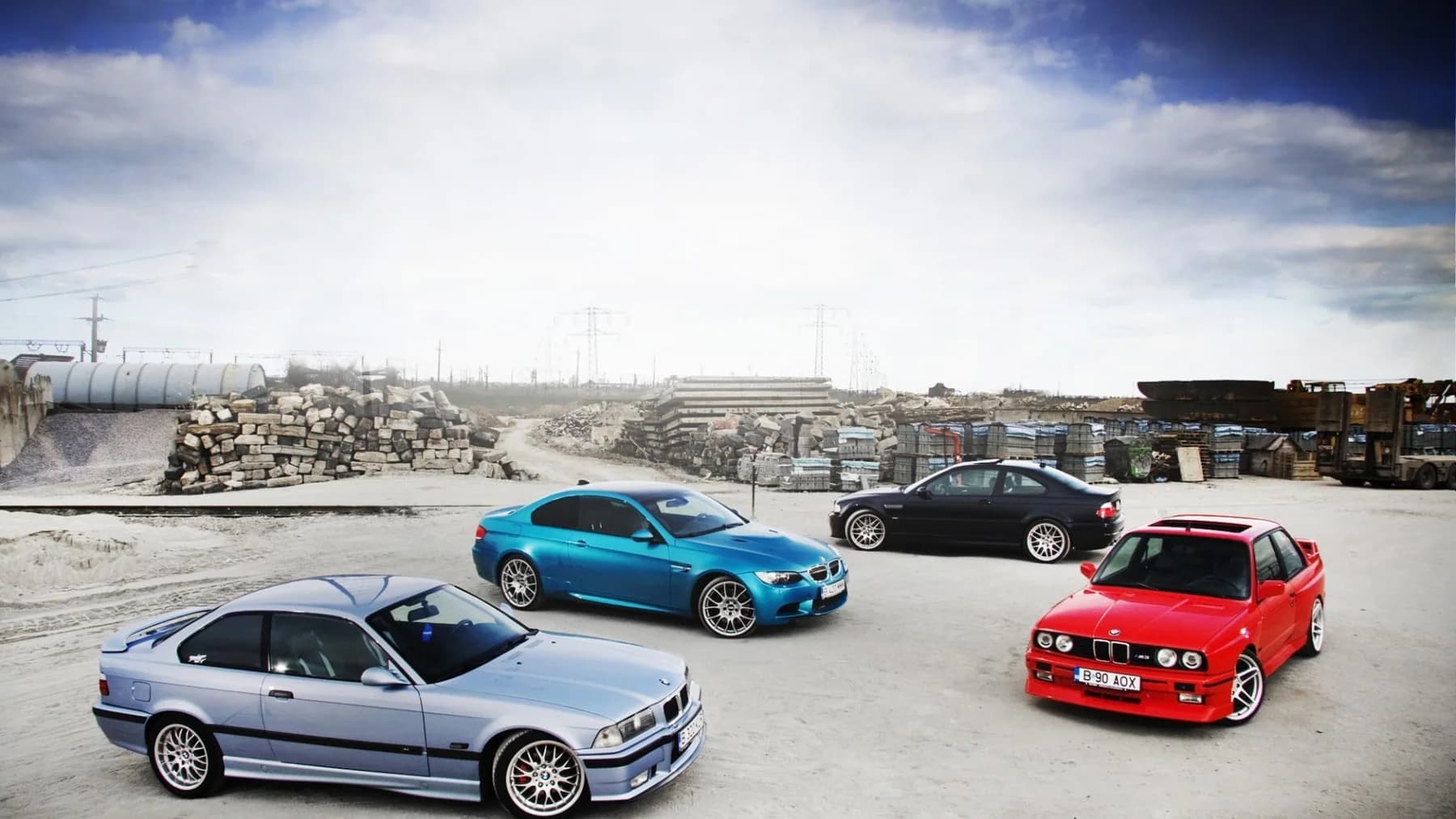
Older M cars shared the base chassis code. An E30 M3 is an E30, an E46 M3 is an E46. That changed with the F generation, when BMW split the M3 and M4 into their own codes: F80 for the M3 sedan, F82 for the M4 coupe, F83 for the convertible. The M5 of that era is the F10 M5, which shares the sedan's code.
This matters when you are buying parts. A part listed for an E90 may not fit an E90 M3, because the M car has different subframes, brakes and geometry. Search by the M designation, not the base chassis.
Engine codes are the more useful skill
Chassis codes tell you the body. Engine codes tell you what you are actually buying, and BMW's system is readable once you know the prefixes.
- M — the older families. M20 (E30 six), M42 (E30 318is four), M50 and M52 (E36, E39), M54 (E46, E39, X5).
- S — Motorsport engines. S14 in the E30 M3, S50 and S52 in the E36 M3 depending on market, S54 in the E46 M3 and Z3 M, S62 in the E39 M5, S85 V10 in the E60 M5, S65 V8 in the E9x M3, S55 in the F8x M3 and M4.
- N — the modern generation of mainstream engines. N52 naturally aspirated six, N54 twin-turbo six, N55 single twin-scroll turbo six.
- B — the modular family that followed. B58 in the M240i and 340i, B48 four-cylinder.
Learning these is more useful than learning chassis codes, because it tells you what the car will do and what it will cost. The difference between an E90 328i and an E90 335i is N52 versus N54, and that single letter change is the difference between a pleasant commuter and a tuning platform with a fuel pump problem.
The M division, briefly
BMW Motorsport GmbH was founded in 1972 to run the racing program, and it started building road cars almost immediately as a side effect. The M1 came first, then the E28 M5 in the mid-80s, which established the formula: an unremarkable sedan body containing a motorsport-derived engine.
That formula is why the codes matter to enthusiasts more than the badges do. The whole point of an M5 is that it looks like a 5.
And then there is Alpina
Alpina is a separate registered manufacturer in Germany, not a tuning shop, which is why Alpinas have their own VINs and their own model names. B3, B7, B10, D3 for the diesels. The philosophy has always been torque and refinement rather than redline, which makes an Alpina the opposite answer to the question an M car asks.
They are also spectacularly expensive to maintain and almost none of them were sold in North America, which is why you mostly encounter them as forum aspirations.
Use it properly
None of this is trivia for its own sake. Knowing that a car is an E39 540i with an M62 and a factory six-speed tells you more in eight characters than three paragraphs of a classifieds listing ever will.
Learn the codes for the cars you actually want. Learn the engine prefixes for everything. The rest fills itself in the first time you go parts shopping and realize the catalogue does not know what a "3 Series" is either.