Putting the heaviest component in the car behind the rear axle is, on paper, a terrible idea. Every chassis engineering textbook says so.
Porsche has spent six decades building the 911 that way anyway, and the current cars are among the fastest point-to-point machines on sale. Understanding why is the difference between respecting a 911 and being scared of one.
Where the mass actually sits
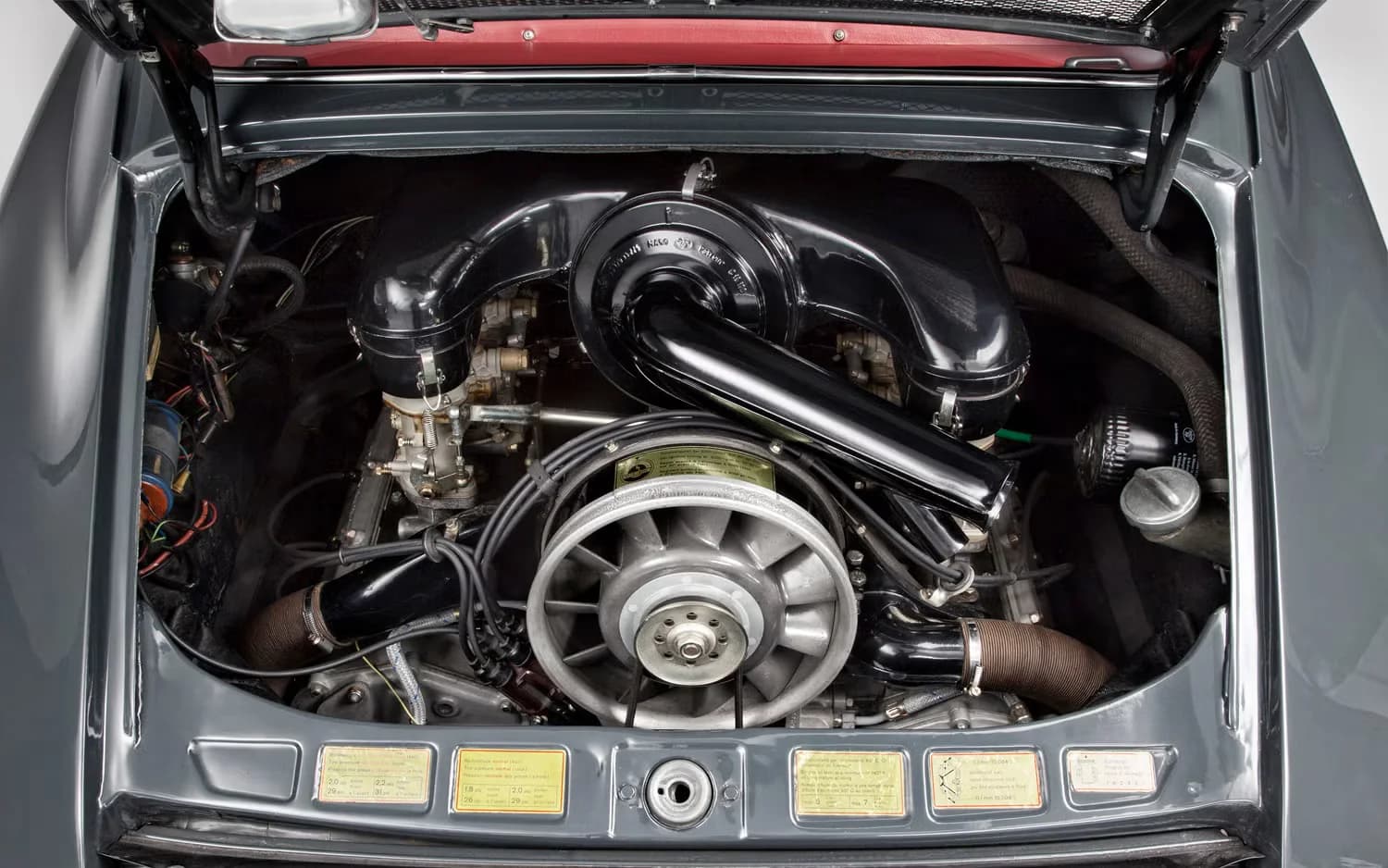
A 911 carries roughly forty percent of its weight over the front axle and sixty over the rear. The engine hangs behind the rear wheel centerline rather than between the axles, which is what makes it rear-engined rather than mid-engined.
Two consequences fall straight out of that. First, the car has enormous rear traction, because the mass sitting on the driven wheels increases as you accelerate and weight transfers rearward. Second, the polar moment of inertia is high, because the heaviest object is a long way from the car's center.
High polar moment means the car resists starting a rotation. It also means that once it starts rotating, it wants to keep going. Both halves matter.
Why it works so well in a straight line and out of corners
The traction advantage is not marginal. A rear-engined car will put power down out of a slow, tight corner in conditions where a front-engined rival is lighting up its tires. It is why 911s have always been quick on wet roads and why they launch harder than their power figures suggest.
Braking is more interesting. With that much rear mass, the rear axle carries real load under braking instead of going light, so the rear brakes contribute far more than they do on a conventional car. That is why 911 rear discs are so large, and why the car feels stable under heavy braking in a straight line.
The part that bites
The famous 911 trait is lift-off oversteer, and the physics are simple. You enter a corner too fast, panic, lift the throttle. Weight shifts forward, the rear tires lose vertical load, and the heavy tail keeps travelling in the direction it was already going.
Once that pendulum swings, the same high polar moment that made the car stable now works against you. The correction has to be earlier and more decisive than in a mid-engined car, and if you get it late, you get it very late.
This is why the old advice about being smooth and getting your braking done before turn-in was never just style points. It is the operating manual.
How Porsche engineered around it
The history of the 911 chassis is essentially a long campaign against its own layout.
- Wider rear tires and rear track than the front, on every generation, to give the tail more grip than the nose.
- Weights in the front bumper ends on early cars, a crude but effective way of moving the balance forward.
- The 993's multi-link rear suspension, replacing the semi-trailing arms that let the rear wheels change camber unhelpfully under load. This is the single biggest handling change in the model's history.
- Longer wheelbases with each generation, stretching the distance the tail has to travel before things get exciting.
- Rear-axle steering on later GT and Turbo models, which sharpens turn-in at low speed and adds stability at high speed.
- Stability control that is calibrated specifically for a car that behaves like this.
The result is that a 991 or 992 will understeer mildly if you overcook it, exactly like everything else. The character is still there, buried deeper.
So why not go mid-engined instead
Porsche knows how to build mid-engined cars. The 917, the 956 and 962, the 919 that dominated at Le Mans, the Cayman sitting in the showroom next door. The company is not confused about where an engine belongs.
The 911 keeps its layout for three reasons. Packaging, because rear seats and a usable front trunk exist only because the engine is out of the way. Traction, which is a genuine performance advantage rather than a compromise. And identity, because a mid-engined 911 stops being a 911 and becomes a slightly bigger Cayman.
The take
The layout is not a mistake Porsche is too stubborn to fix. It is a set of trade-offs the company understood better than anyone and then spent sixty years refining until the downside almost vanished.
Almost. Brake in a straight line, get the car turned, then use all that rear grip on the way out. Do it in that order and the layout is your friend. Do it in the wrong order and you will find out why everyone tells that story.