The best electronics are the ones you never notice working. Which is also why most riders misunderstand what they do, and a few of them find out the hard way where the limits actually are.
Traction control, cornering ABS, wheelie control and the rest hang off one component: a six-axis inertial measurement unit, usually a box smaller than a matchbox bolted somewhere near the middle of the bike. Here's what it knows and what it does with that.
Six axes, and a very fast opinion
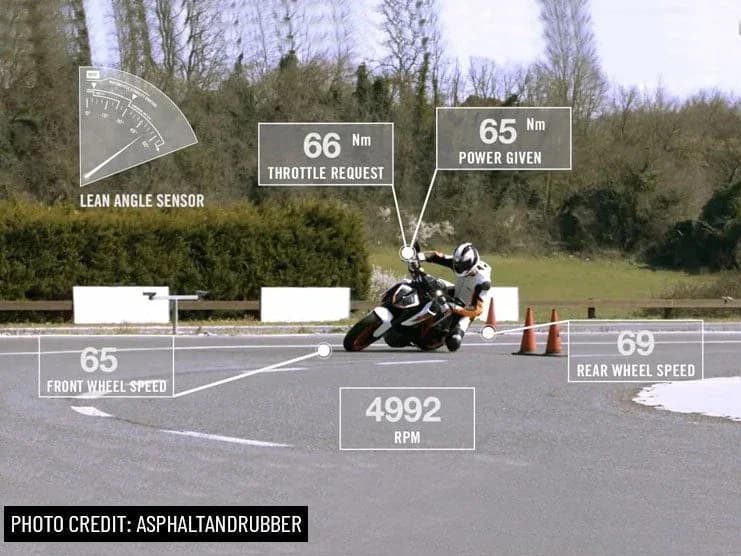
Three accelerometers measure linear acceleration along the bike's three axes. Three gyroscopes measure rotation rate around those same axes: roll, pitch and yaw. Combine them, sample hundreds of times a second, and the ECU has a live estimate of lean angle, whether the front is coming up, and whether the bike is rotating faster than the steering input alone would explain.
That estimate is what turns a crude safety net into a system that can behave differently at 45 degrees of lean than it does upright.
Traction control that knows you're leaned over
Basic traction control compares front and rear wheel speeds. When the rear spins faster than the front by more than a set margin, the ECU cuts power, by retarding ignition, cutting fuel to cylinders, or closing a ride-by-wire throttle. Cheap and effective, but it has to apply the same slip threshold everywhere.
With an IMU, the allowable slip becomes a function of lean angle. Upright, the system tolerates a fair amount of spin because you're on the fat part of the tire and a bit of slide is harmless. At full lean, on the edge of the tire, it gets far more conservative because that's where a spin turns into a highside.
The system is managing slip, not preventing it. Racing-derived setups deliberately allow a percentage of slip because that's where drive comes from.
Cornering ABS, which is not the same as ABS
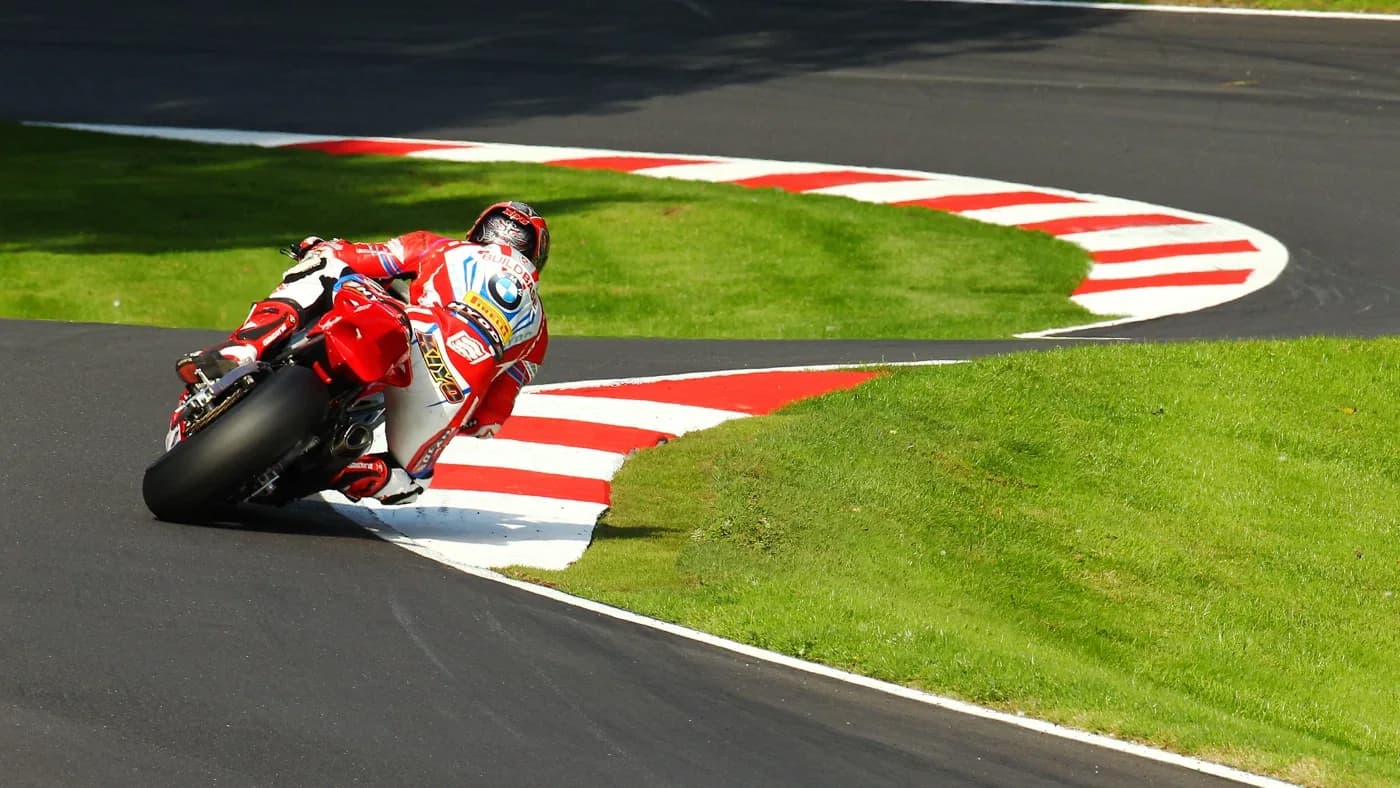
Standard ABS releases brake pressure when a wheel is about to lock. Fine upright. Grab a fistful of front brake at 40 degrees of lean and the tire's available grip is already committed to turning, so locking isn't the only failure mode — tucking the front is.
Cornering ABS uses lean angle to cap how much pressure reaches the caliper, and it will ignore part of your input to keep the front tracking. Bosch's Motorcycle Stability Control is the system most manufacturers license. It has saved a lot of riders who target-fixated and grabbed the lever mid-corner, which is the single most common way to bin a bike on a road you don't know.
Wheelie control, launch control, engine braking
Wheelie control uses pitch rate rather than front wheel speed, so it can catch the front rising before the wheel actually leaves the ground and modulate rather than slamming the power shut. Better systems hold the front at a set height instead of dumping you back down.
Engine braking control cracks the throttle plates slightly on a closed throttle to stop the rear chattering on downshifts. A slipper clutch does the mechanical version of the same job.
What the IMU cannot do
It cannot create grip. On cold tires, painted lines, diesel, gravel or a wet metal bridge joint, the electronics find the limit at the same moment you do — they just react faster once you're past it.
It cannot help with lean angle you've run out of. If you enter too hot and the bike is already at the edge, no amount of processing adds ground clearance. And it cannot see the car turning across your path at an intersection, which remains the most common way riders get hurt.
Off-road, ABS often lengthens stopping distance on loose surfaces, which is why decent ADV bikes let you switch the rear off.
Quickshifters are a separate conversation
A quickshifter has nothing to do with the IMU. It's a sensor on the shift linkage that triggers a brief ignition cut so you can upshift without the clutch. An autoblipper does the reverse for downshifts, opening the throttle a fraction to match revs. They make you smoother. They don't make you safer.
The honest framing is this: rider aids buy you margin, and margin is worth real money. They do not buy skill, and they are calibrated for a rider who is already making sensible inputs. If you're new, the aid worth having is ABS, and it's the one you'll hopefully never feel.