Bikes rarely die of old age. They die of a chain nobody adjusted, a coolant change nobody did, and a valve service the third owner decided was optional. All of it was cheap right up until it wasn't.
Cars hide neglect for years. A bike hands it straight to you through the bars, and occasionally through the pavement. Here's the short list of jobs that decide whether your bike is a 60,000-mile machine or a 20,000-mile parts donor, roughly in order of how badly it hurts to skip them.
The chain is the job you will skip first
A dry chain doesn't just wear out, it wears out the sprockets, then the new chain you fit to the old sprockets wears out in half the time. Replace them as a set, always.
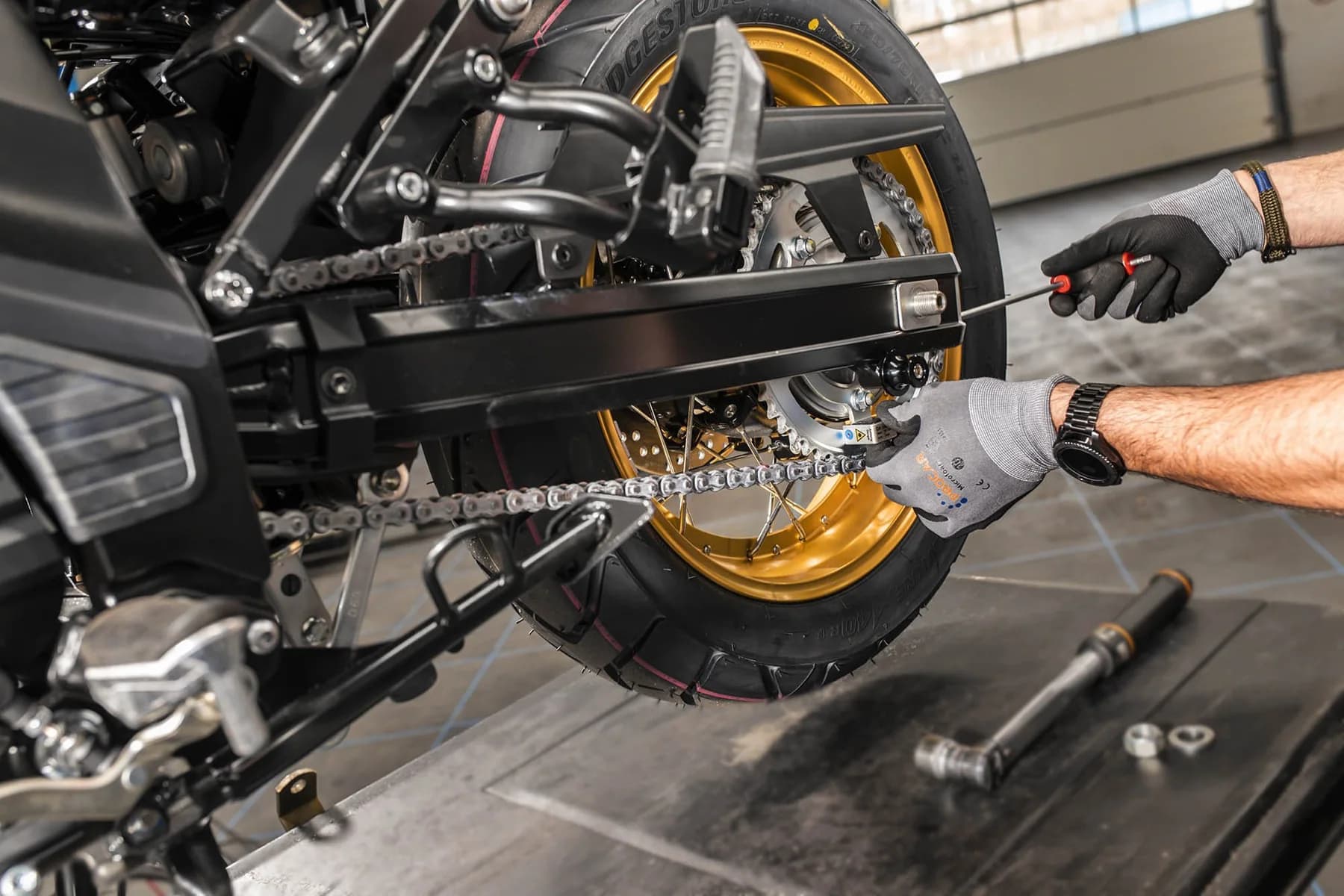
Clean and lube every 300 to 600 miles, and after any ride in the rain. Modern chains are O-ring or X-ring, meaning the grease that matters is sealed inside and your job is protecting the seals. Use kerosene or a dedicated chain cleaner and a soft brush. No wire wheels, no aggressive degreasers, no chain that spent a month bone dry and orange.
Slack gets checked at the tightest point, which means rotating the rear wheel and finding it, not measuring wherever the bike happened to stop. Too tight is far worse than too loose. An overtightened chain binds as the suspension compresses and loads the output shaft bearing, which is a gearbox job.
Tires expire whether you ride or not
Every tire has a four-digit date code on the sidewall: week, then year. Rubber hardens with time regardless of tread depth, and a five-year-old tire with 4mm left is still a five-year-old tire. Grip in the cold and wet goes first.
Check pressure cold, weekly. It's two minutes and it changes how the bike steers more than any suspension part you could bolt on. Watch for squaring off from highway miles and cupping on the front, both of which make the bike feel vague and shift its steering weight mid-corner.
Brake fluid is a consumable, not a level
Brake fluid is hygroscopic. It pulls moisture out of the air through the reservoir seal and the hoses whether you ride or not, and water lowers the boiling point. Fade you experience on the second hard stop down a mountain road is usually old fluid, not cheap pads.
Flush every two years. If your bike has a hydraulic clutch, flush that too. Fluid the colour of weak coffee means it was already overdue.
Valve clearances, and the interval nobody honours
Depending on the bike, valves need checking somewhere between 15,000 and 25,000 miles. Screw-and-locknut setups are an afternoon. Shim-under-bucket on an inline four means cams out, and the bill reflects that.
Clearances tighten as valve seats wear. Tight valves stop sealing, you lose compression, and eventually you burn a seat. The early symptoms are boring: harder cold starting, a slight loss of midrange. By the time it's obvious, the head is off. If you're buying used and there's no record of the service, assume it hasn't been done and price accordingly.
Oil, coolant, and the rest of the boring list
Motorcycle engines share oil with a wet clutch. Use a JASO MA rated motorcycle oil, not energy-conserving car oil with friction modifiers in it, unless you enjoy clutch slip. Change per the manual, which for most modern bikes lands somewhere in the 4,000 to 6,000 mile range.
Coolant every couple of years. Fork oil somewhere around 20,000 to 30,000 miles, which almost nobody does and which transforms a tired bike more than any bolt-on. Air filter when it's dirty. Battery on a tender over winter, because a bike battery that gets deep-discharged twice is finished.
The two minutes before you ride
The MSF acronym is T-CLOCS: tires and wheels, controls, lights, oil and fluids, chassis, stands. It sounds like homework. It's a walk around the bike with your eyes open, and it catches the loose chain, the flat rear, the dragging brake and the missing bolt before they become a story.
None of this is skilled work. It's a torque wrench, a paddock stand, a manual for your specific model, and roughly one Saturday a month. The riders whose bikes look tired at 30,000 miles didn't get unlucky. They just kept deferring a $15 job until it turned into a $900 one.