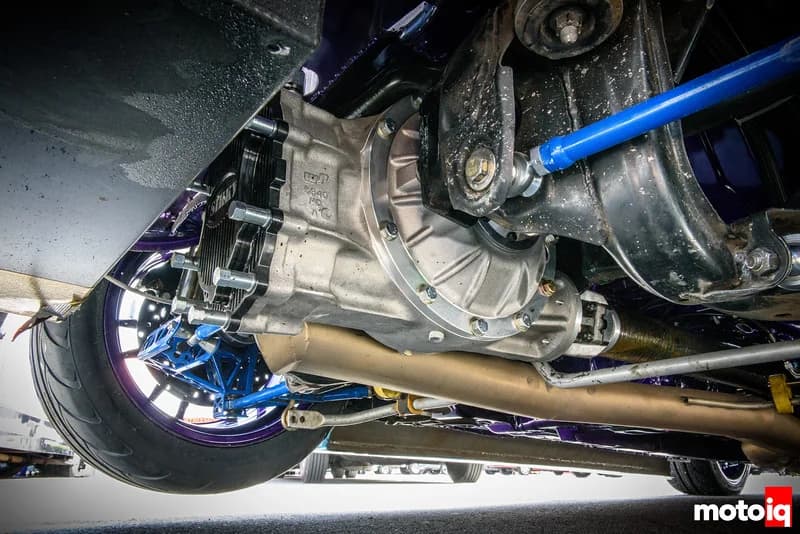
A welded differential is the cheapest good decision in drifting and the internet will never stop arguing about it. Somebody will tell you it destroys axles. Somebody else will tell you it is all you will ever need. Both are half right, and which half applies depends entirely on what you are asking the car to do.
What welding actually does
Weld the spider gears and the two rear wheels are now locked together permanently. They turn at the same speed always, in a slide and in a parking lot and on the highway. There is no torque bias, no ramp angle, no preload to set. It is a solid axle with extra steps.
For drifting that is close to ideal, because the thing you want most is predictability. Both tires break at the same time, both hook back up at the same time, and the car does the same thing on every entry. Learning is much faster on a diff that never surprises you.
Where a welded diff is genuinely good
If you are learning, it is the correct answer. Not the budget compromise, the correct answer. A clutch-type LSD with worn plates behaves differently at the start of a session than at the end, and a beginner cannot tell the difference between the car changing and their own driving changing.
Welding removes one variable at zero cost beyond a few hours of labour and someone competent with a MIG. Spend the money you saved on tires, which is the only thing that actually makes you better.
The failure modes
The complaints are real, they are just smaller than people claim.
- Tire wear on the street. Tight turns make the inside rear scrub and chirp. Rear tires wear faster. If the car is also your commuter, you will feel it every time you park.
- Driveline shock. Locked axles plus clutch kicks plus a worn driveshaft is how you find the weak component. Usually it is a stub axle, a driveshaft, or the diff mounts.
- Wet-weather manners. A welded car in the rain wants to rotate under braking and under power. That is fine on a wet skidpad. It is less fine merging onto a highway in a downpour.
- Bad welds. A weld that cracks and lets go mid-corner is genuinely dangerous. Get it done properly, with the case cleaned and the gears actually fused, not tacked in four places by whoever had the cheapest quote.
Two-way, 1.5-way, one-way
A clutch-type LSD uses ramps to decide how much it locks. The naming refers to which direction those ramps work.
A two-way locks under acceleration and under deceleration equally. That is what most drifters want, because you want the rear axle behaving as one unit when you lift mid-corner, not just when you are on the gas. A 1.5-way locks fully on power and partially off it, which is a good street compromise and a fine competition choice. A one-way locks on power only and freewheels on lift, which is a road-racing preference and will feel vague and twitchy on entry.
The other spec that matters is preload, set by the spring pack. Higher preload means the diff behaves closer to locked at low torque. That is what makes an expensive LSD feel like a welded diff when you want it to and a civilised diff when you do not.
Viscous and helical: why they quit
Factory viscous units, including the ones in a lot of otherwise excellent chassis, go lazy when hot. They work for a lap, then the fluid heats, the coupling gives up, and you are effectively running an open diff at exactly the moment you needed grip. If your car has one and it has 200,000km on it, assume it is done.
Helical and Torsen-type diffs bias torque mechanically and never wear out plates, which is lovely. The problem is that they need load on both wheels to work. Lift the inside rear over a kerb or a camber change and the unit unloads and sends nothing anywhere. On a smooth skidpad they are fine. On a real course with a rise in it, you will feel the car go slack.
What to actually buy
Weld it. Drive it for a season. Learn what the car does. If you get to the point where you are running competitive tandem and you can articulate exactly what the diff is doing wrong, buy a two-way clutch LSD with adjustable preload and rebuild it as a consumable.
Most people never reach that point, and there is nothing wrong with that. There are drivers running lap after lap with a welded diff and a set of takeoffs who are far more entertaining to watch than someone with an expensive diff and thirty degrees of angle.
The diff argument is a proxy for the real argument, which is whether you are willing to spend money instead of seat time. Spend the seat time. The diff is not what is holding you back.