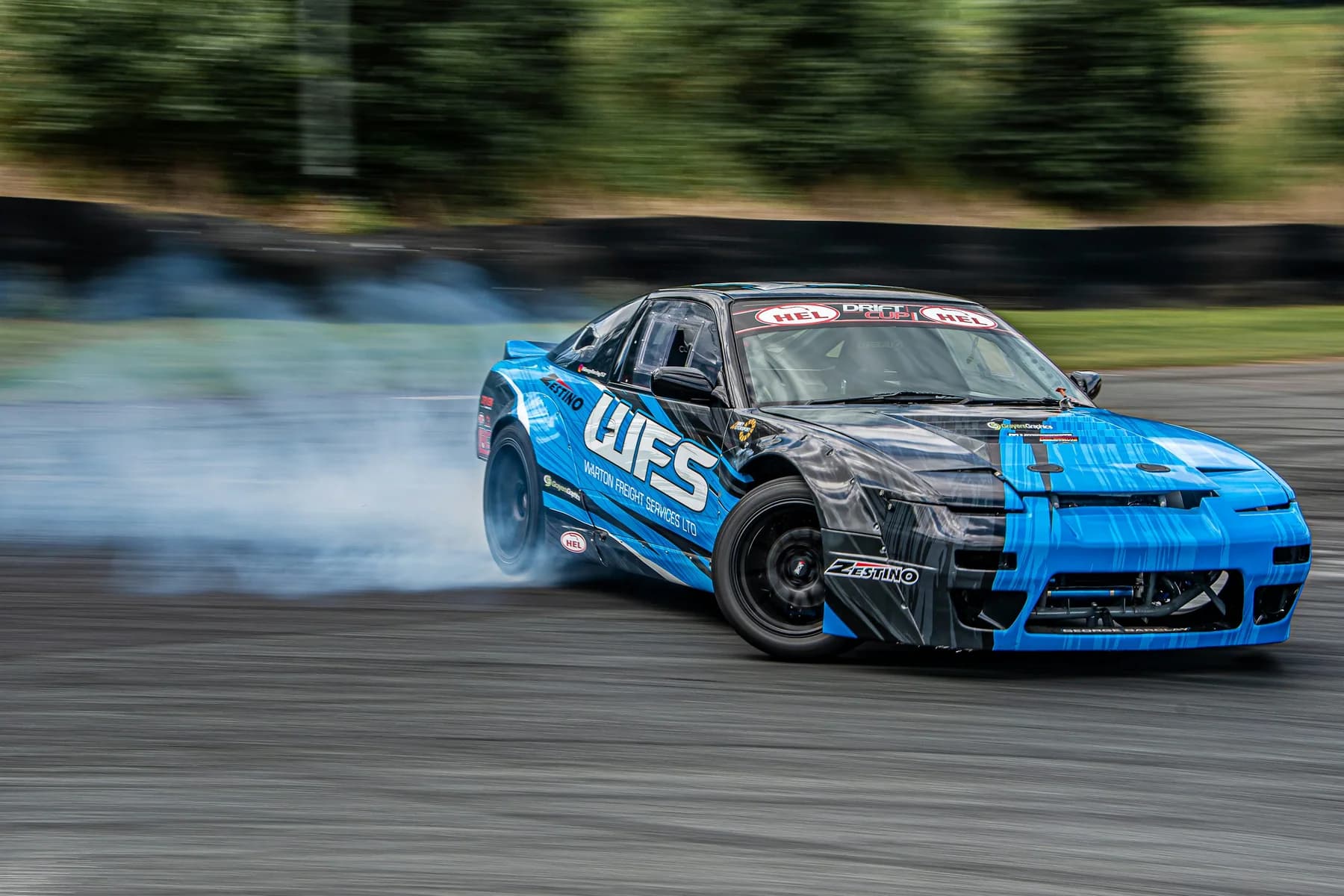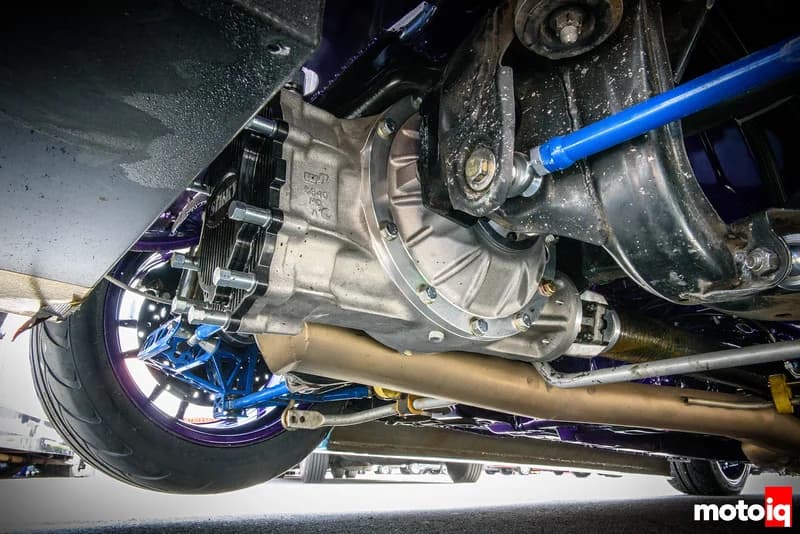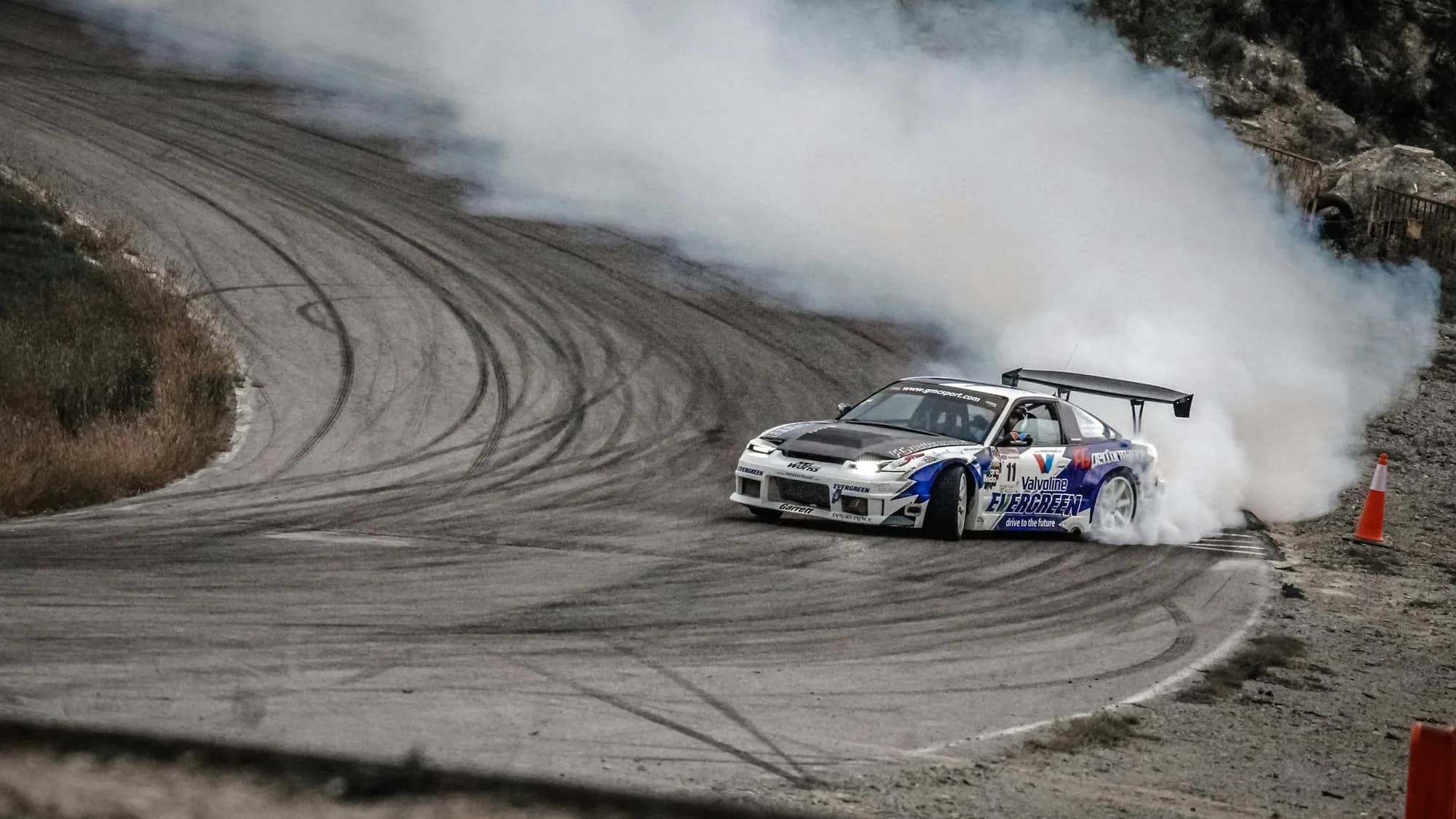
Photo: PhotoPum RanaRoja / Unsplash. A drift car with its rear tires smoking.
Rear tires decide how much driving a drift day actually contains, so most people shop for them on price and a forum thread about how long they last. The sidewall and the rulebook carry better information than that. Three numbers do most of the work: the treadwear grade, the date code and the width the tire really measures once it is mounted.
What the treadwear number measures
The treadwear figure comes from the federal Uniform Tire Quality Grading system. The regulation defines it as a comparative rating of how fast a tire wears on a government test course of roughly 400 miles, graded in steps of 20 against a nominal value, so a tire graded 150 should last one and a half times as long on that course as one graded 100. The same rule cautions that real-world results depend on how the tire is actually used. 49 CFR 575.104, via Cornell LII
The other two UTQG grades tell a drifter less than they appear to. Traction grades, from AA down to C, come from straight-line braking tests on wet asphalt and concrete, and the regulation states plainly that the grade "does not include acceleration, cornering, hydroplaning, or peak traction characteristics." Temperature grades come from a laboratory wheel test of how well a tire resists and sheds heat. None of the three describes a tire at full lock in third gear. 49 CFR 575.104, via Cornell LII
How a pro series turns treadwear into a rule
Even so, treadwear is the lever Formula Drift pulls to keep competition tires street-based. Its 2026 PRO technical regulations require every competition tire to carry a UTQG treadwear rating of at least 200, to be DOT approved and intended for highway use, to be sold through regular retail outlets and to have an MSRP of no more than $500. Only models on the approved list may race, and the 2026 list includes tires from GT Radial, Kenda, Kumho and Nitto. Formula Drift's 2026 PRO Technical Regulations
The development series goes further. Since 2021, every PROSPEC car has used the same GT Radial Champiro SX2 RS, with rears limited to 255/35R18. Formula Drift's 2026 PROSPEC Technical Regulations Formula Drift said at the time that the tire was made at GT Radial's plant in Chester County, South Carolina. Formula Drift's GT Radial announcement
Measured width beats the label
The PRO rules also show why the size molded on the sidewall is only a starting point. Rear tire width is capped by vehicle weight, from 260 mm at a 2,700-pound minimum to 330 mm at 3,400 pounds, rising 10 mm for every 100 pounds. Officials measure the rear tire on the car, on the ground, with a sliding gauge set 3 inches up from where the tread meets the pavement, and that reading decides compliance whatever the advertised size says. Formula Drift's 2026 PRO Technical Regulations
The habit transfers to any event with a width or class rule. Measure the tire as mounted on your own wheel before assuming it fits.
Date codes, storage and used tires
Used take-offs are a fixture of drift budgets, which makes the date code worth reading. A new tire's Tire Identification Number ends in four digits: the first two give the week of manufacture and the last two the year, so 0109 means the first full calendar week of 2009. The regulation requires the TIN on only one sidewall, so check both sides before giving up. 49 CFR 574.5, via Cornell LII
Age is not a precise expiry date. Toyo Tire's consumer advisory says calendar age alone cannot predict a tire's service life, because storage and use matter more, but it still recommends replacing any tire 10 years or more past its manufacture date, even if it looks serviceable. It also advises storing tires somewhere dry, cool and well ventilated, away from direct sunlight and ozone sources such as electric motors. Toyo's tire service life advisory
What the rulebook forbids
Formula Drift bans tire warmers, chemical treatments and traction compounds, grooving or shaving, and balancing with fluids or loose internal weights. Competitors can also claim a rival's tires and have them sent for laboratory analysis. Formula Drift's 2026 PRO Technical Regulations Its safety baseline for affiliate events adds wheel rules: no beadlocks or wheel screws, nothing but air between rim and tire, which rules out inner tubes, tire balls, mousse and Tubliss systems, no pressure relief valves, and wheels DOT approved for passenger cars. Formula Drift's 2026 PRO/AM Safety Regulations
Pressure changes are allowed while a car waits in line for the burnout box. Formula Drift's 2026 Sporting Regulations Once a tandem battle starts, no service of any kind is permitted between the two runs, and the same rear tires must complete both. Formula Drift's 2026 Judging Regulations That is the real test of a competition tire: it has to survive two hard runs back to back on the pressures set before the battle began.
Shop in the right order. Read the tire rule you will run under, check the date code, measure the mounted width, and only then compare prices. A cheap tire that is too old, too wide for the class or banned by the organizer is not a bargain.