Grassroots drivers spend years guessing what judges want, and most of the guesses are wrong in the same direction. They think it is about angle. It is mostly about line, and the drivers who figure that out early climb faster than the ones with the biggest angle kits.
Judged drifting comes down to three things scored together on every run: line, angle, and style. Different series weight them differently and word them differently, but the categories have been stable for two decades because they describe genuinely separate skills.
Line
Line is where the car goes, and it is the category the organisers control completely. Before an event, judges set the course: outer zones the car should reach, inner clipping points it should touch, and a rough path connecting them. Then they score how close you got.
This is the highest-value category to practice because it is the most objective. You either put the rear quarter panel out to the wall or you did not. You either clipped the cone or you missed it by a metre. Nobody is arguing about taste.
It is also the one grassroots drivers ignore, because on a practice day there is no course. If your local event does not set zones, set your own. Pick a cone, decide the rear bumper is going to pass within a hand's width of it, and run it until that is boring.
Angle
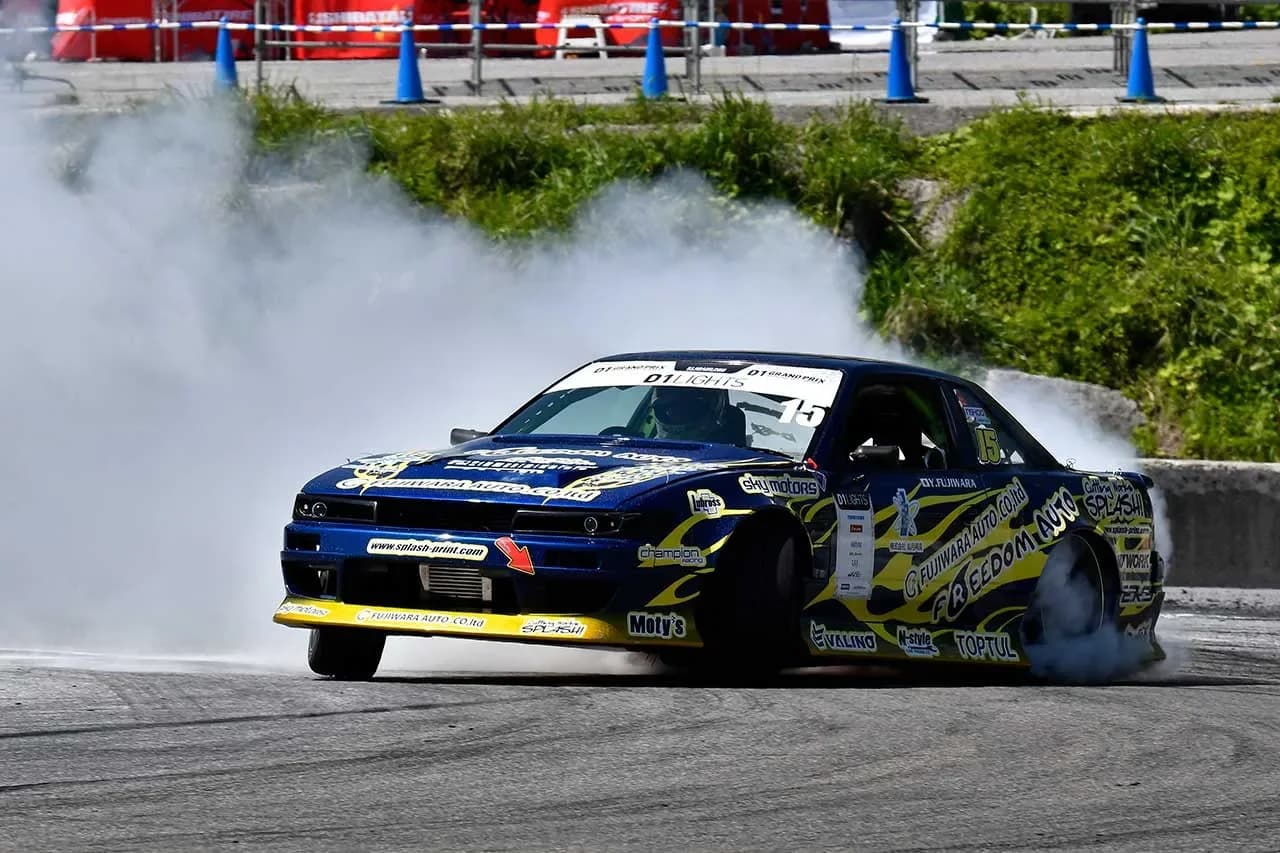
Angle is how far sideways the car is, and it is scored against the corner rather than against some absolute number. More is generally better, but only while you keep the line and keep the speed. A car at enormous angle that has stalled its momentum and is crawling through the zone scores worse than a car at moderate angle carrying real speed and holding its line to the exit.
The specific mistake is entering at maximum lock because it looks dramatic, then having no adjustment left when the car needs more. If the steering is already on the stop, your only remaining input is the throttle, and you are one small mistake from straightening or spinning. Leave yourself somewhere to go.
Style
Style is the fuzzy one, and drivers use that as an excuse to dismiss it. It is not that fuzzy. It covers commitment, fluidity, and how confident the car looks doing what it is doing.
Concretely, judges are watching for:
- Initiation. Aggressive, early, committed. A car that eases into a slide over three seconds looks tentative next to one that snaps to angle at the entry marker.
- Transitions. Sharp and clean. Any hesitation, correction, or wobble between zones is visible from the tower.
- Commitment through the exit. Straightening early to make the next zone comfortable reads as backing out, because it is.
- Corrections. Every dab of steering to save a bad line is a small deduction, even when nobody crashes.
Style is also where fault-free runs are separated from clean runs. A run with no mistakes is not automatically a good run. It might just be cautious.
Chase runs and tandem
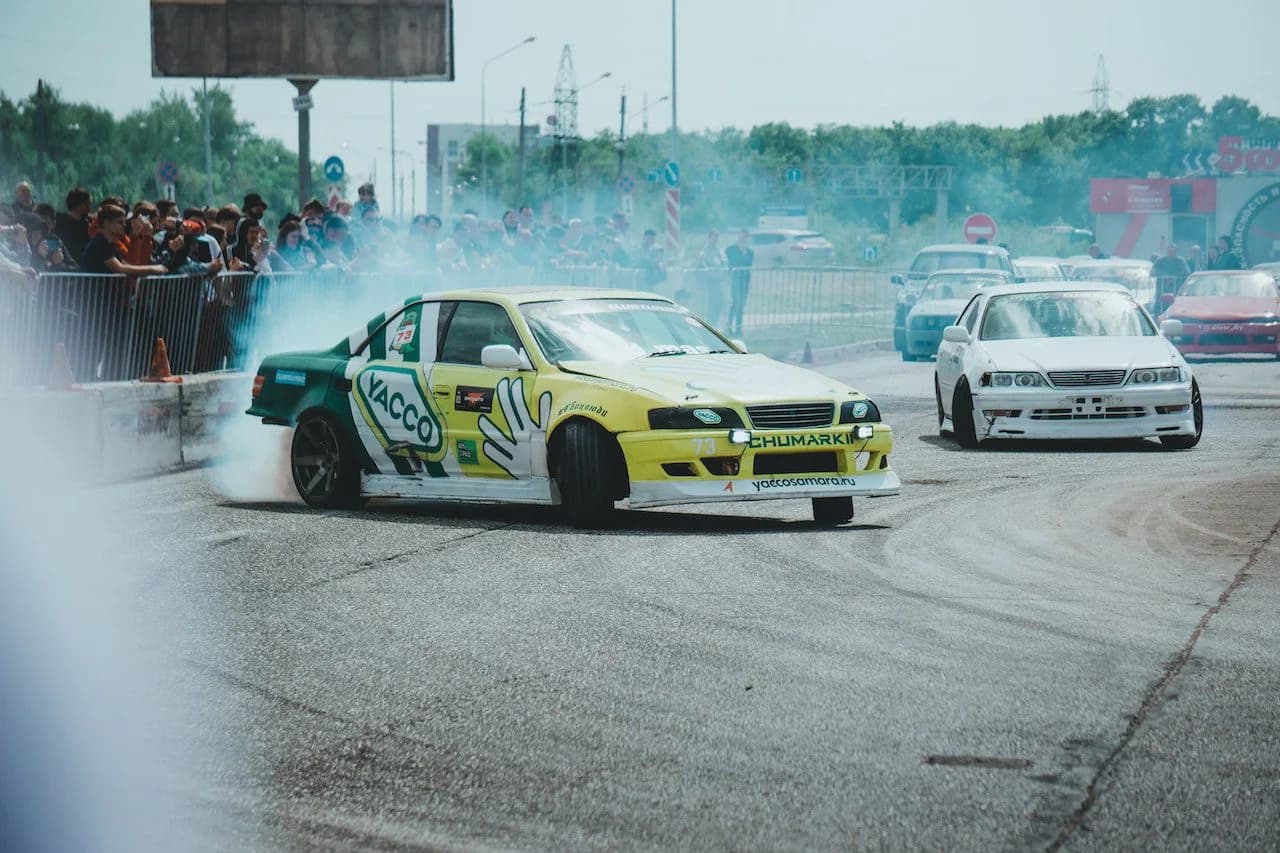
Head-to-head battles add proximity. In a chase run you are judged on how well you mirror the lead car and how close you stay, while still respecting the course. Getting close is worth a lot. Getting close and then running into the lead car is worth considerably less than nothing, because contact that ends someone's day is treated as the chase driver's fault by default.
The other half of tandem is the lead run, and it is judged too. Lead runs are scored roughly as a solo run: line, angle, style, on the same course as always. Trying to shake the chase car with a deliberately erratic line usually costs you more than the gap it creates.
If judges cannot separate two drivers, most formats run the pair again. That is the "one more time" you hear about, and it is a compliment.
Using this at a local event
You do not need a judged competition to train for one. Three things work at any practice day.
Run to a fixed line every session, not just wherever the car ends up. Ask a friend to film from a fixed point rather than following you, because a static camera shows line and a panning camera shows nothing. And run tandem with someone slower than you first, since learning proximity behind a predictable car is far more useful than chasing someone who is quicker.
The uncomfortable truth is that most grassroots drivers are already good enough at angle to score well and are losing points on line and consistency, which are the two things nobody films for social media. Fix those and you will beat drivers with twice your budget.