The mountain road origin story is the best marketing drifting ever had, and it has been holding the sport back for about fifteen years. Every discipline gets one folk myth, and drifting's is a blind, unlit, guardrail-lined public road with a drop on one side.
It made for incredible footage. It also made for a lot of dead people, and pretending otherwise is the least honest thing in car culture.
What the touge actually was
Japanese mountain passes gave a generation somewhere to drive fast at night with no traffic, and the driving style that developed there was born from constraint. Narrow roads, low speeds, tight radii, and the need to place a car precisely with no room for error. Drifting on the touge was a way of carrying speed through corners you could not see the exit of.
Keiichi Tsuchiya popularising that style is well documented, and the video culture that grew around it built the entire aesthetic that the sport still runs on. Video Option tapes, grainy footage, the mythology of the mountain. None of that is nothing.
But the touge was never a good place to learn. It was the only place available.
What replaced it is better in every measurable way
Take a modern grassroots drift day and compare, feature by feature.
- Runoff. A skidpad has grass or tarmac where a mountain road has a barrier and a hillside.
- Repetition. You can run the same corner forty times in a day. On a pass you get one attempt per run and a long drive back.
- Feedback. Other drivers watching, sometimes judges, always someone who will tell you your entry was late.
- Recovery. Somebody with a truck who will pull you out instead of leaving you to explain it to police.
- Legality. You are not risking a licence, a vehicle seizure, or somebody's family.
Every one of those things makes drivers better. The current standard of grassroots driving is far higher than the mountain era, and that is not nostalgia failing, it is what happens when a skill sport gets safe practice facilities.
The arena format changed the sport more than the cars did
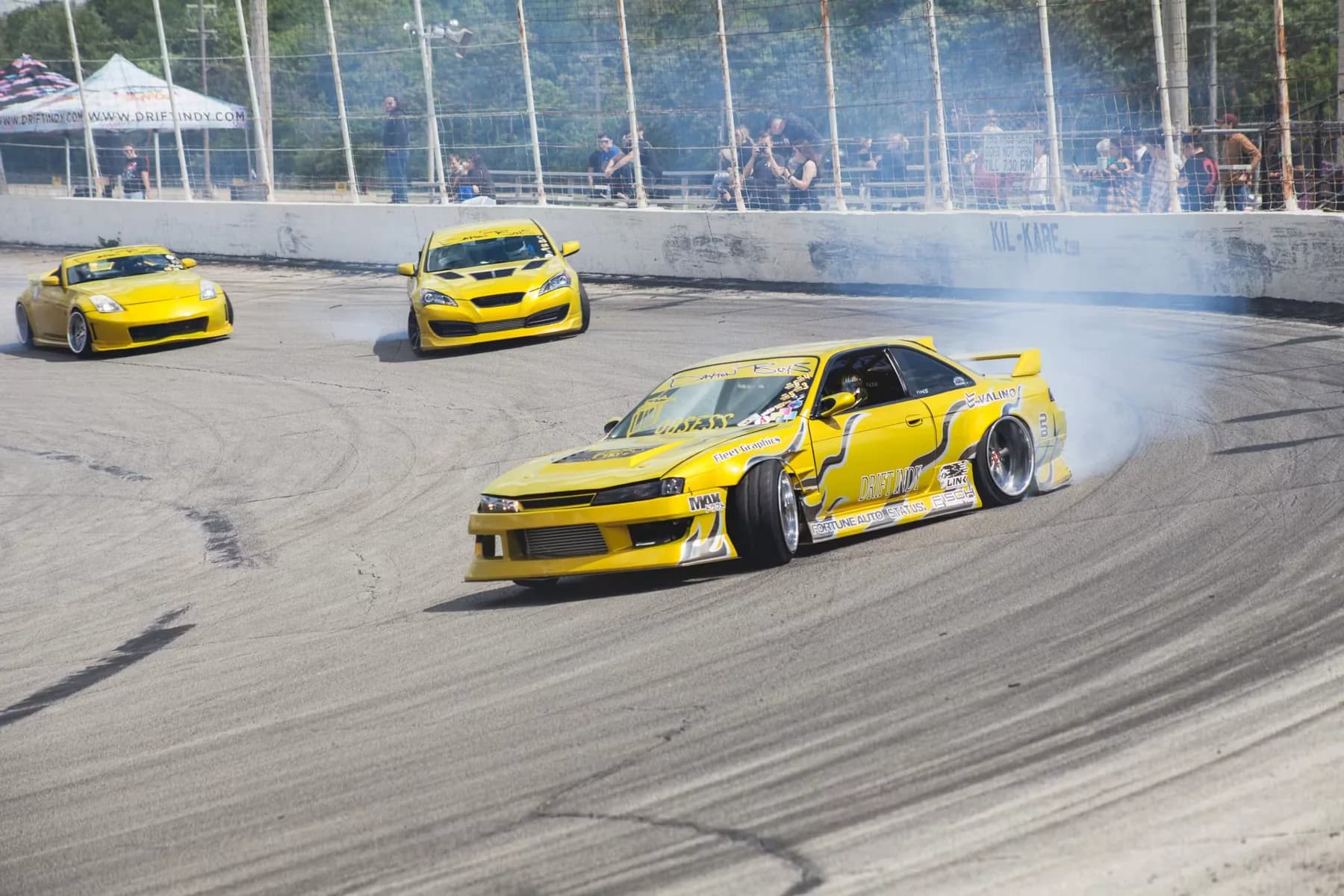
Once drifting moved to purpose-built stadium-style courses, everything downstream shifted. Judged criteria became formal. Courses got designed for spectators rather than inherited from geography. Wide entries at speed became possible, which pushed power levels up, which pushed tire compounds and angle kits and everything else.
The criticism people make is that arena drifting is homogenised. Big power, big angle, close proximity, similar cars. There is something to that. A stadium course rewards a narrow set of skills and the way to win is to do those specific things better than everyone else, which converges builds.
But the touge equivalent converged too. It rewarded low-power precision on tight radii and produced a similarly narrow style, we just remember it fondly because it was on VHS.
What genuinely got lost
Two things, and they are worth naming.
The first is accessibility of a certain kind. A mountain road is free. A track day is not, and there are people who would have found this hobby in 1998 who cannot afford the entry fee, the tires and the tow vehicle in the current version.
The second is the sense of a place belonging to a scene. Grassroots events are organised, insured and scheduled, which is what makes them work, and it also makes them an activity you book rather than somewhere you go. Something informal died in that trade.
Neither of those is a reason to go back. They are a reason to support cheap local events, low-cost entry categories, and any venue willing to open a car park on a Sunday.
The take
People who romanticise the mountain era are usually people who did not have to bury anybody from it. The sport moved onto closed courses, got judged properly, got safer, got faster, and got better drivers, and the aesthetic survived the move intact.
Keep the tape-deck aesthetic. Keep the mythology on the wall. Do the driving somewhere with runoff and an ambulance, and stop telling new drivers that the real version happens at night on a public road.
The best thing that happened to drifting was somebody putting cones in a car park and charging fifty for the day.