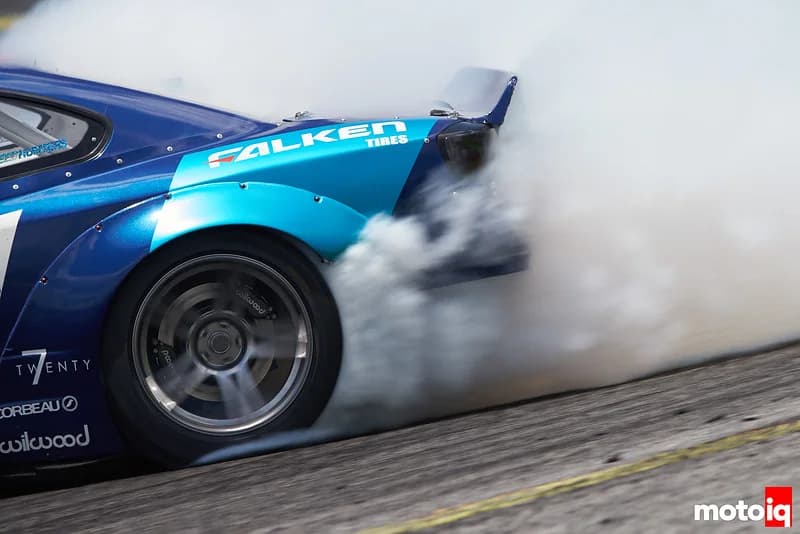
A missile car is a chassis you have already forgiven. Mismatched panels, no interior, a bonnet from a different colour car, and a driver who is not thinking about resale because there is no resale. It is the ugliest thing in the paddock and it is usually the one making progress.
People treat this as a joke build. It is closer to a training method.
Fear is the actual limiting factor
Every new driver has the same ceiling, and it is not power or angle or diff choice. It is the flinch. There is a moment mid-corner where you need to stay in the throttle while the car is pointed somewhere alarming, and a driver who is worried about their paintwork lifts.
Lifting mid-slide is how you spin, so the cautious driver gets punished for being cautious. That is a miserable feedback loop, and the fastest way out of it is to remove what you are protecting.
A car with a dent already in it is a car you will commit in. That is the entire philosophy, and it works.
The economics are not a joke either
Consider two drivers with the same money. One buys a clean chassis and spends the rest on paint, wheels and a nice interior. The other buys a rough one, spends the difference on tires and event entries, and drives it every month.
Twelve months later, one has a car that looks excellent in the driveway and maybe six days of seat time. The other has a horrible-looking car, twenty-odd days of seat time, and the ability to hold a chase run. Drifting is a skill sport with a consumable cost, and money spent on appearance is money not spent on repetitions.
The missile car is what happens when someone does that maths honestly.
What "missile" does not mean
Here is where the joke gets dangerous, because a lot of people hear "throwaway car" and assume nothing matters. Plenty does.
- Brakes. Fresh fluid, decent pads, no air, no leaks. You will need them at the worst possible moment.
- Steering and suspension. Nothing loose, nothing cracked, nothing held on with a zip tie and optimism. A tie rod failing at angle is a wall impact.
- Fuel system. No leaks, secured lines, no fuel cell in the cabin without proper mounting and isolation.
- Battery and bonnet. Tied down and latched. Both are tech inspection failures and both are how debris ends up on track.
- Seat and belts. A fixed-back seat properly mounted with a harness anchored correctly, or the factory seat with a factory belt. The dangerous middle option is a cheap harness bolted to sheet metal, which is worse than the seatbelt it replaced.
None of that costs much. All of it separates a missile car from an accident with a paint job.
The cultural bit
The missile aesthetic came out of practicality and then became a look, which is what happens to everything. Zip-tied bumpers, spare panels in whatever colour was available, a rear window with a sticker where the glass used to be. Some of it is genuine and some of it is people distressing a perfectly good car for the photograph.
It is easy to be cynical about that, and mostly it is harmless. What matters is the underlying idea, which is that the car is a tool and the tool exists to generate seat time. A paddock full of cars that people are unafraid to drive is a paddock where everyone improves faster.
Compare that to a meet full of immaculate builds where three people take turns doing careful entries at half commitment. One of those scenes produces drivers.
The counterargument, honestly
Rough cars break more. A missile chassis with two hundred thousand kilometres on tired bushings will develop a habit of failing at inconvenient times, and there is a version of this philosophy that is simply neglect wearing a costume.
There is also a real loss when a genuinely nice example of a car gets turned into a wall-tester, and as decent chassis get scarcer that argument gets stronger every year. If a car is straight, rare and rust-free, maybe let it be that.
The answer is not complicated. Buy the rough one, keep the safety-critical parts honest, and let the rest of it look like whatever it looks like.
The take
Nobody has ever learned to drift while worrying about the paint. The missile car is a shortcut past the part of the learning curve that has nothing to do with driving, and the drivers who arrive at their first tandem day already unafraid got there because they bought something they did not love.
Buy something you like driving and do not care about. It is the cheapest performance upgrade available.