Every new drifter builds the car in the wrong order. Coilovers, angle kit, hydro, wheels, then a season of wondering why they are still spinning at the exit of every second corner. The parts were not wrong. The order was.
Here is a sane sequence for the first three thousand or so, assuming you already own a running rear-drive car with a manual.
First: the diff and the seat
Nothing else works until the rear axle is locked and you are attached to the car.
Weld the diff. A few hours of a welder's time. It makes the car predictable, which is the single most valuable property a learner's car can have. Skip the debate about whether a two-way is better. It is, eventually, and you are not there yet.
Buy a fixed-back seat and mount it properly. Being able to feel yaw through your hips instead of sliding around on a worn factory seat is a genuine driving aid, not a comfort item. A sliding driver makes late corrections, and late corrections are what spins the car.
Mount it on proper rails to proper floor mounting points. If you fit a harness, it needs anchor points that are designed for it. A four-point harness bolted to thin floor pan is worse than the factory belt you removed.
That is a few hundred and it is the highest-return money in the whole build.
Second: tires and a session
Before another part goes on, spend the money on a set of rears, an entry fee and a full tank of fuel.
You cannot plan a build for a car you have not slid yet. Two practice days will tell you more about what your specific chassis needs than any forum thread, and half the parts you were about to buy will drop down your list.
The people who skip this step are the ones with a beautifully specified car and a driving style built entirely around avoiding its problems.
Third: suspension, and only what you need
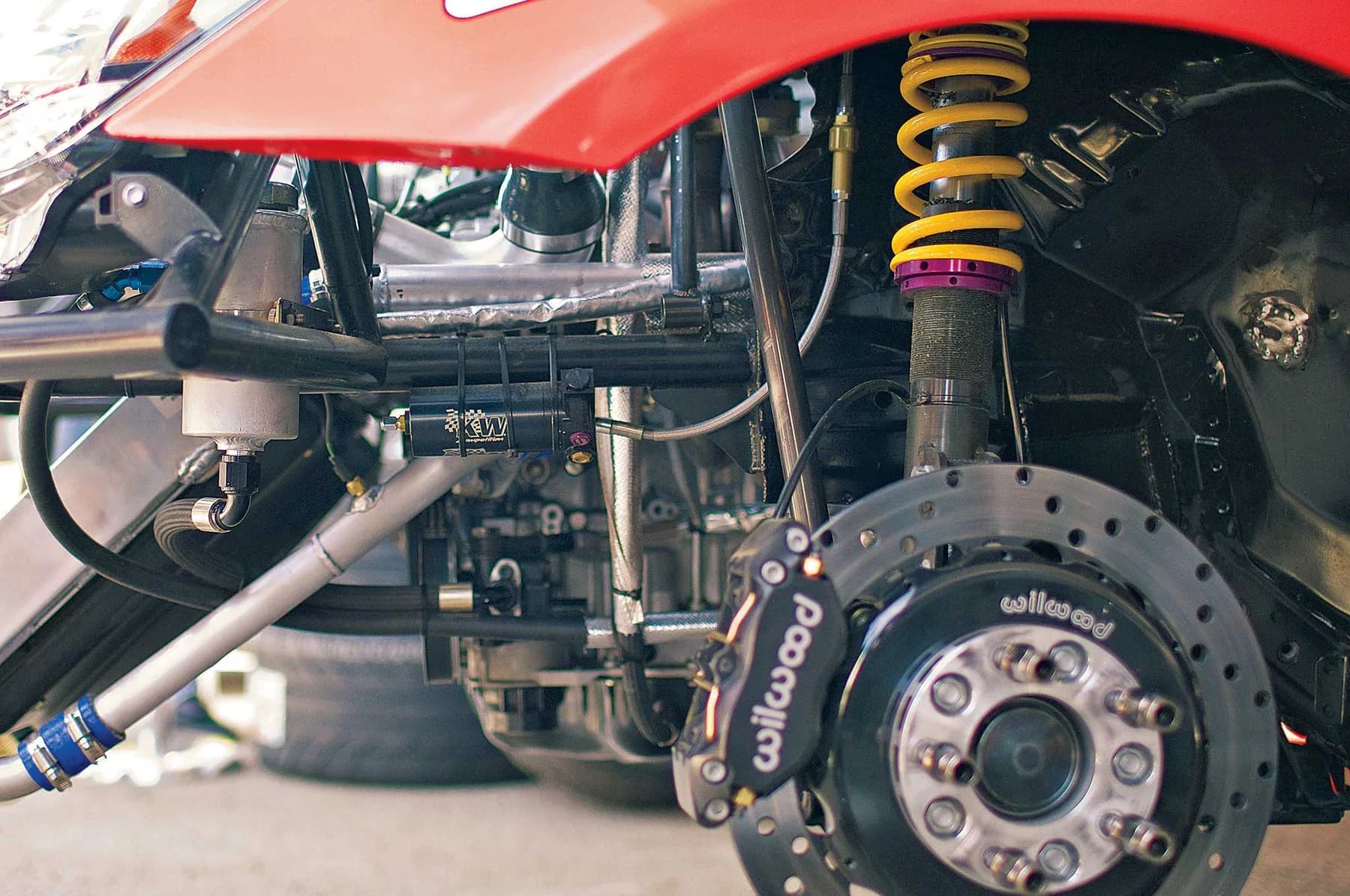
Now buy coilovers, and buy sensible ones. You want adjustable ride height, spring rates in the ballpark for your chassis, and rebuildable damping. You do not want the cheapest set on the market with rates chosen for a photograph.
While you are in there:
- Bushings. Worn rear subframe and control arm bushings make the car vague and unpredictable at exactly the moment you need clarity. Polyurethane or spherical, depending on how much noise you can tolerate.
- Alignment. More caster if the chassis allows it, which gives you self-steer and helps the wheel come back on its own. Modest negative camber up front, close to zero at the rear, and toe set for stability rather than turn-in.
- Steering rack limiters or bumpstop spacers. A cheap intermediate step that stops the tires hitting the arches before you commit to a full kit.
Fourth: steering angle, if the car needs it
Now, and only now, look at an angle kit. Some chassis genuinely need one. Many are fine on a stock knuckle with limiters and good alignment for the first year or two.
What a proper kit does is change the front geometry so the outer front wheel is not fighting the inner one at full lock. Factory Ackermann geometry has the inside wheel turning further than the outside, which is right for a car cornering normally and wrong for a car at forty degrees of angle, where both fronts are sliding and want to point in roughly the same direction. A good kit reduces or reverses that, cuts scrub, and stops the car dragging itself to a stop mid-corner.
A cheap kit that only adds lock without fixing bump steer or roll centre makes the car worse. It will turn further and feel vaguer, and you will end up slower with more angle available.
Fifth: the hydro, last
Yes, last. A hydro handbrake is a correction and initiation tool, and if you fit one early you will use it to paper over the entries you never learned to do properly.
Two ways to plumb it. Inline into the existing rear circuit is cheap and simple, and it compromises your foot brake if anything goes wrong. A dedicated setup with its own master cylinder and, ideally, its own rear calipers leaves the foot brake untouched. Many venues have opinions about which they will pass at tech, so ask before you buy.
What is not on this list
Power. You do not need more power in your first year and probably not in your second. A car with modest torque that you can drive at full commitment teaches you more than one with enough to hide your mistakes.
Wheels are also not on this list, which will annoy people. Buy whatever cheap set fits the tires you can source in quantity, and spend the difference on entries.
Build the driver first. The car will tell you what it needs once you can actually hear it.