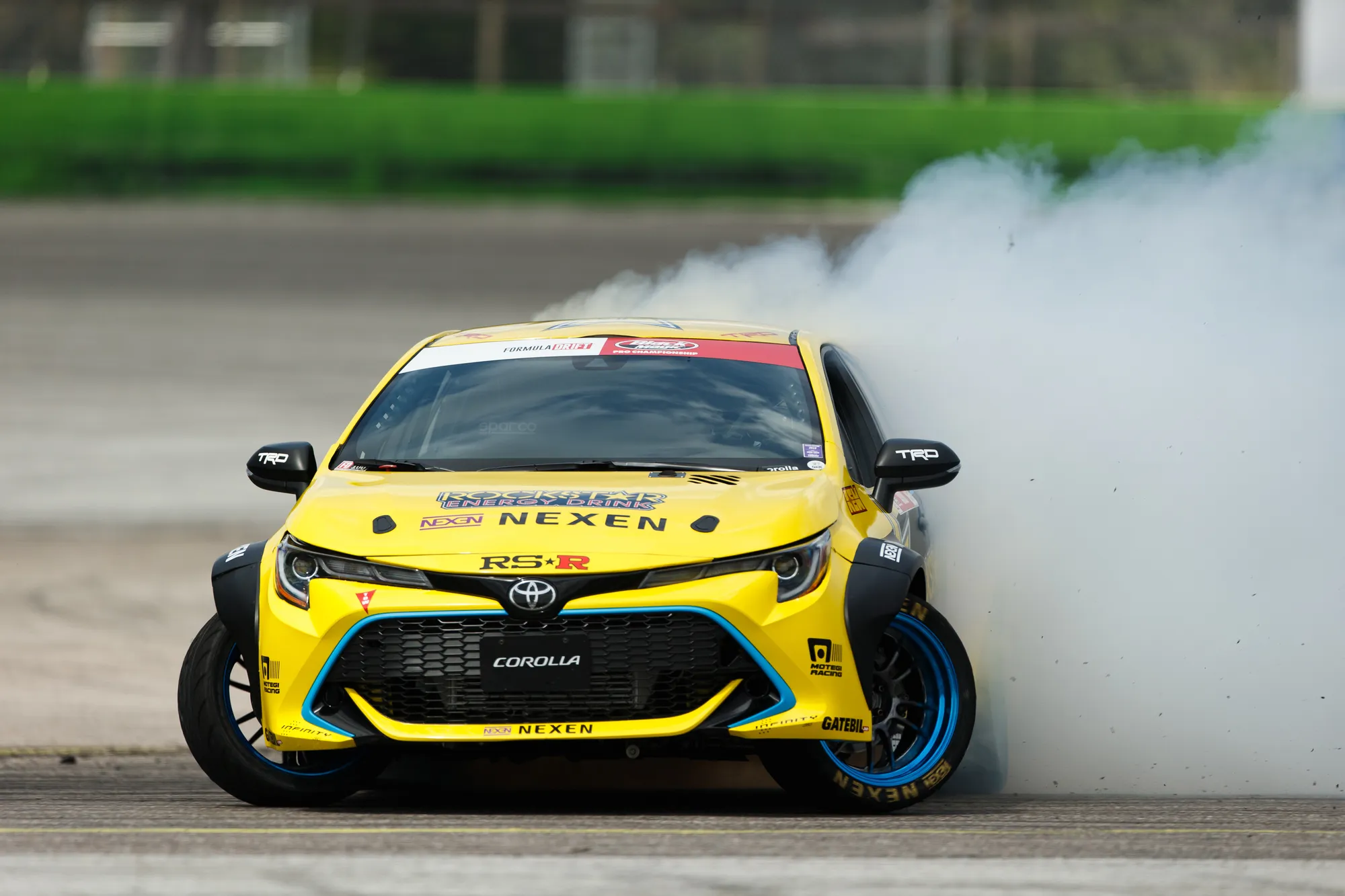
Photo: Toyota Every drift car eventually hits the same wall: the steering runs out before the slide does. An angle kit moves that wall. Wisefab claims 65-plus degrees of lock for its S14/S15 front-rack kit, and its U.S. store lists front kits at $1,880 for an E36 or E46 and $3,300 for a rear-drive Tesla Model 3.
More lock is the headline. The geometry that comes with it is what you are paying for.
What the kit is really changing
Wisefab's E46 kit bundles knuckle add-ons with Ackermann adjustment, lightweight lower arms, assembled tie rods and adjustable top mounts. Its pages promise minimal bump steer at high angles, a higher front roll center on lowered cars and geometry that keeps the wheel from getting stuck at full lock.
Ackermann, in drift terms
Ackermann geometry sets how much more the inside wheel turns than the outside one, so the wheels can circle a common turn center. In a drift the front wheels point toward the side where that center sits, so in theory a drift car wants reverse Ackermann.
In practice each setting is a trade. Positive Ackermann is easier to drive but scrubs the trailing wheel, costing speed and lock. Parallel steering gives the most lock and suits drivers who won't give up speed. Reverse is theoretically fastest, hard to control at high lock and rarely used.
Most drift cars also keep the factory rack position, so Ackermann shifts through the sweep. Wisefab's example car runs reverse at 30 degrees, parallel at 50 and positive at 65, and its kits tune that with zero, 3 mm and 6 mm offset washers.
Bump steer, jacking, caster and camber
Bump steer (toe change as the suspension moves) follows the tie rods. GKTech's high-misalignment S-chassis tie rod ends, made for longer lower arms or aftermarket knuckles, come with shims that correct up to 25 mm of it.
Jacking and self-steer. Wisefab says it reworked its 350Z geometry so jacking at big angles doesn't upset the car and the wheel "always turns in the direction of movement."
Caster. Wisefab recommends 3.5 degrees for the S14/S15 front-rack kit Wisefab and 6 for the F-series BMW kit. It adds that caster alone is not enough; a combination of settings keeps trail and self-aligning torque consistent.
Camber and roll center. On the E36 kit, Wisefab notes the leading wheel gains positive camber at lock, which its geometry minimizes. The S14/S15 kit drops the ball joint 60 mm to raise the roll center, which Wisefab says can let the front anti-roll bar go.
Scrub radius. None of these pages gives a figure. They specify wheels instead: 135 to 140 mm of backspacing for the S14/S15 kit, and 17x8.5 ET30 wheels under factory 350Z fenders. If a kit widens the track, ask the maker what your offset does.
Three ways to more lock
Engineered kits. Knuckles or add-ons, arms, tie rods and mounts, designed together. The $2,900 S14/S15 front-rack kit even moves the rack to the front of the subframe, and is designed only for a BMW E36/E46 rack.
Cut and weld. Wisefab's DIY kit for the E36 and E46 has you cut the factory lower arm with a grinder, weld in an extension of up to 80 mm on an E46, and add a new ball-joint housing. You then fit a rack extender spacer and a lock stopper, and Wisefab warns the tire may rub the anti-roll bar at full lock.
Rack parts. This is the cheap end. ISR's offset rack spacers for the 240SX, $99.28 at Enjuku Racing, are sold to cure steering bind, which aftermarket knuckles make more common, instead of relocating the rack for more lock.
Tires, fenders and the rest of the bill
Lock needs room. Wisefab's E36 and E46 kits call for wider fenders or flares and tires no taller than 645 mm, a 235/40 R18. The S14/S15 kit allows 635 mm and may need the inner wheel wells trimmed on a lowered car. The narrow 350Z kit, $1,990, is the exception, sized for the factory fenders.
Add an alignment, which GKTech says is likely after fitting its tie rod ends. Set against a season of entries, tires and fuel, a kit at these prices is a serious line item.
Why pro cars run so much lock
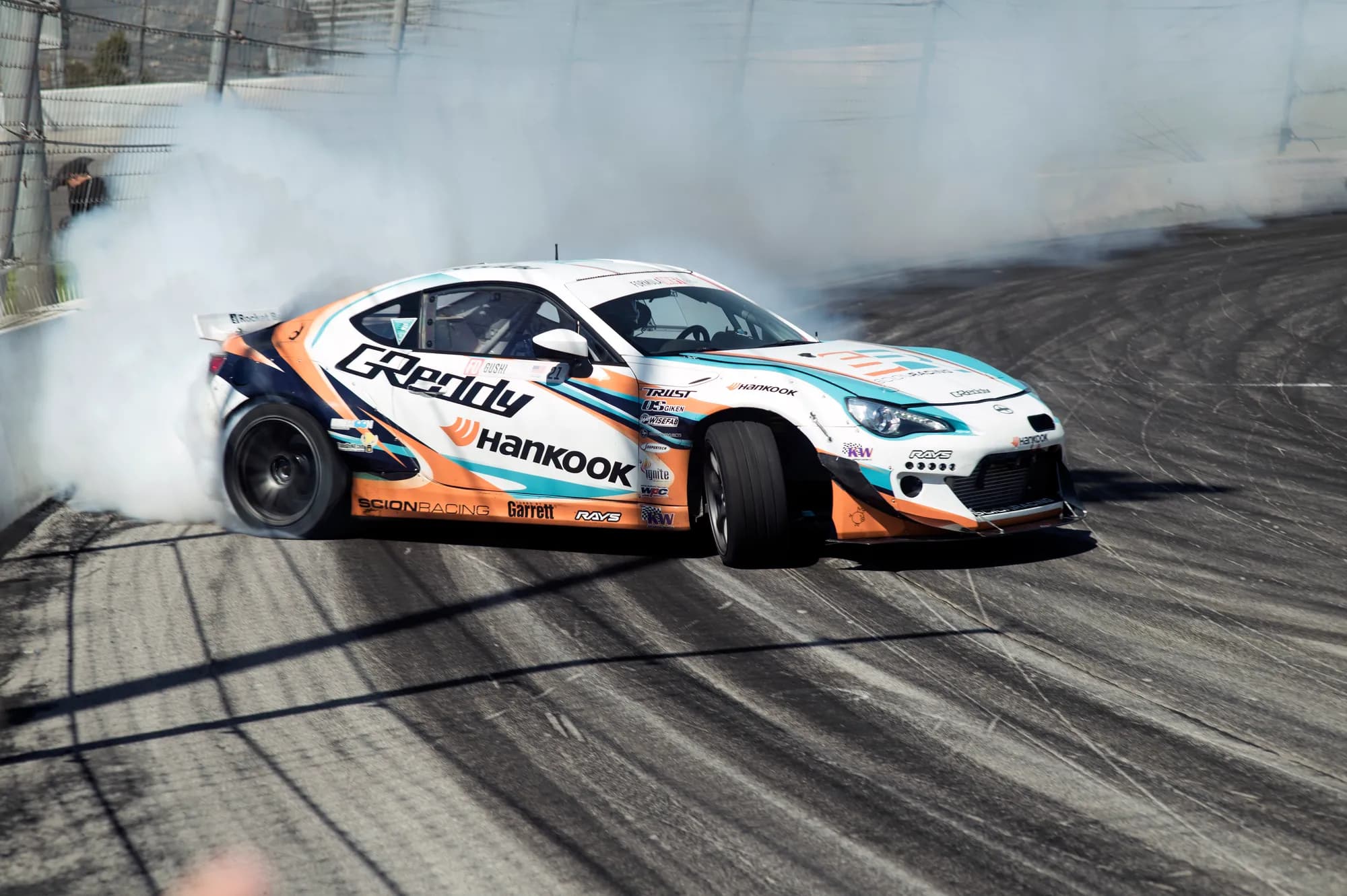
Wisefab's claims run from 55-plus degrees for the narrow 350Z kit Wisefab to 65 and up for its S14/S15 and F-series kits. Serious builds go there too: the 700-hp, 2JZ-swapped E46 that Drifted profiled in 2013 ran 65 degrees on handmade parts.
Think of lock as margin: the further the front wheels can turn into the slide, the more angle a driver can hold or rescue.
Street and inspection
GKTech sells its high-misalignment tie rod ends as legal only for competition vehicles that may never be registered or used on public roads.
In Britain, the MOT inspection manual fails a missing or badly adjusted lock stop where one was fitted as standard, and a steering linkage that fouls any part of the car. It lists welded repairs and excessive heat on highly stressed parts as unsafe modifications. A linkage modified to the extent that steering is affected counts as a dangerous defect. Rules elsewhere differ, so check yours before cutting anything.
When a beginner actually needs one
Usually later than you think.
Our rule of thumb: buy lock when you run out of it in the same place, run after run, in a car that is otherwise sorted. If the spins are random, the cheaper fix is seat time.