Pull out of a wet junction with any enthusiasm in a car with an open differential and you get the same show every time. One rear tire spins uselessly, the other does nothing, and you go nowhere with a lot of noise.
That is not a fault. That is exactly what an open diff is designed to do, and understanding why explains every limited-slip option you can buy.
The open diff problem in one paragraph
An open differential splits torque equally between both output shafts while allowing them to turn at different speeds. Equal torque sounds fair until you realize it means the wheel with the least available traction sets the number for both. If one tire can only hold 20 lb-ft before it spins, the other one gets 20 lb-ft too. The rest of your engine's output goes into tire smoke and disappointment.
Every limited-slip design is an answer to that single sentence.
Viscous: the one that is probably already dead
A viscous unit uses stacked plates in silicone fluid inside a sealed housing. Speed difference between the plates shears the fluid, the fluid thickens, and some torque gets dragged across.
They are smooth, silent and completely maintenance-free, which is a polite way of saying they cannot be serviced. They also fade slowly over 100,000 miles and give you no warning that they have gone. A huge number of Z cars and older Japanese coupes advertised as LSD cars are running what is functionally an open diff.
Check it before you pay extra for it. One wheel jacked up, car in gear, hand on the other wheel. If the free wheel spins with no resistance at all, you have your answer.
Helical and Torsen: the street answer
A helical limited slip uses meshing worm gears that bind against the housing under load. The result is a torque bias ratio, usually somewhere around 2:1 to 3:1, meaning the loaded wheel can receive two or three times the torque of the unloaded one.
It is progressive, quiet, requires no special fluid and no rebuild schedule. For a street car, an autocross car, or anything you drive to work, it is the correct choice roughly nine times out of ten.
The catch is that a helical unit multiplies whatever torque the slipping wheel can hold. Lift an inside rear wheel over a curb and that number is zero, and zero multiplied by three is still zero. Cars with brake-based traction control mask this well; cars without it just sit there and spin.
Clutch-type: the one with opinions
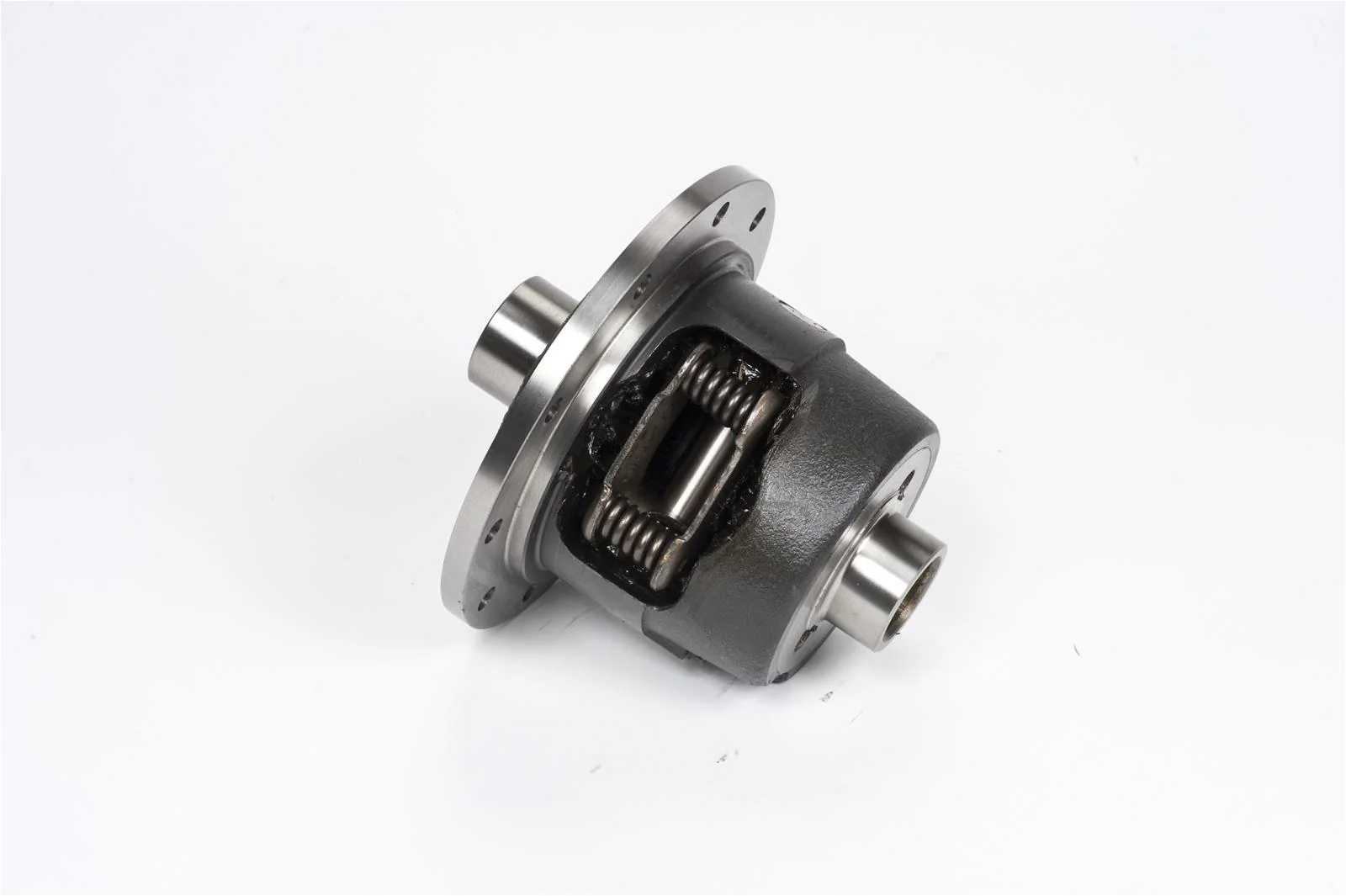
Stacked clutch packs, preloaded by springs, squeezed harder by ramps as torque rises. The ramp angles determine behavior:
- 1-way locks on power only, free on overrun. Least intrusive on corner entry.
- 1.5-way locks fully on power and partially off throttle. The common track compromise.
- 2-way locks in both directions. Stable, predictable, and it will fight you in a parking lot.
Clutch-types are rebuildable, tunable through preload and ramp changes, and they lock regardless of what the other wheel is doing. They also chatter in tight turns, demand specific gear oil with friction modifier, and lose preload as the plates wear. If you spend real time on track, this is the money.
The cheap options and the bad one
Brake-based systems that pinch the spinning wheel work better than snobs admit on the street and cook the brakes on track. Factory electronic diffs are genuinely good and expensive to replace.
Welding an open diff is free and appropriate on a dedicated car built for going sideways, which is somebody else's article. On a street car it destroys tires, loads the drivetrain and makes wet roundabouts a coin flip.
What to spend
A used factory Torsen out of a donor car remains one of the best value upgrades in the hobby. Budget somewhere in the $400–900 range for a used unit plus fluid and the labor to swap it, and considerably more if you are paying a shop for a full carrier install.
Aftermarket clutch-type units typically land north of a grand before install, plus rebuild kits every few seasons if you use them properly.
The take
Buy the diff for the driving you actually do, not the driving you post about. Most people are best served by a helical unit, fresh fluid and tires that cost more than the diff did.
A limited slip does not make a car faster in a straight line. It makes it predictable in the moment where predictability is worth the most, which is a much better thing to own.