Every era's supercar canon gets written by whoever sold the most posters. The Countach, the F40, the Diablo, the McLaren F1. Great cars, all of them, and also the reason nobody under thirty can name a single Cizeta.
These six were real, road-legal, and in several cases technically ahead of the machines that beat them to the wall of a teenager's bedroom. Some failed on merit. Most failed on timing, money, or a story too complicated to fit on the back of a trading card. Ranked from historical curiosity to genuine what-were-we-thinking.
6. Vector W8
American, angular, and built as though somebody handed a defence contractor a stack of car magazines and a deadline. Aerospace-flavoured construction, a twin-turbocharged Chevrolet-derived V8, and a cabin laid out like an attack helicopter cockpit.
Production numbers were tiny and the company's story is mostly ambition outrunning cash. As a driving proposition it was compromised in every direction, with a three-speed automatic doing duty behind an engine that deserved considerably better. As an artefact of late-eighties American excess it remains unbeaten.
5. Lamborghini Jalpa
The forgotten baby Lamborghini. A 3.5-litre V8, a targa top, and the direct ancestor of the idea that eventually produced the Gallardo and Huracan. It landed while Lamborghini was financially wobbling and never got the development budget it needed.
It is also the only Countach-era Lamborghini you could realistically drive on a Tuesday without a spotter, a chiropractor and a tolerance for third-degree burns.
4. De Tomaso Pantera
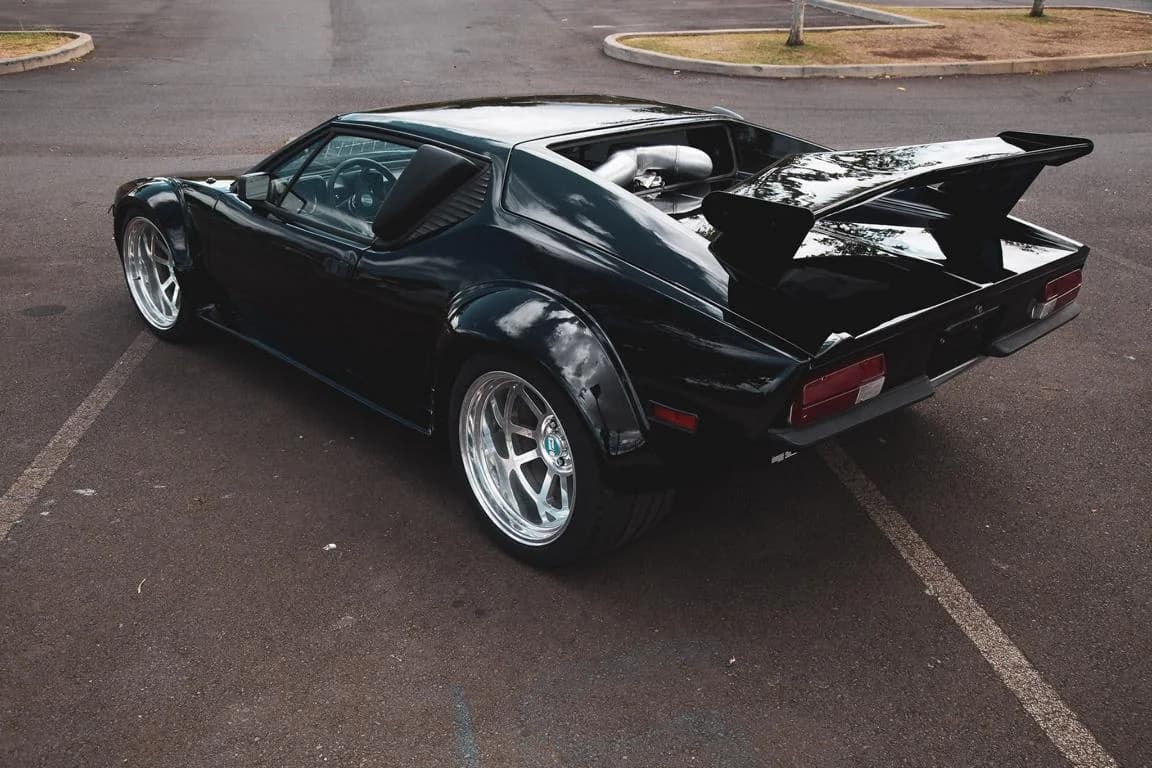
Italian body, American heart. A Ford 351 Cleveland V8 mounted behind the driver in a steel-bodied mid-engine chassis, sold in the United States through Lincoln-Mercury dealers. Cheap to fix by exotic standards, because the engine is a small block with parts available in every town in the country.
The Pantera's problem was never the concept. It was build quality and cooling on early cars, and the community has spent fifty years quietly solving both.
3. Cizeta V16T
Marcello Gandini drew a wedge for Lamborghini, Lamborghini softened it into the Diablo, and Cizeta went ahead and built the original shape anyway. Then it fitted a transversely mounted V16, built from two V8-derived halves with the power taken out of the middle.
Almost nobody bought one. The engineering was mad in a way that modern hypercars, with their committee-approved packaging and their simulation-verified everything, will never be again.
2. Jaguar XJ220
The most misunderstood supercar ever built. Jaguar showed a V12, all-wheel-drive concept, collected deposits, then delivered a twin-turbo V6 with rear-wheel drive. Buyers revolted, the early-nineties market collapsed underneath it, and the car spent three decades being filed under disappointment.
It was also, briefly, the fastest production car in the world, recorded comfortably north of 210mph in testing, with a chassis that people who have actually driven one rate extremely highly. The V6 was a race-derived engine rather than a compromise pulled off a shelf, and the car was enormous, wide and startlingly capable. The narrative buried it anyway.
1. Bugatti EB110
Before Volkswagen owned the name, an Italian revival built this. A 3.5-litre quad-turbocharged V12, all-wheel drive, a carbon-fibre chassis and scissor doors, in 1991. It was doing hypercar things a full decade before hypercar was a category anyone recognised.
The company collapsed, the car became a pub-quiz answer, and the specification still reads like something from ten years later. Nothing else here was that far ahead of its own decade.
Why this keeps happening
Being good is not enough. A car enters the canon when the story around it is simple enough for a fourteen-year-old to repeat at lunch. Fastest. Wildest. Most expensive. The one from the film.
The XJ220 had a complicated story. The EB110 had a company that died mid-sentence. The Jalpa had the misfortune of being sensible in a range built on excess. The canon has room for maybe three cars a decade, and the rest end up here, cheaper than they deserve, better than their reputations, waiting for somebody to look properly.
Which is the actual reason to care about this list. Cars that never made the poster wall are the ones still priced by what people remember rather than what they are, and that gap is the only bargain left in a market where every famous shape has already been discovered.