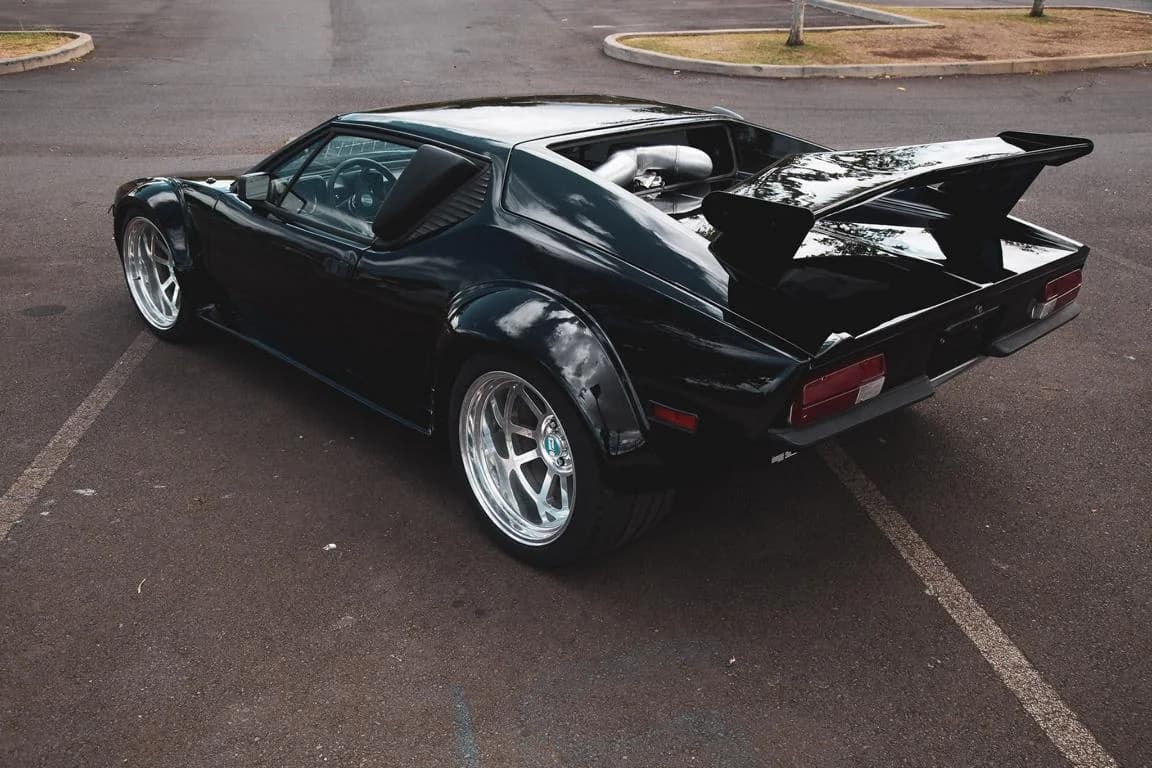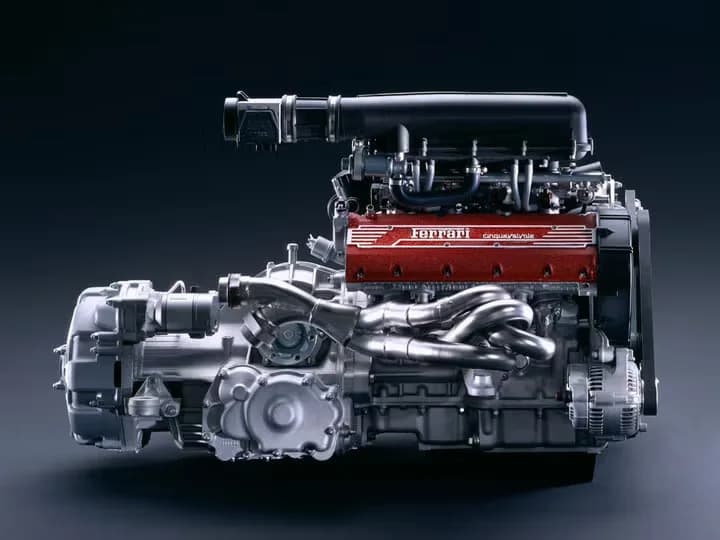
Two V8s, identical displacement, identical cylinder count, completely different noise. One shrieks like a superbike with a grudge. The other burbles like a boat idling into a marina. The difference is a single component, and it is the crankshaft.
What "plane" actually refers to
Look at a crankshaft from the end. On a cross-plane V8, the American default and the thing under most muscle car hoods, the four crank pins sit at 90-degree intervals, so from that view they trace a cross. On a flat-plane crank, all four pins sit on one plane, 180 degrees apart, like two inline-fours sharing a block.
That is the entire hardware difference. Everything else follows from it.
Why it changes the sound
Firing order is downstream of crank geometry. A flat-plane V8 fires left bank, right bank, left, right, perfectly alternating. Each bank produces evenly spaced exhaust pulses, exactly like an inline-four, and evenly spaced pulses produce that hard metallic scream.
A cross-plane V8 cannot do this. Its firing order hands one bank two consecutive firings at one point in the cycle. The pulses leaving each bank are unevenly spaced, and that irregularity is the burble. The classic American V8 rumble is, mechanically, the sound of an uneven exhaust schedule.
Cross both banks into one collector with 180-degree headers and you smooth the spacing out, which is why certain cross-plane race cars sound uncannily European.
Why it changes the revs
A flat-plane crank needs far less counterweighting. A cross-plane crank uses heavy counterweights to cancel secondary forces, and all that mass is rotating inertia the engine must accelerate and decelerate every time your right foot moves.
Strip the weight and you get:
- A lighter crank that spins up quicker and revs higher before it runs out of structural courage.
- Better per-bank exhaust scavenging, because evenly spaced pulses help drag the next charge through.
- Simpler, shorter, lighter headers, since you no longer need long crossover pipes to even out the pulse spacing.
That is how Ferrari took the 458's 4.5-litre to 9,000rpm, and how the 355 was already screaming to 8,500 back in the mid-nineties.
The catch is vibration
Flat-plane V8s carry unbalanced secondary forces that a cross-plane layout naturally cancels. In practice that means more high-frequency vibration transmitted into the structure of the car, which is why flat-plane engines historically lived in machines where a bit of buzz counted as personality rather than a warranty claim.
The fixes are engineering rather than magic. Stiff blocks, careful engine mounting, obsessively balanced rotating assemblies, and an owner base that has decided the vibration is part of the appeal.
The same engine family, both ways
The cleanest proof sits inside Ferrari's F136 V8 family, shared with Maserati. Ferrari's versions use flat-plane cranks and rev to the moon. Maserati's versions of the same basic architecture use cross-plane cranks, because a grand tourer wants low-rpm smoothness and a rumble, not a shriek at nine grand.
Same block family. Different crank. Two completely different characters. Nothing demonstrates the principle more clearly.
Ford ran the trick in reverse with the 5.2-litre Voodoo V8, a flat-plane engine in a Mustang that spins past 8,000rpm, which proves the layout is not inherently exotic. It is inherently focused.
Which is better
Neither, and the question is wrong. A flat-plane crank is a decision to prioritise throttle response, rev ceiling and per-bank exhaust tuning over low-rpm smoothness and lazy torque. A cross-plane crank is the opposite trade, made by people who wanted a different job done.
Turbocharging has blurred the argument further. Once you are forcing air in, the exhaust-tuning advantage of even pulse spacing matters less and turbo packaging matters more, which is part of why the turbo-era exotics never sounded the way the naturally aspirated ones did.
If you want to know what a car was built for, look at the crankshaft. It tells you what the engineers actually cared about before you read one line of the spec sheet.