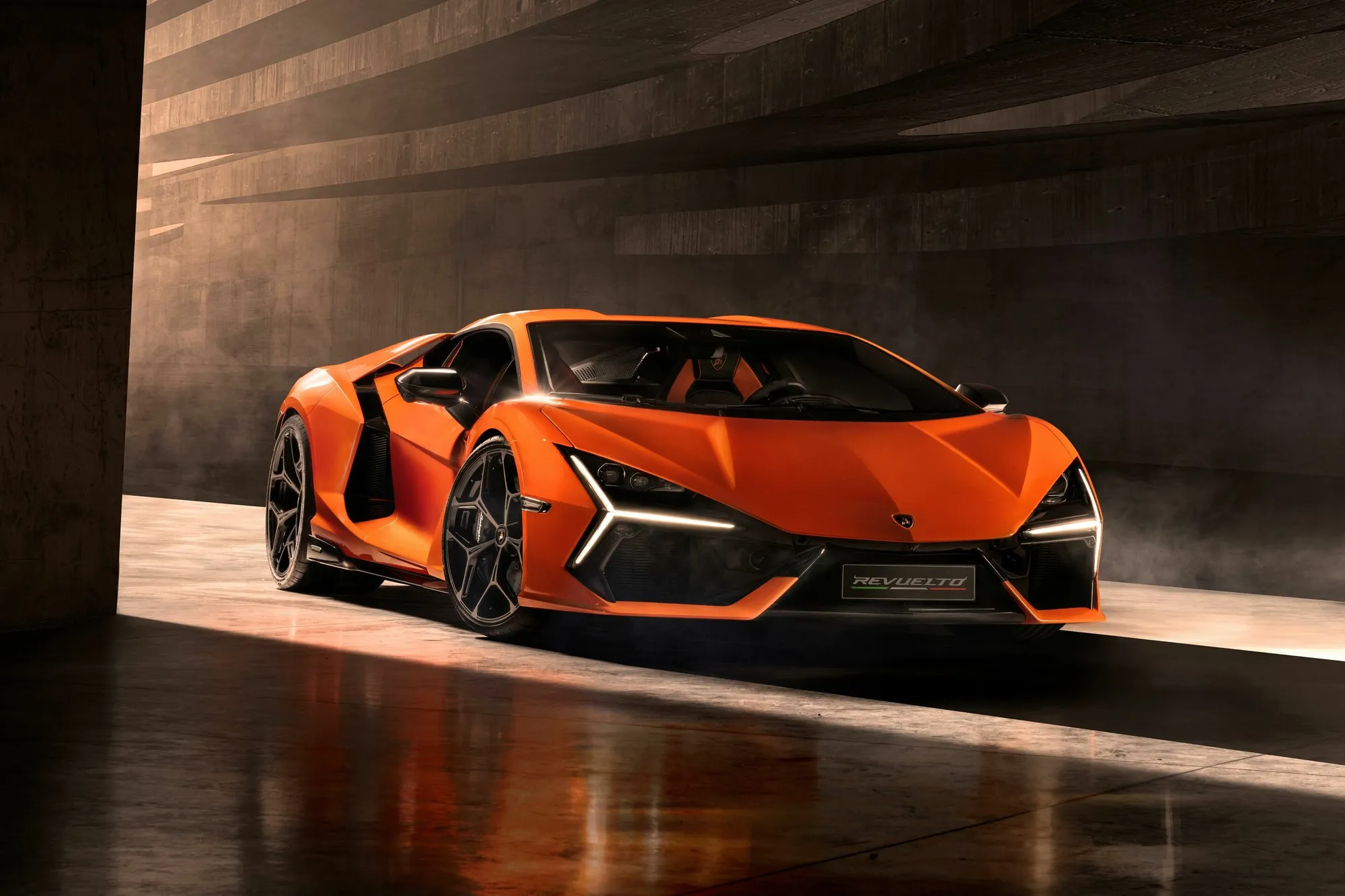
Photo: AUDI AG. The Lamborghini Revuelto.
Hybrid now describes headline cars from Ferrari and Lamborghini, and before them Honda's second NSX, but the label hides very different hardware. The useful question is where the electric motors sit. Location decides whether a motor fills in the engine's response, drives the front wheels, moves the car with the engine off or recovers energy under braking, and it shapes how much the whole car weighs.
A motor between the engine and the gearbox
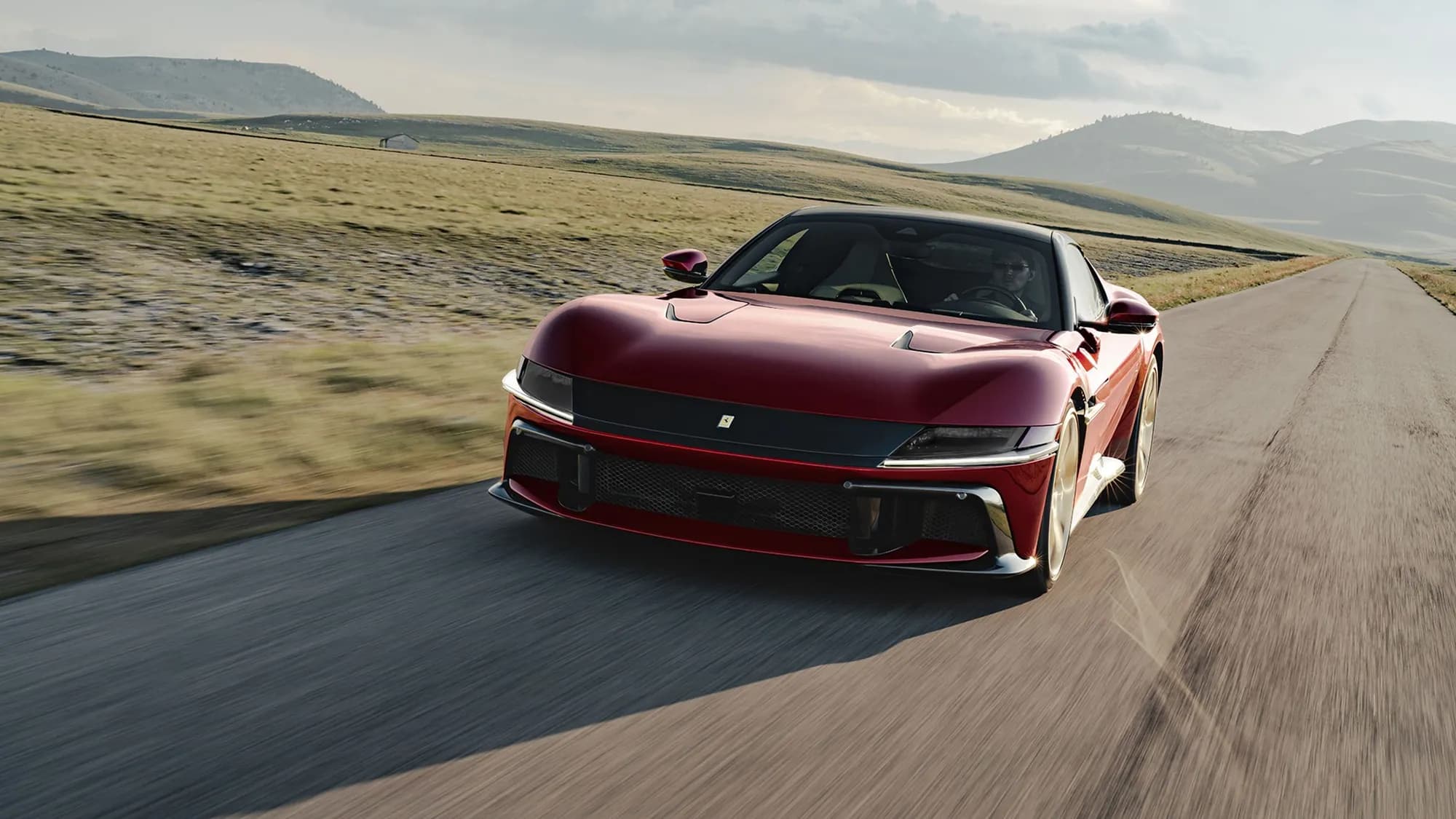
Ferrari's 296 GTB is the clearest single-motor example. Ferrari pairs a 663 cv, 120-degree V6 with an electric motor of up to 122 kW (167 cv) for a combined 830 cv. The motor, which Ferrari calls an MGU-K after its Formula 1 lineage, sits between the engine and the eight-speed dual-clutch gearbox. A clutch Ferrari calls the Transition Manager Actuator can disconnect the engine so the car runs on electricity alone. Ferrari's 296 GTB release
Ferrari gives that one motor four jobs: charging the 7.45 kWh battery, starting the V6, adding torque and power, and driving the rear wheels in the all-electric eDrive mode, which covers up to 25 km at a maximum of 135 km/h. Ferrari also credits the plug-in system with cutting pedal response times to zero. Because the motor is a compact axial-flux design, it shortened the powertrain, which helped give the 296 a wheelbase 50 mm shorter than Ferrari's previous mid-rear-engined berlinettas. Ferrari's 296 GTB release
Honda's second-generation NSX used the same location for one of its three motors. Its 2015 launch release describes a direct-drive motor housed between the twin-turbo V6 and the nine-speed dual-clutch transmission, supporting acceleration, braking and shift performance. Honda's NSX release
Motors on the front axle
Put motors at the front and the job changes. The NSX added a twin-motor unit with two independent motors driving the front wheels, which Honda used to distribute torque between left and right for torque vectoring as well as to help acceleration and braking. Its Quiet mode allowed electric-only driving at lower speeds for short periods. Honda's NSX release
Ferrari's SF90 Stradale, the brand's first plug-in hybrid, uses three motors: two independent units on the front axle and a third at the rear between the engine and the gearbox. Ferrari quotes a maximum of 1,000 cv and lists electric-drive power at 120 kW. Ferrari's SF90 Stradale page
Lamborghini's Revuelto applies the idea to a naturally aspirated V12. Its launch release describes two front axial-flux motors and a radial-flux motor positioned above an eight-speed dual-clutch gearbox, the first dual-clutch on a 12-cylinder Lamborghini, with all-wheel drive available even in fully electric mode. Lamborghini's Revuelto release Lamborghini quotes 1,015 CV combined from the 6,498.5 cc V12 and its three motors. Lamborghini's Revuelto page
The common thread is a pair of electric motors on the front axle. They add driven front wheels, and Honda used its pair to split torque between the left and right wheels, the job it called torque vectoring.
The battery is a power buffer
These are not long-range batteries. Ferrari sized the 296's at 7.45 kWh, and Lamborghini describes the Revuelto's pack in terms of power rather than capacity, as a high-specific-power battery rated at 4,500 W/kg. Ferrari's 296 GTB release Lamborghini's Revuelto release
How that energy is spent is partly the driver's choice. The 296's eManettino selector has four positions. eDrive keeps the engine off. Hybrid, the default, manages power flows for efficiency and decides when the engine runs. Performance keeps the engine on so the battery stays ready to deliver full power. Qualify releases maximum performance at the cost of less battery recharging. The car recovers energy through regenerative braking at the rear axle in normal braking and when ABS intervenes, and it uses a brake-by-wire system. Ferrari's 296 GTB release
Those mode descriptions are the important detail behind any combined output figure. Ferrari created one mode specifically to keep full power available and another that trades charging for maximum output. In its own descriptions, full power depends on keeping the battery ready, which is why the modes exist.
The weight bill
Motors, inverters and batteries add mass, and the 296 release is open about how Ferrari offset it. The company says the hybrid system's weight was balanced partly by a V6 that weighs 30 kg less than the V8 in its previous berlinettas, partly by extensive use of lightweight materials, and partly by fitting a single electric motor driving only the rear wheels. With optional lightweight content, it quotes a dry weight of 1,470 kg. Ferrari's 296 GTB release
That is the trade in plain terms. One motor between engine and gearbox delivers response, engine starting and short electric running with less added hardware, which is why Ferrari lists it as a weight saving. Front-axle motors add driven front wheels and torque splitting, with more components to package.
Before quoting a hybrid supercar's total output, ask three questions. Where does each motor sit? What is the battery sized to do? Which mode produced the headline number? The answers reveal what the electricity is for, and they make cars with similar power figures much easier to tell apart.