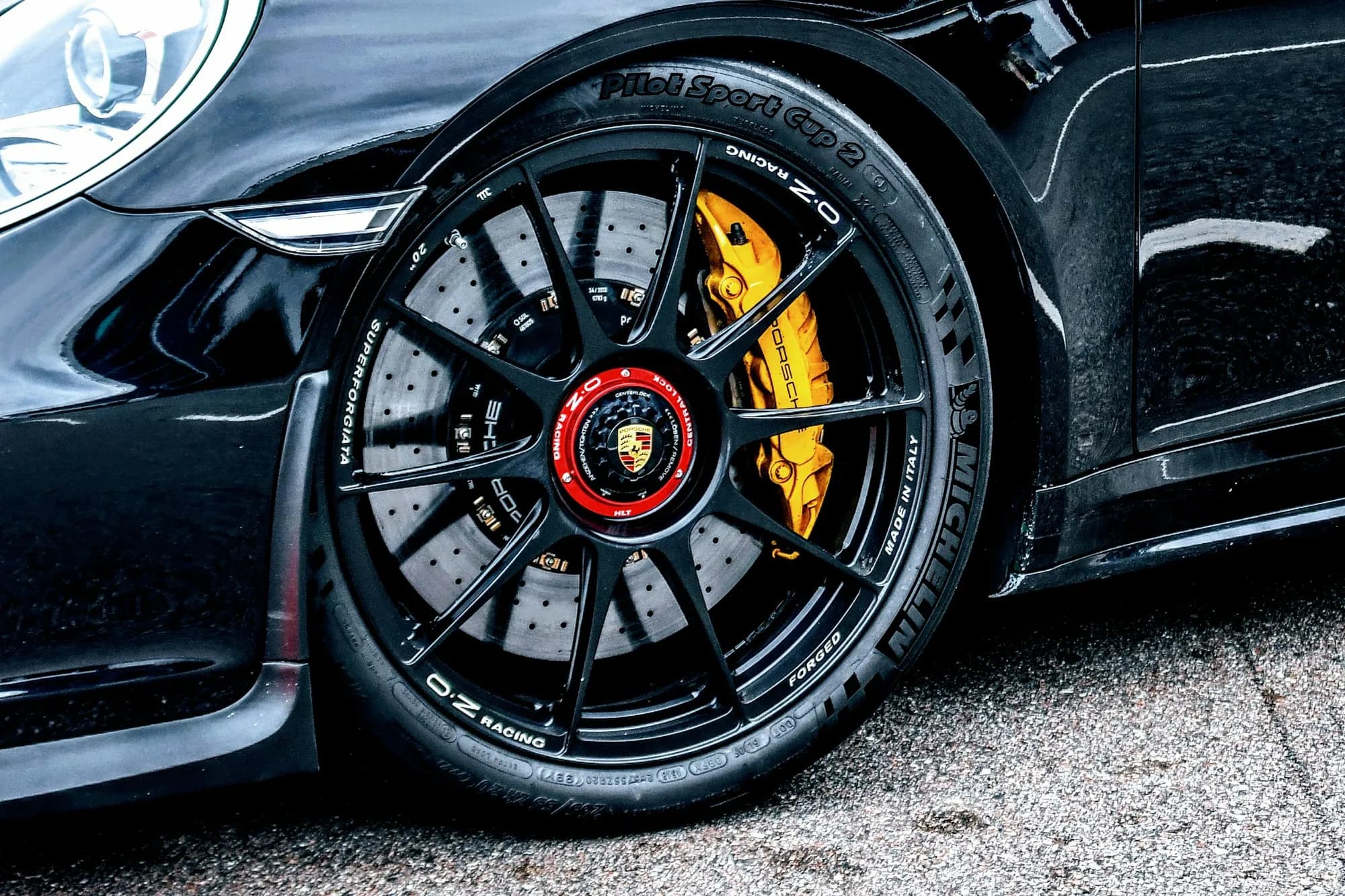
Photo: Carl Gelin / Unsplash. The yellow brake caliper of a Porsche 911 GT3 RS.
Gold calipers on a BMW M car signal carbon ceramic discs, the same type of brake Brembo supplies for machines such as the Ford Mustang GTD and the Mercedes-AMG GT Black Series. Carbon ceramic brakes are a familiar box on performance-car option lists and an often misunderstood one. Their advantages are measurable, and so are the conditions attached to the most impressive claims.
How a carbon ceramic disc is made
Brembo SGL Carbon Ceramic Brakes, a joint venture between Brembo and SGL Carbon, publishes an outline of its process. Short carbon fibers are mixed with phenolic resin and molded into the disc's friction ring, with the internal ventilation channels formed in the mold. After drilling, the part is heat-treated until the resin turns into a carbon-carbon material. Molten silicon is then infiltrated into that carbon structure, where it reacts to form silicon carbide, the ceramic that gives the disc its hardness and wear resistance. An anti-oxidation treatment seals pores to limit oxygen penetration at high temperature, and the friction surfaces are finished with diamond tooling because the material is too hard for ordinary tools. BSCCB's production process
The ceramic ring is joined to a metal bell. Because the two materials expand at different rates, the joint lets the ring slide radially, with springs spreading the loads. Every disc gets a non-destructive internal inspection, and its density and weight are checked after the critical heat treatments. BSCCB's production process
Carbon ceramic is also a family rather than one product. Brembo's original-equipment range includes CCM, a ceramic disc reinforced with carbon fiber; CCB, which adds a ceramic layer to each friction surface; Dyatom, built from five carbon-ceramic layers for track driving; and CCM-R Plus, a disc for racing, hypercars and top sports cars. Brembo's original-equipment range The CCM-R Plus uses long carbon fibers in a carbon matrix, was developed for endurance racing with organic race pads, and draws on Brembo's experience making carbon discs for Formula 1. Brembo's CCM-R Plus page The material also has design pedigree: Brembo received its first Compasso d'Oro award in 2004 for the design of its carbon ceramic disc braking system. Brembo's history
The weight case
Weight saving is the benefit every manufacturer source agrees on. BSCCB says a carbon ceramic disc weighs up to 50% less than a cast iron disc, saving up to 25 kg across a vehicle, and links the lower unsprung mass to better handling and acceleration. BSCCB's braking performance page Brembo's Mustang GTD case study gives the same proportion for that car's 420 mm front CCB discs: roughly half the weight of a cast iron disc of similar size. Brembo on the Mustang GTD
BMW's figures put it in a more familiar context. It lists the 2025 M3's optional M Carbon ceramic brakes, identified by gold calipers, as about 30 pounds lighter than the standard M Compound brakes, and ties the reduction in unsprung mass to agility. BMW's 2025 M3 release For the M3 CS Handschalter, BMW quotes 31.5 pounds saved over the M Compound brakes. BMW's M3 CS Handschalter release
Heat and fade
The second benefit is behavior under repeated hard stops. BSCCB says cast iron discs suffer fade as heat builds, while carbon ceramics hold a stable friction coefficient above 800°C. BSCCB's braking performance page Brembo describes its CCM disc as deforming very little at high temperature and keeping its braking force consistent through repeated use. Brembo's CCM page For CCB, it claims a stopping distance 3 meters shorter than cast iron in its 0–100 km/h braking test. Brembo's CCB page
Treat those as manufacturer test claims. They show what the material can do on a correctly specified system. They do not tell you how a particular used car, with unknown pads and an unknown history, will stop.
Lifespan claims come with conditions
The longevity claims are the boldest. Brembo says CCB discs last at least four times longer than cast iron and can even outlast the vehicle. Brembo's CCB page BSCCB says that carbon ceramic discs used mainly on the road can last the life of the vehicle, and that a set going beyond 200,000 km is not unusual. BSCCB's braking performance page
The road-use condition is part of that claim. Brembo also makes discs specifically engineered for track work, such as Dyatom, which Brembo says is built to withstand hard track use. Brembo's Dyatom page Use shapes the hardware, and it should shape an owner's expectations too.
That leads to a few practical rules. Treat pads as part of the system and follow the vehicle or brake manufacturer's specification rather than a generic recommendation. On a used car, have a specialist familiar with the system assess the discs, and do not assume a lifetime claim applies to a car with track days in its history. Keep the inspection report with the car's records.
Carbon ceramics are first a weight and heat-management upgrade. The durability story is real, but it is written for a specific kind of use. Decide based on how you actually drive, and value the option on a used car according to the condition of the parts fitted to it.