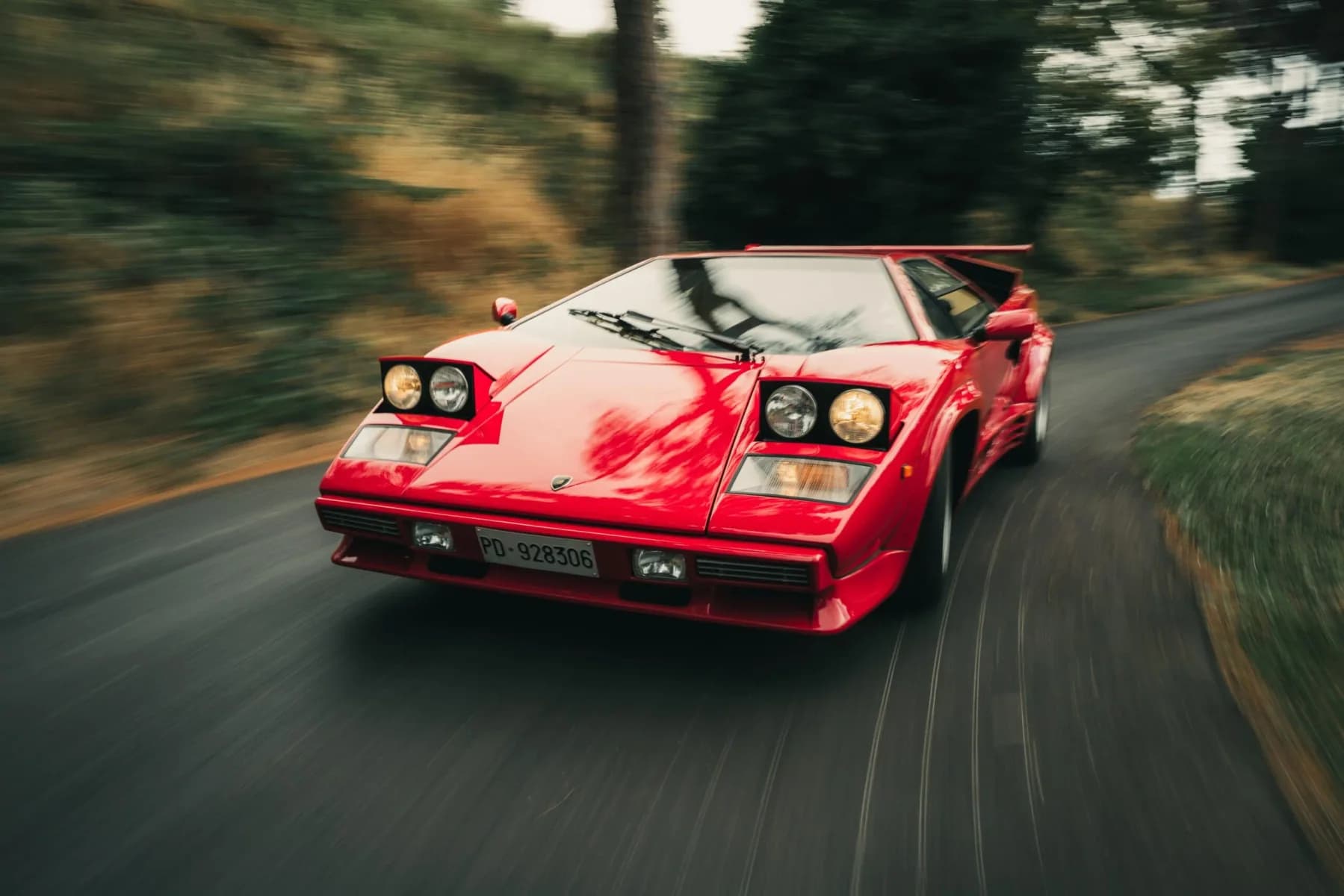
Ask an owner to be honest about a Countach and you get the same list every time. The clutch is a leg press. The visibility is theoretical. You reverse by opening the door and perching on the sill, looking back over the rear arch like a forklift operator. The pedals sit offset because the front wheel arches stole the footwell.
Then ask whether they would sell it.
It lost on paper, constantly
Through most of the Countach's 1974 to 1990 run, a Porsche 911 Turbo would have been quicker point to point, easier to drive fast, more reliable and cheaper to run. Any number of front-engined grand tourers would have been more comfortable at speed and less likely to cook the cabin.
That was true when the car was new and it is true now. Assessed strictly as transport, the Countach is a bad car that happens to be very fast in a straight line, provided the road is smooth and you are feeling brave.
The later cars did not fix this so much as decorate it. Wider arches, fatter tires and a wing that traded top speed for the look of top speed. Lamborghini understood exactly which product it was selling.
And it did not matter in the slightest
The Countach was never sold as transport. It was sold as an image, and it performed that job better than any car before or since. Gandini's wedge at Bertone sat so far outside what a car was supposed to look like that it reset the entire category in one move.
For two decades, every kid's mental picture of the word supercar was that shape, in red, on a bedroom wall. The Countach's real product was desire. The driving was a side effect, and frequently a disappointing one.
The spec sheet was never the argument
This is the part the modern internet cannot process. Cars now get evaluated with lap times, 0-60 figures quoted to the hundredth and quarter-mile traps, and by those measures a mid-priced performance sedan buries a Countach without effort.
Fine. Nobody ever put a poster of a fast sedan on their wall. Nobody's pulse changes at the sound of something merely quick. The Countach did something to people that no lap time has ever managed, and it did it while being genuinely awkward to operate.
The LP400 was the pure one, narrow and light with the periscope roof channel. Later cars added flares, wider rubber, an optional wing that cost top speed, and finally the 25th Anniversary revisions overseen by Horacio Pagani before he went off to build his own cars. Enthusiasts will argue forever about which version counts as the real one. Everyone who was not there pictures the wide one with the wing.
What we traded away
Supercars have drifted toward being objectively excellent. Modern exotics are quiet, cool, easy to see out of, comfortable over distance, and fast enough that the limiting factor is the driver's nerve rather than the machine. That is genuine progress and this is not an argument against it.
The trade is legible, though. A Huracan is a better car than a Countach in every measurable dimension and it will never be as much of an event, because a real part of the Countach's magic was that it plainly did not care about you. The doors, the heat, the visibility, the noise. The difficulty was the product.
The take
Stop grading old supercars against modern rubrics. A Countach measured against a current mid-engine car looks pathetic on every axis, and the comparison explains absolutely nothing about why the thing exists or why values went where they went.
Judge it against the job it was hired for. It had to stop traffic, sell posters, and make the idea of Lamborghini bigger than the company's balance sheet ever justified. It did all three for sixteen years on a design that was already finished before most of its rivals started.
The right question was never whether it was good. It is whether anything built since has made a fifteen-year-old stop walking and stare. On that test the Countach is still undefeated, and half the cars that would beat it around a circuit have already been forgotten.