Plenty of road cars borrow a racing name. The Huracán STO borrowed the race car. The letters stand for Super Trofeo Omologata: a homologated, road-legal take on Lamborghini's Huracán Super Trofeo race car. It kept the parts that matter: a naturally aspirated V10, drive to the rear wheels only, a carbon body and a rear wing you set by hand.
A race car with a registration
Lamborghini revealed the STO in November 2020, with first deliveries planned for spring 2021. Lamborghini says the car concentrates its motorsport know-how, and its rear fenders are derived from the Huracán Super Trofeo EVO racer.
One comparison sums it up. The road car's 640 CV (Italian metric horsepower, the same unit as PS) edged out the 620 CV of the Super Trofeo race car, which made 570 Nm. In Europe the STO listed at €249,412 before tax.
V10, rear drive, no turbos
The 5.2-liter V10 makes 640 CV (470 kW) at 8,000 rpm and 565 Nm at 6,500 rpm. Lamborghini quotes 0-100 km/h in 3.0 seconds, 0-200 km/h in 9.0 seconds and a 310 km/h top speed. In US terms that is 631 hp and 417 lb-ft, sent only to the rear wheels. The gearbox is a seven-speed dual-clutch.
The chassis changes read like a race shop's worksheet. Lamborghini swapped its Dynamic Steering system for a fixed, more direct ratio. The car also has rear-wheel steering. MagneRide 2.0 dampers, a wider track, stiffer bushings and specific anti-roll bars completed the job.
The cofango and the carbon diet
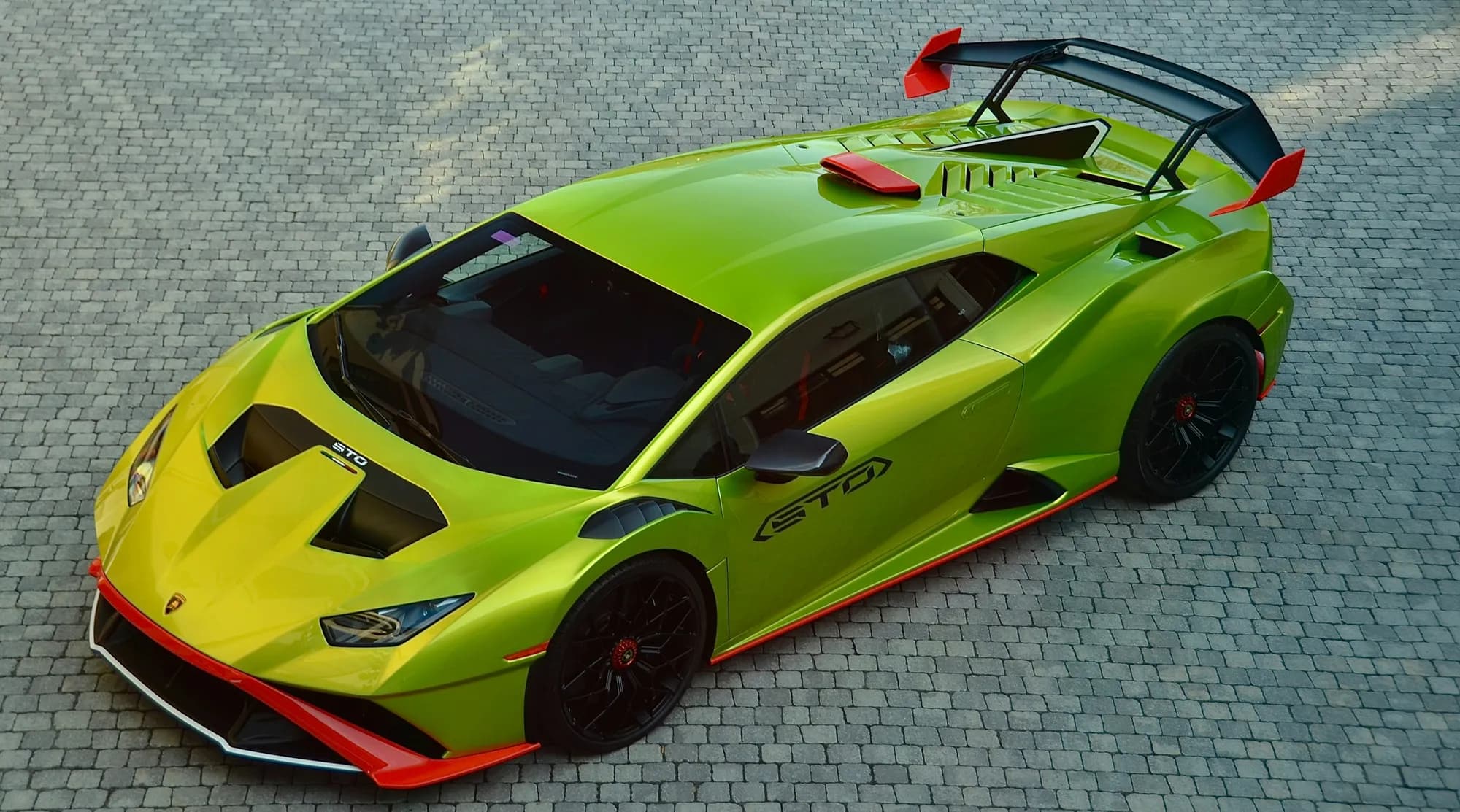
The signature piece is the cofango, a single body component that combines the bonnet and front fenders. The name joins the Italian cofano (bonnet) and parafango (fender). The one-piece carbon part also takes in the front bumper, saving weight and smoothing airflow around the wheel arches.
Carbon fiber makes up more than 75 percent of the body panels. Lamborghini also fitted a windscreen it says is 30 percent lighter, magnesium wheels and less sound deadening. The rear fenders use an aerospace-style sandwich construction that needs 25 percent less carbon fiber for the same rigidity.
The result is a dry weight of 1,339 kg, or 2.09 kg per CV. That is 43 kg less than the Huracán Performante.
Aero you can read from the grandstand
Up front, ducts in the bonnet feed air to the central radiator and add downforce, and a new splitter steers air toward a reworked underbody. Louvers above the front wheels bleed pressure out of the wheelhouses.
At the back, NACA ducts in the rear fenders feed the engine intake. An air scoop keeps the engine bay cool, and a shark fin sharpens the car's behavior in corners. The fin also guides airflow onto the rear wing, a slotted design with three manually adjustable positions.
At launch, Lamborghini claimed 53 percent more downforce than the Performante and 37 percent better overall aerodynamic efficiency.
Brakes, modes and a data logger
The brakes use Brembo CCM-R carbon-ceramic discs, which Lamborghini says are derived from Formula 1, along with dedicated brake cooling and a slightly longer pedal. Against conventional carbon-ceramic discs, Lamborghini claimed 60 percent more stress resistance, 25 percent more maximum braking power and 7 percent more longitudinal deceleration.
The Anima selector offers three modes, each named for its job. Here is how Lamborghini describes them:
- STO is the road setting, for any road and any weather.
- Trofeo tunes the vehicle-dynamics system for maximum grip and neutral balance on a dry track.
- Pioggia calibrates it for road holding in the wet, changing how traction control, rear steering and ABS behave.
Lamborghini Connected Telemetry records data and video from two cameras for analysis in an app.
How the V10 bowed out
Two later Huracáns rounded out the family around the STO. The Tecnica shares the STO's 640 CV and direct steering but has a more versatile brief and a 325 km/h top speed, 15 km/h more than the STO. The Sterrato went the other way: 610 CV, all-wheel drive and a ride 44 mm higher than the Huracán EVO.
In May 2023 Lamborghini said the Huracán was sold out until the end of production, scheduled for 2024.
The send-off came in April 2024 with the STJ: 10 cars built on the STO, with adjustable race-derived dampers, 20-inch center-lock wheels, Bridgestone Potenza Race tires and revised aero. It added no power, yet lapped Nardò more than a second faster than the STO.
The Huracán's successor, the Temerario, is quicker on paper, with 0-100 km/h in 2.7 seconds and a 343 km/h top speed. What it does not have is a naturally aspirated V10 making peak power at 8,000 rpm and driving only the rear wheels. That is why the STO matters.