The most dangerous object on a trail is not a cliff. It is a recovery point failing under load with a steel hook on the end of a rope that has been storing energy like a drawn bow. Recovery gear is the only category in off-road where the cheap option can put a piece of metal through a windshield.
Buy it in this order.
Tier one: about $150, buy it before your next trip
- A shovel. A real one with a metal blade, not a folding entrenching tool.
- Two soft shackles. Rated, from a known brand, with the working load listed.
- A kinetic recovery rope sized to your vehicle weight.
- Gloves.
- A line damper, or a heavy jacket you are willing to sacrifice.
That kit handles the overwhelming majority of real-world stucks, which are not dramatic. They are a truck buried to the frame in mud or sand with a friend's truck twenty feet away.
Why a kinetic rope, not a tow strap
A kinetic rope is nylon and stretches roughly 20 to 30 percent under load. It stores energy on the stretch and releases it into the stuck vehicle, which means the recovery vehicle can get a rolling start and let physics do the pulling.
A tow strap is polyester and barely stretches. Using one for a snatch recovery transmits a shock load straight into whatever it is attached to, which is how bumpers get ripped off. Chains are worse: no stretch at all, and a chain that breaks becomes shrapnel with a return path.
Kinetic ropes have a life. UV, mud, grit inside the fibers, and repeated hard pulls all degrade them. Wash them, dry them, and retire them when the sheath is chewed.
The things that actually get people killed
This is the part to memorize.
Tow balls. People hook a strap over a hitch ball constantly. Balls have failed and departed the vehicle at high speed. There have been fatalities. A hitch ball is a shear-loaded part being used in tension by someone who has not thought about it.
Unrated hardware. A hardware store shackle, a clevis with no marking, a hook welded to a bumper by a guy with a stick welder. If the rating is not stamped on it, it is a guess.
Attaching to anything that is not a recovery point. Tie-down loops on a frame are for holding a vehicle on a trailer, not for absorbing a kinetic snatch. Find the factory recovery points or fit real ones.
Standing in the danger zone. If a line breaks, the energy goes somewhere. Nobody should be within one and a half rope lengths of either side of the line, and everyone should know where they are standing before anything is pulled tight.
Skipping the damper. A heavy blanket over the middle of the line drives failure energy into the ground instead of through the air.
When you actually need a winch
You need one when there is nobody else, when the recovery has to be slow and controlled, or when the terrain does not allow a run-up. Snow, off-camber, and technical descents are winch problems. Mud with a buddy present is a rope problem.
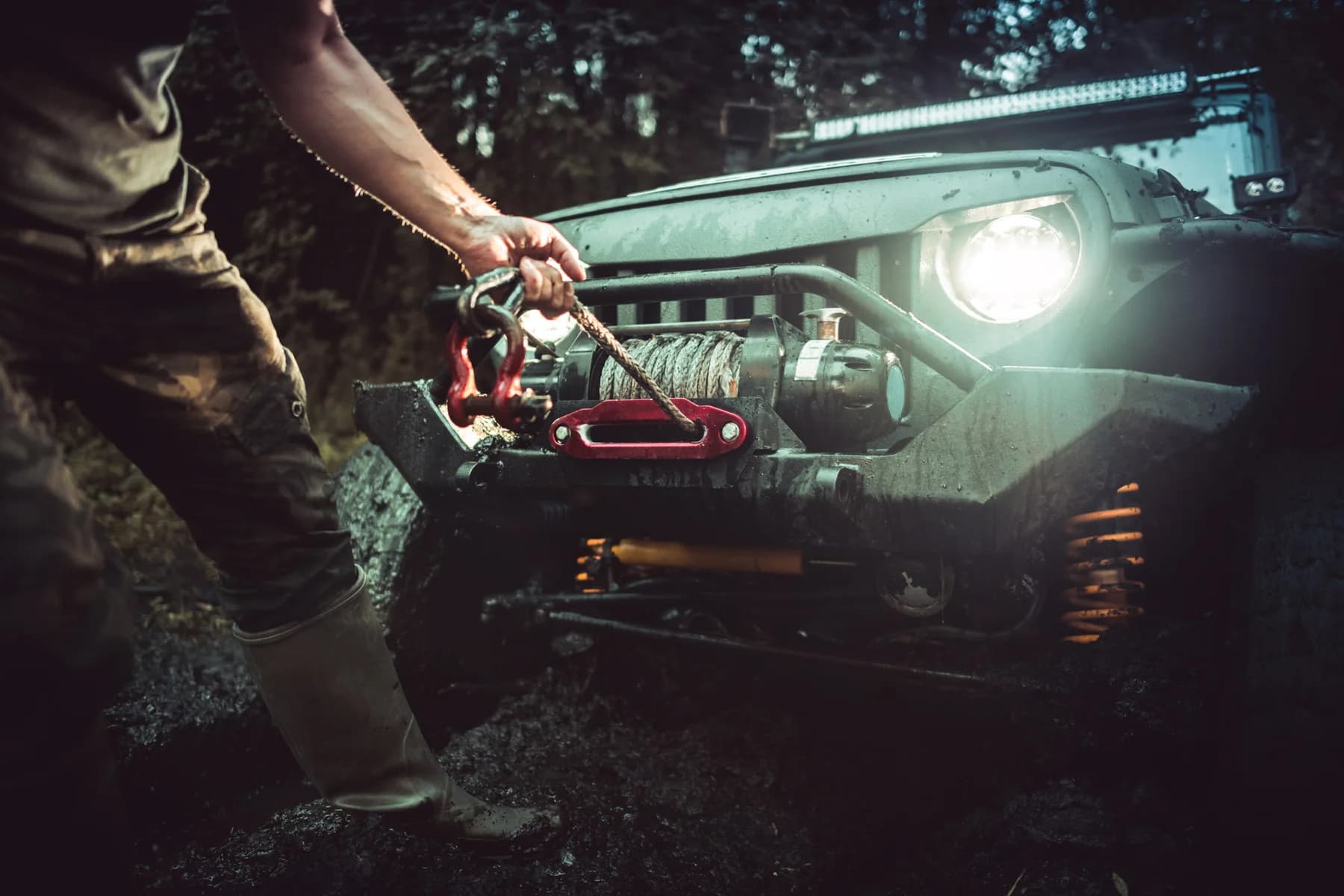
Budget honestly. A decent 9,000 to 12,000 pound winch, a mount that ties into the frame, and the wiring is a four-figure project on most vehicles. Synthetic line costs more than steel, weighs a fraction, and does not store the same lethal energy when it parts. Buy synthetic.
Add a tree saver strap, because running bare cable around a trunk kills the tree and damages the line. Add a snatch block, which redirects the line and roughly halves the load on the winch at the cost of doubling line pull length. Never put a snatch block on a kinetic rope.
Traction boards, in their proper place
Boards are excellent in sand and snow and mediocre in deep clay. They are also the tool most likely to be used incorrectly: keep your speed low, do not spin on them, and never stand behind a vehicle that is climbing out on boards. They launch.
The last thing
Buy the gear, then go practice with it on flat ground with a friend and nobody nearby. Learn how the rope loads, how the truck moves, and how loud the whole thing is before you learn it on a ledge at dusk with a phone at eight percent battery. Recovery is a skill. The equipment is just the part you can order.