Porsche says a first-generation Taycan needs 37 minutes to charge from 10 to 80 percent at 15°C. The updated car does it in 18, with 12 percent more capacity to fill. That comparison explains why the model-year line matters more on a Taycan than the styling does.
The shape has stayed familiar since 2019, but the choice now runs from a depreciated early 4S to a 1,092 hp track special.
The 2020 to 2024 cars set the template
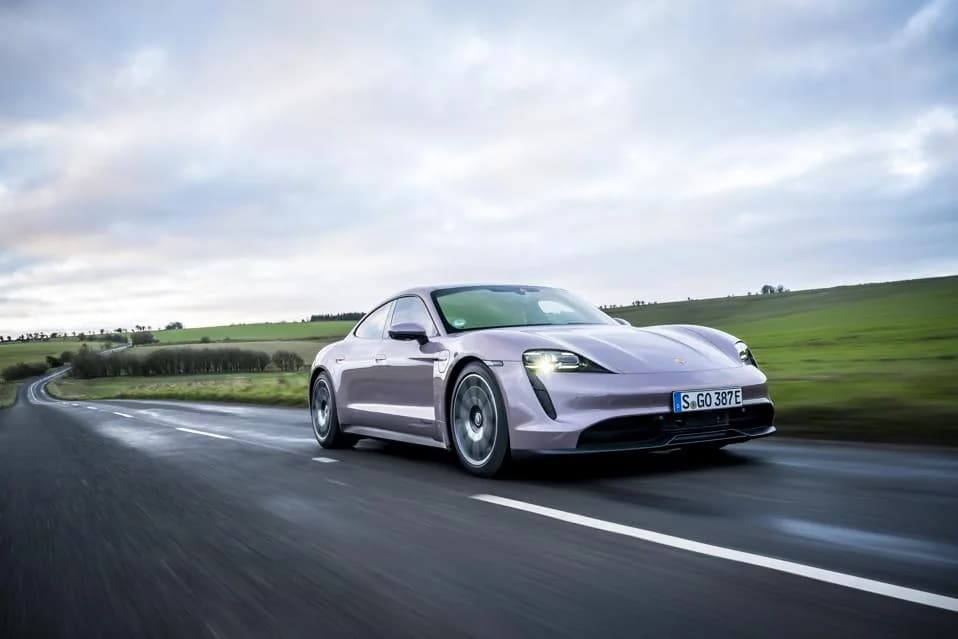
Porsche revealed the Taycan on September 4, 2019, as the first production car with an 800-volt system and a two-speed gearbox on the rear axle. The launch models were the Turbo and Turbo S, at $150,900 and $185,000 in the U.S. With overboost, the Turbo made up to 670 hp and the Turbo S 750 hp, and the 93.4 kWh Performance Battery Plus was standard.
The 4S followed that October at $103,800 with a 79.2 kWh battery and up to 522 hp, or $110,380 with the larger pack and up to 563 hp. Either version reached 60 mph in as little as 3.8 seconds, and deliveries began in spring 2020. A rear-drive base car came next at about $80,000 before destination, and the long-roof Cross Turismo and Sport Turismo widened the range.
The weak spots were range and charging. The Turbo S was first rated at 192 EPA miles and the Turbo at 201, later revised to 201 and 212 for 2021. The 2021 base car managed 200 miles with the small battery and 225 with the large one. Peak charging was 270 kW.
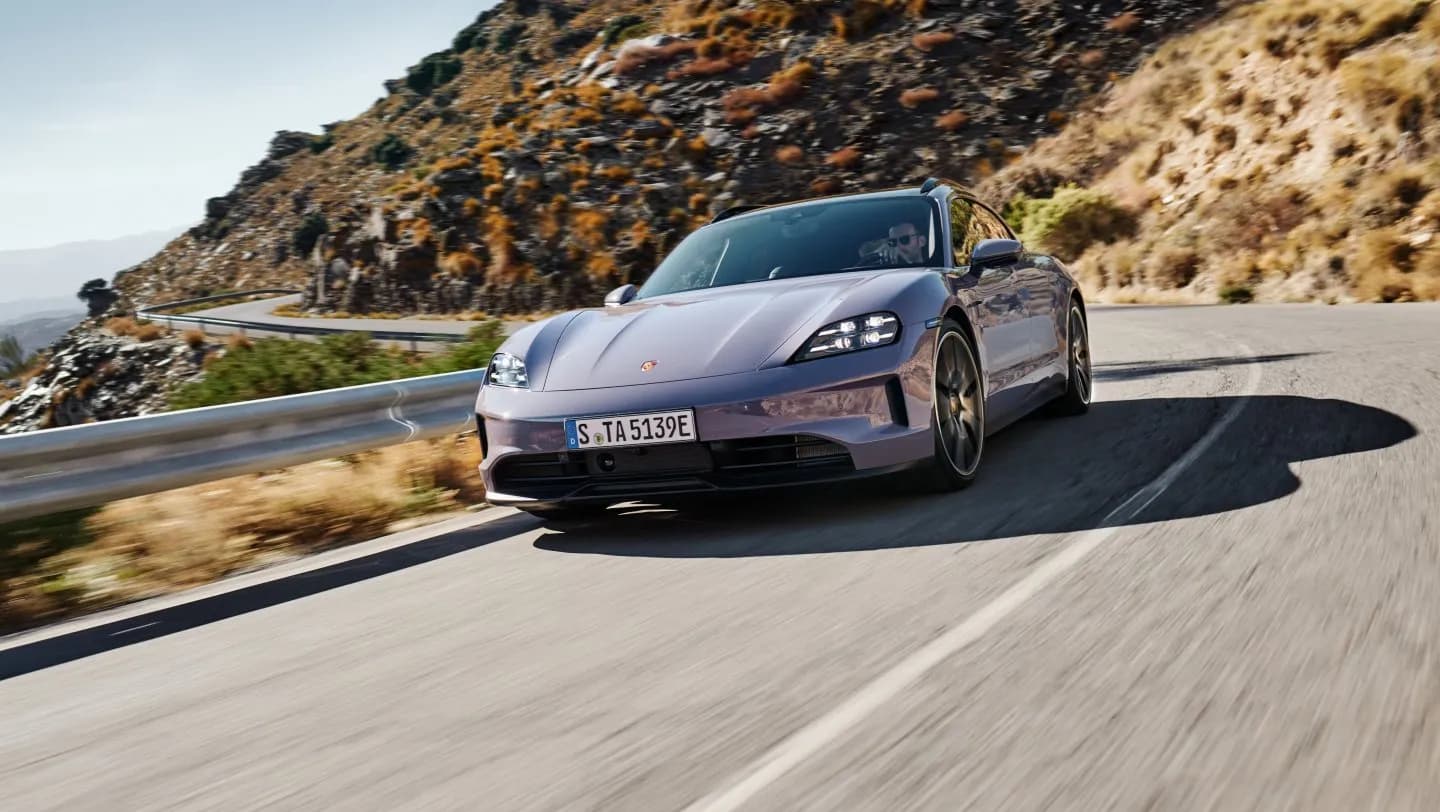
The 2025 update changed the important parts
The list of 2025 changes reads like a new generation in everything except the body:
- Battery: Performance Battery Plus grew from 93 to 105 kWh gross, with 320 kW peak charging, 50 kW more than before.
- Motor: a new rear motor adds up to 80 kW over its predecessor.
- Regeneration: peak regen rose from 290 kW to as much as 400 kW.
- Chassis: air suspension became standard, with the optional Porsche Active Ride holding the body level under braking, steering and acceleration.
The range gain is the part owners will feel. A 2024 base car was rated at 206 miles; the 2025 base car is rated at 274 with its 89 kWh battery and 318 with the 105 kWh pack. The 4S went to 252 and 295. The Turbo S reached 938 hp and 2.4 seconds to 60 mph, and the 4S and above can add push-to-pass with Sport Chrono and the big battery, worth up to 94 hp for 10 seconds.
Prices rose too, with the 2025 base car at $99,400 and the 4S at $118,500 before delivery.
The Turbo GT is a different kind of Taycan
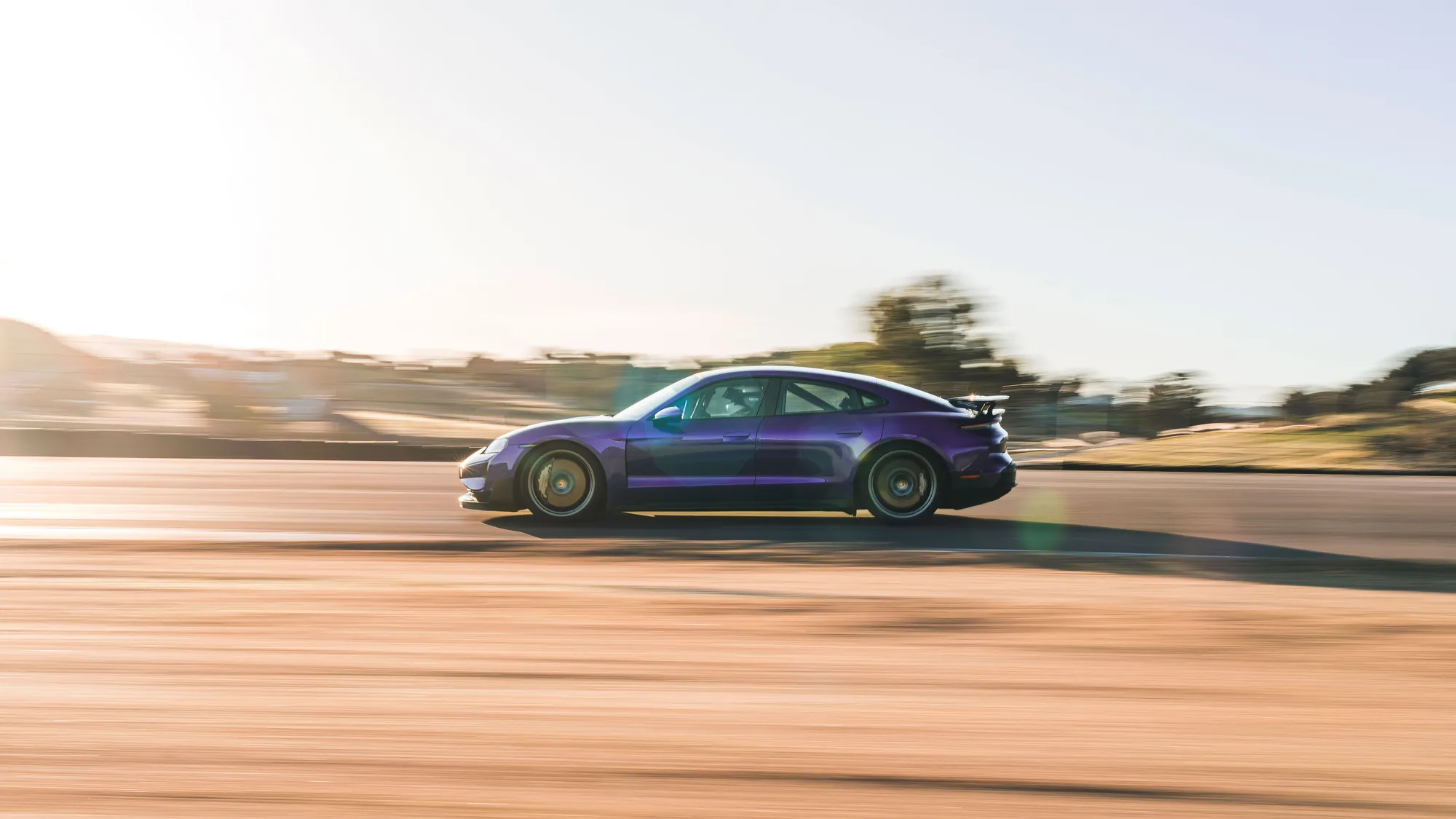
The Turbo GT arrived for 2025 as the most powerful production Porsche ever built. It is rated at 777 hp in normal driving, and Attack Mode adds 120 kW for 10 seconds at the push of a button. Launch Control brings 1,019 hp, with a 1,092 hp peak available for two seconds. The key hardware is a rear pulse inverter that handles 900 amps instead of the Turbo S's 600, using silicon carbide semiconductors, along with a strengthened rear gearbox.
There are two versions. The standard car keeps its rear seats, hits 180 mph and reaches 60 in 2.2 seconds. The Weissach Package deletes the rear seats and some insulation, adds a fixed carbon wing and underbody aero making up to 220 kg of downforce, cuts roughly 70 kg, and goes on to 189 mph and 2.1 seconds. It came as a no-cost choice in the U.S. at launch.
The results are on the clock. In October 2023, a pre-series Weissach car ran 7:07.55 at the Nordschleife, which Porsche called the fastest time for a four-door of any powertrain. A Weissach car lapped Laguna Seca in 1:27.87 in February 2024. In 2026, a Turbo GT with the new Manthey Kit went about 12 seconds quicker at the Nordschleife, at 6:55.5, a new record for production EVs.
Available from the factory only on Weissach cars, the kit raises downforce at 124 mph from 209 to 683 lb, lifts the discharge limit from 1,100 to 1,300 amps, and adds wider forged wheels, 440 mm front brakes and retuned chassis software.
What 2027 changes in America
The 2027 Taycan arrives in fall 2026. The Cross Turismo and Sport Turismo are gone from the American market, leaving only the sedan. The 105 kWh battery is now standard on the Taycan, Taycan 4 and Taycan 4S, and the car gets a native NACS port, a battery health display and a much faster infotainment system.
E-Shift also arrives, with eight simulated gears, drag torque that mimics engine braking, a virtual rev limiter and a shift light. It is optional on every Taycan and standard on the Turbo GT. A Turbo GT with the Weissach Package doesn't get the NACS port, so check that if you plan to rely on Tesla stations.
Starting U.S. prices, before a $2,350 delivery fee:
- Taycan: $111,900
- Taycan 4S: $131,800
- GTS: $157,000
- Turbo: $184,600
- Turbo S: $221,400
- Turbo GT: $243,700
Which one to buy
A used 2020 to 2024 car is the value play, because roughly 40 to 50 percent of the original price has gone from many five-year-old examples. Favor the 93.4 kWh battery, since the small pack's range is hard to live with, and check the car's recall record. In 2024, Porsche recalled 27,527 U.S. Taycans from the 2021 to 2024 model years over a high-voltage battery short-circuit risk that could cause a fire. Owners were told to limit charging to 80 percent until new diagnostic software went in, and dealers replace the battery if needed. Run the VIN through NHTSA and get written proof the work is done.
A 2025 or 2026 car is the one to buy if it has to do real road trips. A rear-drive sedan or a 4S with the large battery is the sensible spec. Don't assume the battery is there, because it was still an option on those cars.
A 2027 makes sense if you want NACS, the bigger battery as standard or E-Shift, and will pay more for them.
The Turbo GT only makes sense if track time is the point. Take the Weissach if you don't need rear seats, and treat the Manthey Kit as a lap-record tool for a car that already costs almost a quarter of a million dollars.