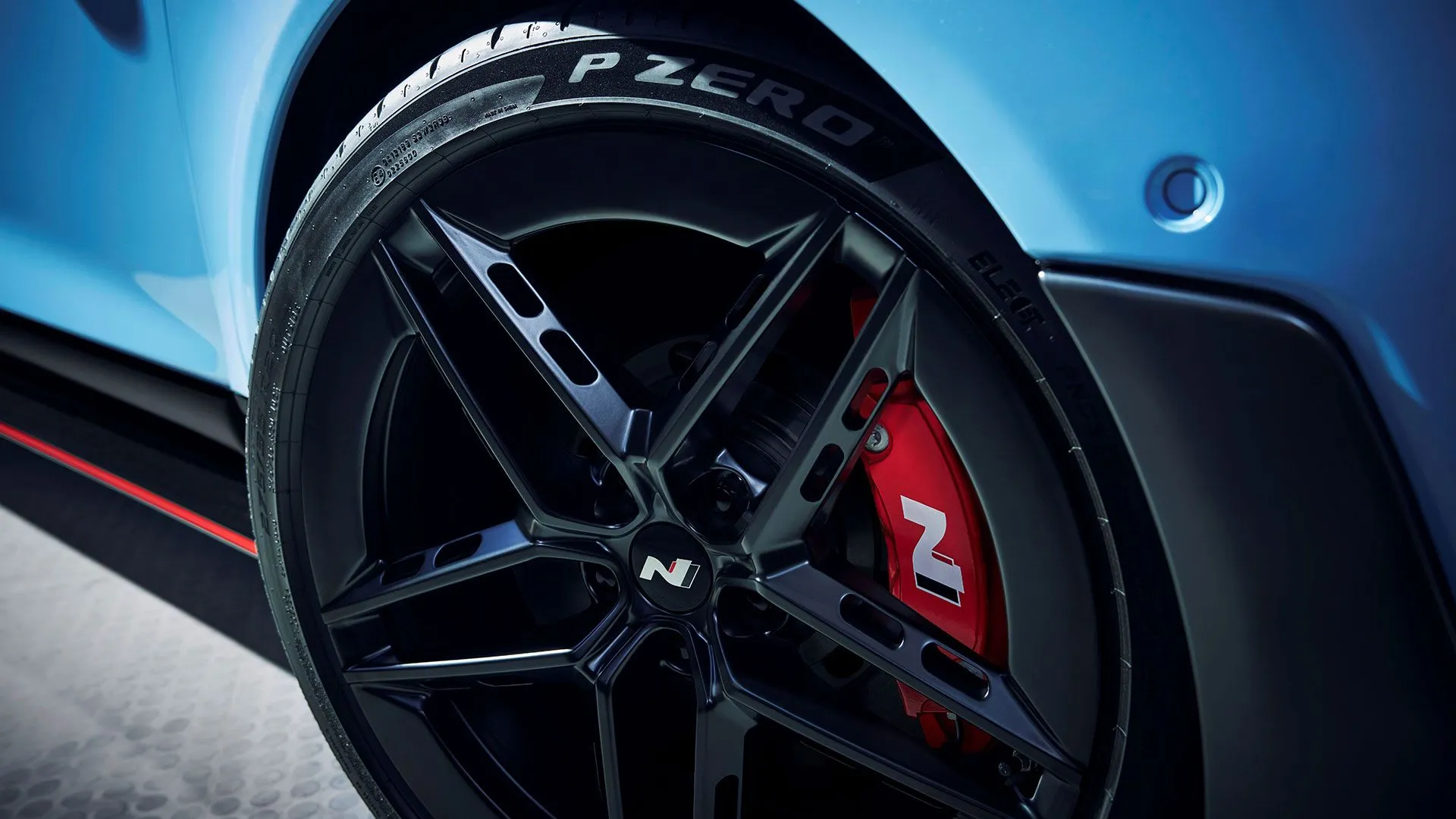
Photo: Hyundai Motor Company. The Hyundai IONIQ 6 N's wheel and brake caliper.
Fitment has its own vocabulary: offset, width, poke, tuck, stretch. All of it applies to an electric car. A heavy battery car adds a question that rarely comes up on a light sports car, though: will the tire you want carry the weight the car puts on it? On an EV, that question belongs at the top of the list, ahead of the look.
Start at the door jamb
Federal Motor Vehicle Safety Standard No. 110 sets the baseline for how a car leaves the factory. For passenger cars, the maximum load on each tire may not exceed the tire's rated maximum, and the normal load may not exceed 94 percent of that rating at the recommended cold pressure. For trucks and multipurpose vehicles, the tires on each axle must together be rated for at least that axle's gross axle weight rating, and passenger-car tires fitted to those vehicles are derated by a factor of 1.10. The tire and loading placard, normally on the driver's side B-pillar, lists the recommended cold pressures and the original tire sizes. FMVSS No. 110 via Cornell's Legal Information Institute
Those rules govern the car as built. Once you choose different wheels and tires, keeping that margin is your job. Before shopping, write down the full sidewall description of the tires the car came on, including the load index, not just the size printed on the placard.
SL, XL and the newer HL
Load capacity is coded on the sidewall as a load index. When Continental announced in 2021 that it was producing the first tires with the new HL code, it used one size, 245/40 R19, to show the steps: a standard-load version carries up to 670 kg (load index 94), an extra-load version 750 kg (98), and the HL version 825 kg (101). On the sidewall, the HL marking sits in front of the size. Continental's HL tire announcement
Continental's reasoning sums up the EV fitment problem. Large electric and hybrid cars and SUVs put considerably more weight on the road but leave little room for bigger tires. Fitting more capacity into the same size took a reinforced bead, a reshaped contour to limit road noise and a revised compound. Continental's HL tire announcement
If your car came on extra-load or HL tires, treat that load index as the minimum when you shop, including for a winter set. Confirm that the exact size you want exists in that load range before you buy wheels around it.
Wheel size shows up in the EPA numbers
The EPA lists some EVs separately by wheel size, and the gaps are not small. The 2025 Hyundai IONIQ 6 RWD is rated at 132 MPGe and 26 kWh per 100 miles on 18-inch wheels, against 111 MPGe and 30 kWh per 100 miles on 20-inch wheels. The AWD versions follow the same pattern: 121 MPGe and 28 kWh on 18s, 103 MPGe and 33 kWh on 20s. fueleconomy.gov, 2025 Hyundai Ioniq 6
That works out to roughly 15 percent more energy per mile for the rear-drive car on the larger wheel. The ratings describe each complete package, including the tire fitted to each wheel size, so they are not a pure measure of rim diameter. The signal is still clear: on an EV, an upsize is a range decision as well as a visual one.
Tires built for the car
Many EVs leave the factory on tires developed with them in mind. Pirelli, for example, uses an Elect marking for tires engineered for electric and plug-in hybrid vehicles, addressing instant torque, higher vehicle weight, range and cabin noise. Selected sizes add its PNCS noise-reduction technology, which Pirelli says cuts perceived interior cavity noise by up to 50 percent. Pirelli's P Zero Elect page
Performance EVs take it further. Hyundai says the IONIQ 6 N runs 275/35R20 Pirelli P Zero 5 tires carrying an HN marking, developed exclusively for that car. Hyundai Motor Group on the IONIQ 6 N The IONIQ 5 N uses forged 21-inch wheels with 275/35R21 Pirelli P Zero tires, and behind them sit 400 mm front discs with four-piston monobloc calipers. Hyundai's IONIQ 5 N launch release
A replacement tire without the carmaker's marking may fit the wheel perfectly and still change noise, efficiency and grip, because the original was developed for that specific car.
A checklist for heavy cars
- Load first. Match or exceed the original load index, and note whether the original was standard load, extra load or HL.
- Rim width. FMVSS No. 110 requires a car's original rims to be built to the dimensions of a rim listed by the tire manufacturer. Apply the same test to aftermarket wheels and stay within the widths the tire maker lists for that size. FMVSS No. 110
- Brake clearance. Big performance brakes, like the IONIQ 5 N's 400 mm front discs, limit how small a winter wheel can go. Confirm caliper clearance before ordering.
- Pressures. For original sizes, set cold pressures from the placard. If you change size or load construction, ask the tire maker or installer what pressure gives the capacity the car needs.
- Efficiency. Check your model's EPA listings by wheel size before upsizing.
None of this rules out a lower, wider or more aggressive setup. It simply puts one number ahead of the look, which on a car this heavy is where it belongs.