Somewhere between 1995 and now, the industry decided that the fix for every sports car was more power. It worked, mostly. The cars got faster and the driving got quieter.
Here are six that gained numbers and lost something in the exchange. Argue in the comments, that is what it is for.
None of these are bad cars. Several are objectively excellent, and every one of them would walk away from its predecessor on any road you can name. The complaint is narrower than that: somewhere in the pursuit of the bigger number, each of them stopped talking to the driver quite as clearly as the thing it replaced.
Camaro, fourth to fifth generation
The fourth-gen was a crude, plasticky, quick car that weighed a manageable amount and let you see out of it. The fifth-gen arrived with a proper interior, real chassis rigidity, roughly 3,800 pounds of curb weight and gunslits for windows.
It is faster in every measurable way. It also feels like driving a bank vault with a bad haircut. The sixth-gen Alpha car fixed most of it, which quietly proves the point that the fifth-gen was the detour.
350Z to 370Z
The 370Z got a better engine, a shorter wheelbase, more grip and rev-matching downshifts. It also got heavier, stiffer-riding, and more insulated from the thing you bought a Z to feel.
The 350Z's slack, its noise, its slightly loose-limbed VQ — that was character. The 370Z traded some of it for competence. Competence is easier to sell and harder to love.
Mustang, Fox body to S550
A Fox body weighed around 3,100 pounds and made a couple hundred horsepower. It handled like a shopping trolley and demanded that you pay attention every single second.
The S550 GT makes well over 400 horsepower, has independent rear suspension, and will out-corner the old car on any surface. It also weighs closer to 3,700 pounds and does 80 percent of its violence with the traction control light off and your right foot barely moving.
Corvette
The Corvette did not get worse. It got further away.
A C5 was a genuinely attainable used car within a decade of leaving the factory. Each generation since has climbed in capability and, more importantly, in price. The mid-engine car is a supercar by any honest measurement, which is great, and also means the entry-level American sports car is now a used car from twenty years ago.
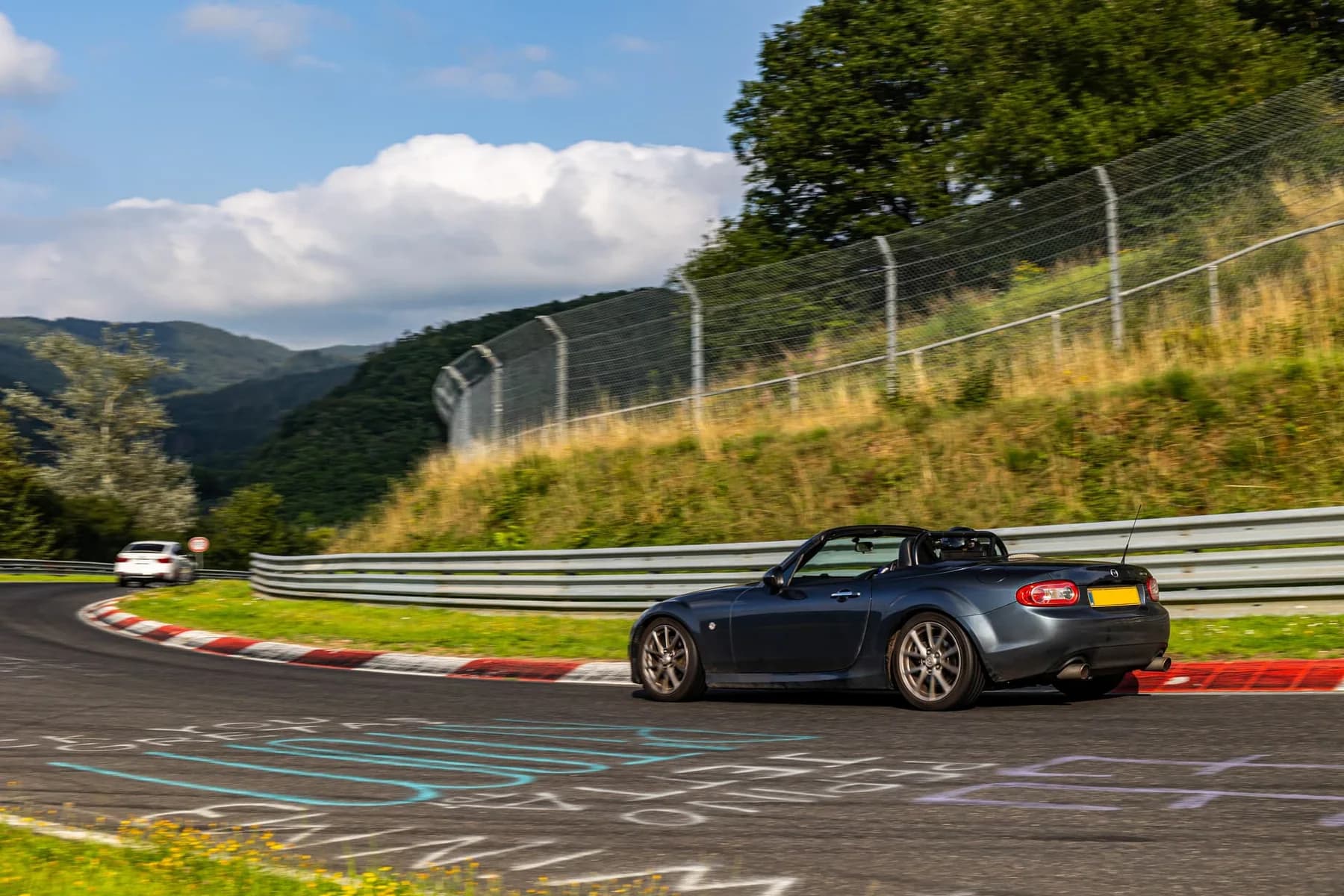
Miata, NA to NC
The NC gained around 200 pounds over an NB, grew in every dimension, and softened its edges. It is a better car to drive across a state and a slightly duller one to drive across a mountain.
Mazda noticed. The ND clawed back the weight and the immediacy, which makes the NC the only genuine detour in the model's history. It is also, for that reason, the used bargain of the four.
S2000, AP1 to AP2
This one starts fights. The AP2 got the 2.2-liter F22C, more midrange torque, revised suspension geometry, wider rear tires, and a redline dropped to 8,200 rpm from the AP1's 9,000.
Every one of those changes made the car easier and more usable. Every one of them also sanded down the specific, deranged quality that made an F20C worth owning in the first place. A 2.0 screaming to nine grand is an experience. A 2.2 pulling harder at four is a car.
The AP2 is the one to buy. The AP1 is the one people still talk about twenty years later. Those two facts sitting next to each other explain this entire article.
What actually happened
Power got cheap and weight got expensive. Airbags, crash structures, sound deadening, infotainment and rigidity all cost pounds, and the easiest way to hide pounds from a spec sheet is with a bigger engine.
The result is a class of cars that are quicker than their ancestors and less interesting below eight tenths, which is where all of us actually drive. The ND Miata, the 86 twins and the Alpha-platform Camaro are proof that manufacturers can still choose the other path.
They just have to be asked. Loudly, and with money.