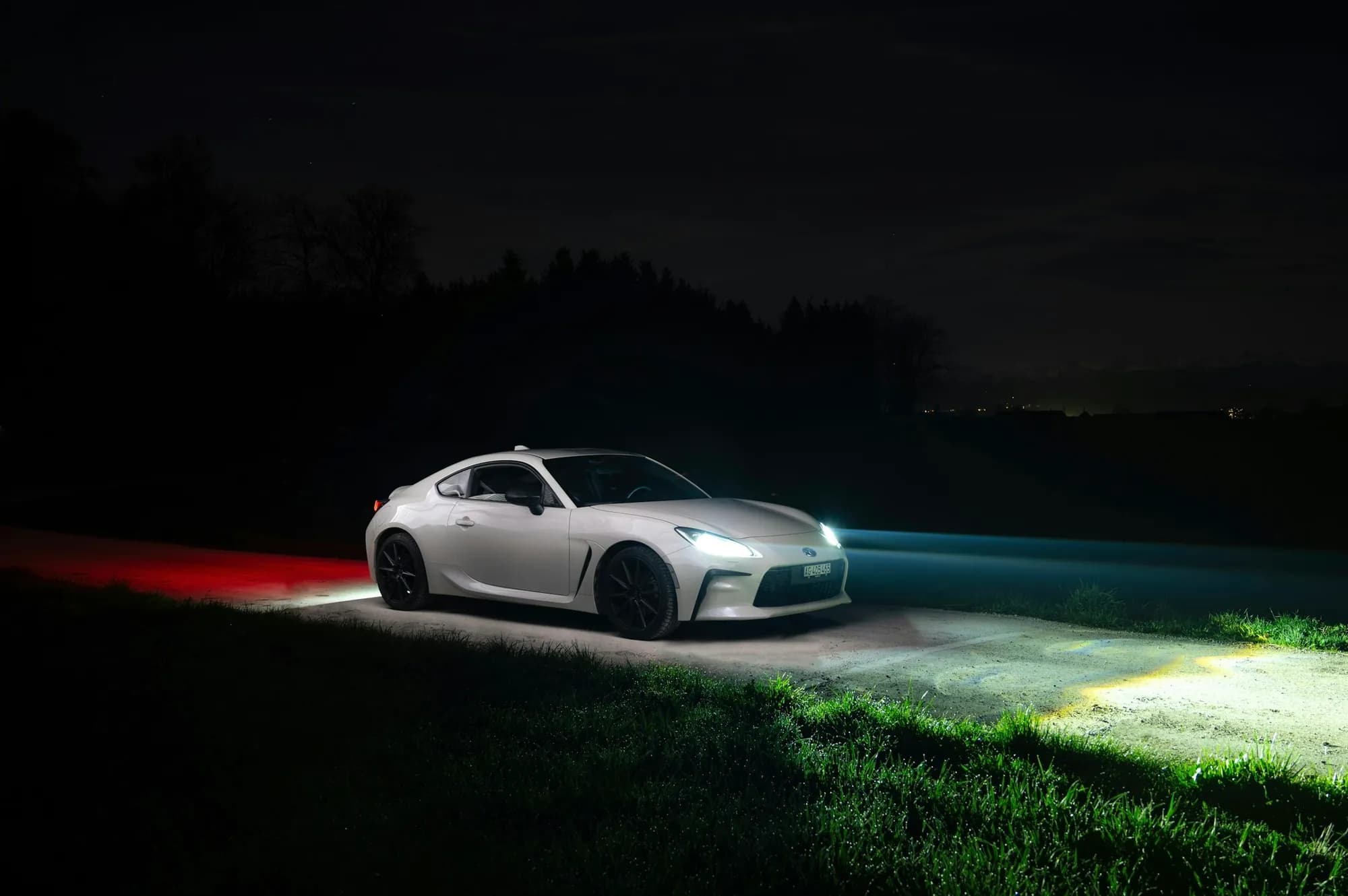
Photo: ben / Unsplash. A Toyota GR86 at night near Bern, Switzerland.
Toyota and Subaru's shared coupe has always been sold on balance rather than output. Toyota's version arrived in 2012 as the 86 and Scion FR-S, a name that points back to the mid-1980s AE86, known in Japan as hachi-roku. Toyota's GR 86 debut release
The second generation kept that brief. Subaru revealed the 2022 BRZ in November 2020 Subaru's BRZ debut release, and Toyota followed with the GR 86 in June 2021. Toyota's 2022 GR 86 page What changed is worth understanding in detail, because it decides which car to buy and what a sensible build looks like.
Where the torque went
The headline is displacement. Toyota says the flat-four grew from 1,998 cc to 2,387 cc through a bore increase from 86 mm to 94 mm, and that peak torque now arrives at 3,700 rpm rather than 6,600 rpm. Toyota's technical release Output for the manual rose from 205 hp and 156 lb-ft to 228 hp and 184 lb-ft, and Toyota's 0-60 mph estimates fell from 7.0 to 6.1 seconds with the manual and from 8.0 to 6.6 seconds with the automatic. Toyota's GR 86 debut release
Subaru's specifications fill in the rest: peak power at 7,000 rpm, a 7,000 rpm redline, a 12.5:1 compression ratio and Toyota's D-4S system, which combines direct and port injection. Subaru's BRZ debut release
The torque figure matters more than the power figure. Moving the peak almost 3,000 rpm lower puts the engine's strongest pull in the range where most road driving happens, instead of near the redline. It also changes what a sensible first modification is, a point we come back to below.
A stiffer shell, lightened where it counts
Subaru quotes a 50 percent increase in torsional stiffness and a 60 percent increase in front lateral bending rigidity, and uses aluminum for the roof, front fenders and hood. The suspension layout is conventional: MacPherson-type struts in front and double wishbones at the rear. Subaru's BRZ debut release Toyota describes new diagonal front cross members, a full-ring rear structure and structural adhesive through the underbody, and lists a base manual curb weight of 2,811 lb with a 53:47 front-to-rear weight distribution. Toyota's technical release
Subaru lists a Torsen limited-slip differential as standard Subaru's BRZ pricing release, and Toyota fits one with both transmissions. Toyota's 2027 GR86 release Tires vary more. Toyota fitted the base GR 86 with Michelin Primacy HP tires on 17-inch wheels and the Premium with Michelin Pilot Sport 4 tires on 18s, which is worth remembering when two used cars feel different on a test drive. Toyota's GR 86 debut release
Subaru also redesigned the stability control with five settings, allowing more driver input before it intervenes, and it can be switched off entirely. Subaru's BRZ debut release
The hardware added since launch
For 2024, Toyota introduced a Performance Package with SACHS dampers and Brembo brakes, standard on that year's TRUENO Edition and offered as an upgrade on other GR86 models. Toyota's 2024 GR86 page Subaru's 2024 BRZ tS took its own route, with STI-tuned Hitachi dampers and gold-painted Brembo calipers. The same year, Subaru made EyeSight standard on every manual BRZ, the first time it had offered the driver-assist system with a manual transmission. Subaru's BRZ tS release
So two cars from the same year can share an engine and a structure and still ride on different damper hardware. Check which package a car actually has instead of assuming from the badge.
The 2027 GR86 changes are smaller but specific. Toyota refined the throttle calibration for a more linear response and widened the shifter interlock chamfer between fourth and fifth gears by about 0.02 inch to improve the fifth-to-fourth downshift. It also nearly doubled the stereo camera's recognition range for cruise control and lists its Active Safety Suite as standard on all models. Toyota's 2027 GR86 release
Buying and building one
Toyota's own race car is an instructive build sheet. The GR Cup, sanctioned by SRO America from the 2023 season, turns stock GR86s into race cars at TRD's facility in Mooresville, North Carolina, adding a roll cage, a 22-gallon fuel cell, Alcon brakes, adjustable JRI shocks and a SADEV sequential gearbox, among other parts. Toyota's GR Cup announcement Most of that list concerns safety, braking, damping and gearing.
A road build can follow the same priorities at a smaller scale: tires and brake pads suited to the use, a proper alignment, then dampers if the factory hardware falls short. With peak torque already in the midrange, chasing power before those basics is harder to justify than it was on the old 2.0. If track days are the goal, Toyota includes a one-year National Auto Sport Association membership with the 2027 car, a reminder that organized events are the intended outlet. Toyota's 2027 GR86 release
Shop the generation for its torque and its structure, then shop the individual car for its tires, dampers and model-year equipment. Those details explain more of the difference between two second-generation cars than the badge on the trunk.
Specifications are manufacturer figures for U.S.-market cars. No TUNERS road or track test is claimed.