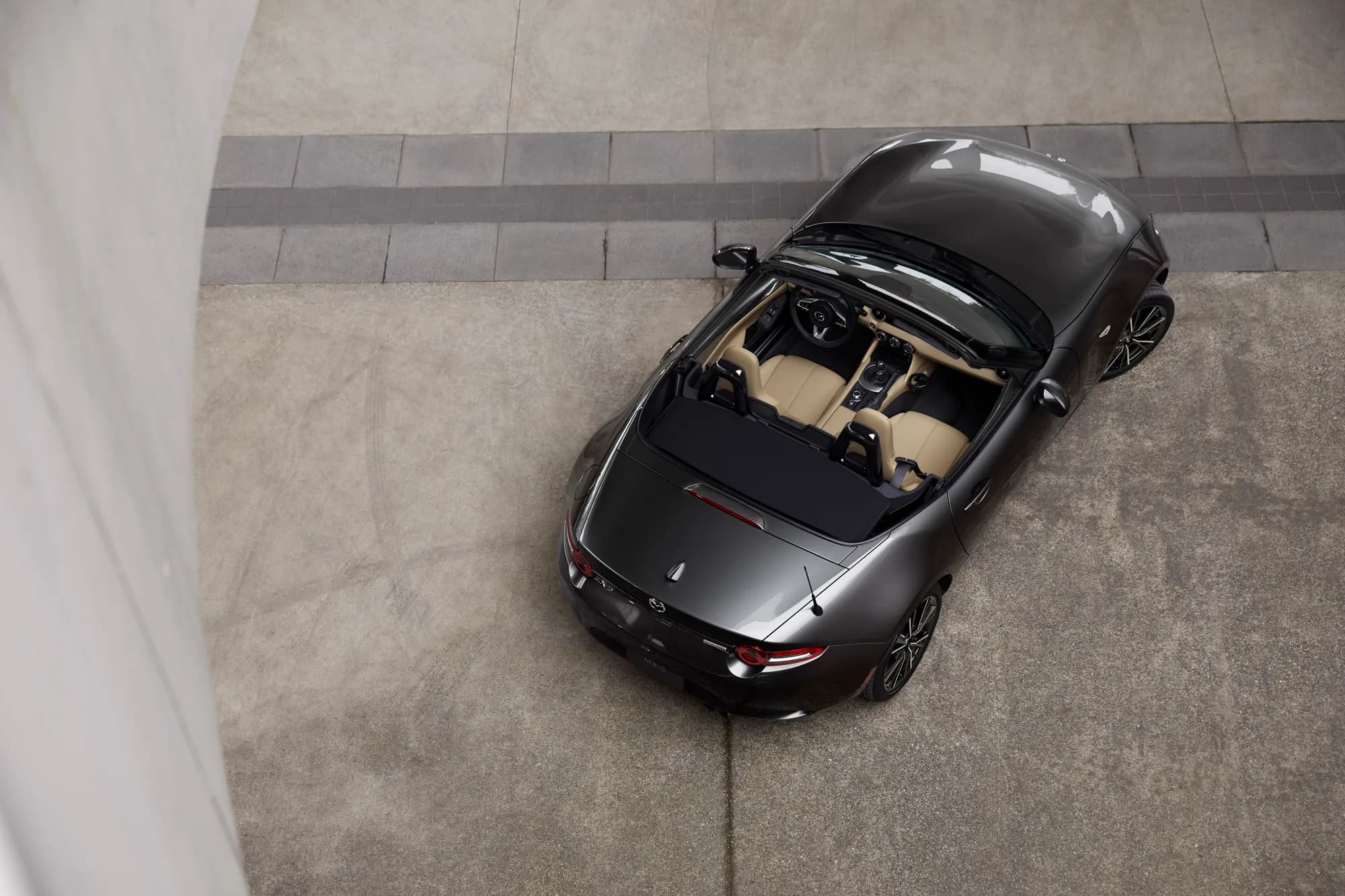
Photo: Mazda North American Operations. The 2024 Mazda MX-5 Miata.
More than a decade into production, the fourth-generation MX-5, known to enthusiasts as the ND, is no longer one car. Mazda began building it on March 5, 2015, at Ujina Plant No. 1 in Hiroshima, and the current car differs from the first ones in its engine, its steering hardware and its limited-slip differential. Mazda's 2016 MX-5 page
Those changes arrived in stages. Knowing them narrows a search quickly and helps you avoid paying for a feature a particular car does not have.
2016 to 2018: the light original
Mazda's launch fact sheet put the 2016 MX-5 at 2,332 lb with the six-speed manual, about 150 lb less than its predecessor. Its 2.0-liter four made 155 hp at 6,000 rpm and 148 lb-ft at 4,600 rpm. Mazda's 2016 fact sheet Mazda's press kit adds a 50:50 weight distribution and aluminum for every exterior panel except the windshield frame and doors. It also lists the hardware that came with a manual Club: Bilstein shocks, a limited-slip differential and a shock tower brace. Mazda's 2016 MX-5 press kit
The car was named 2016 World Car of the Year. Mazda's 2016 MX-5 page The early cars remain the reference point for low weight and simplicity; their engine is the part of the package that Mazda's later updates set out to improve.
2019: a different engine
For 2019, Mazda reworked the 2.0-liter rather than the styling. Output rose to 181 hp at 7,000 rpm, a 17 percent gain, with 151 lb-ft at 4,000 rpm, and the redline moved from 6,800 rpm to 7,500 rpm. To get there, Mazda cut 27 g from each piston and 41 g from each connecting rod, increased valve lift and opening angle, and enlarged the exhaust manifold's inner diameter, which it says reduced pumping losses by 30 percent. Mazda's 2019 MX-5 release
The same update added a telescoping steering wheel with 30 mm of travel, and the car gained only 7 lb despite the new equipment. Mazda's 2019 MX-5 release
For a car this light, 26 more horsepower and 700 more rpm are a large share of the performance envelope. The telescoping wheel is easy to overlook in a listing, yet it matters to anyone who has struggled to find a comfortable driving position in the earlier car.
2022 and 2024: software, then hardware
For 2022, Mazda added Kinematic Posture Control, software that applies a slight brake to the inside rear wheel during high-g cornering to reduce body roll. Mazda says it adds no weight, and that the slightly stronger braking during corner acceleration enhances the limited-slip effect. Mazda's 2022 MX-5 page
The 2024 update changed hardware. Mazda introduced an asymmetric limited-slip differential for the Club, using a cam mechanism with different ramp angles under acceleration and deceleration. The result is stronger lockup under engine braking, for stability at corner entry, and less lockup on acceleration, to reduce understeer. Mazda also added a DSC-Track mode that raises the stability-control threshold to a point between fully engaged and fully off, and notes that it is meant for closed-circuit use. A new steering rack with reduced internal friction and revised assist calibration went on every trim, along with an 8.8-inch display and new LED lighting. Mazda's 2024 MX-5 page
For drivers who use the car hard, this is the update to look for. The differential and the stability-control mode address corner entry and exit directly, and the steering work affects every mile.
Choosing a year and a trim
Trim matters as much as year. For 2026, Mazda lists the asymmetric differential, DSC-Track mode, Bilstein dampers and a front shock-tower brace on the Club and on the manual Grand Touring. The Sport is offered only as a manual soft top, the automatic is limited to the Grand Touring, and output remains 181 hp. Mazda's 2026 MX-5 page
A practical way to narrow the search:
- Lowest weight and the original character: a 2016 to 2018 car.
- The 7,500 rpm engine and a telescoping wheel: 2019 or later.
- Regular autocross or track days: a 2024 or later Club or manual Grand Touring, which brings the asymmetric differential, DSC-Track mode and the revised steering together.
Whatever the year, confirm the trim and its equipment against the car's original documentation, including the window sticker if it survives. Two NDs from the same model year can carry different dampers and differentials depending on trim, and a later owner's modifications can blur the picture further.
Decide which of the three changes matters most to you, the weight, the engine or the chassis hardware, and the model year largely chooses itself.
Specifications are Mazda's U.S.-market figures. No TUNERS road or track test is claimed.