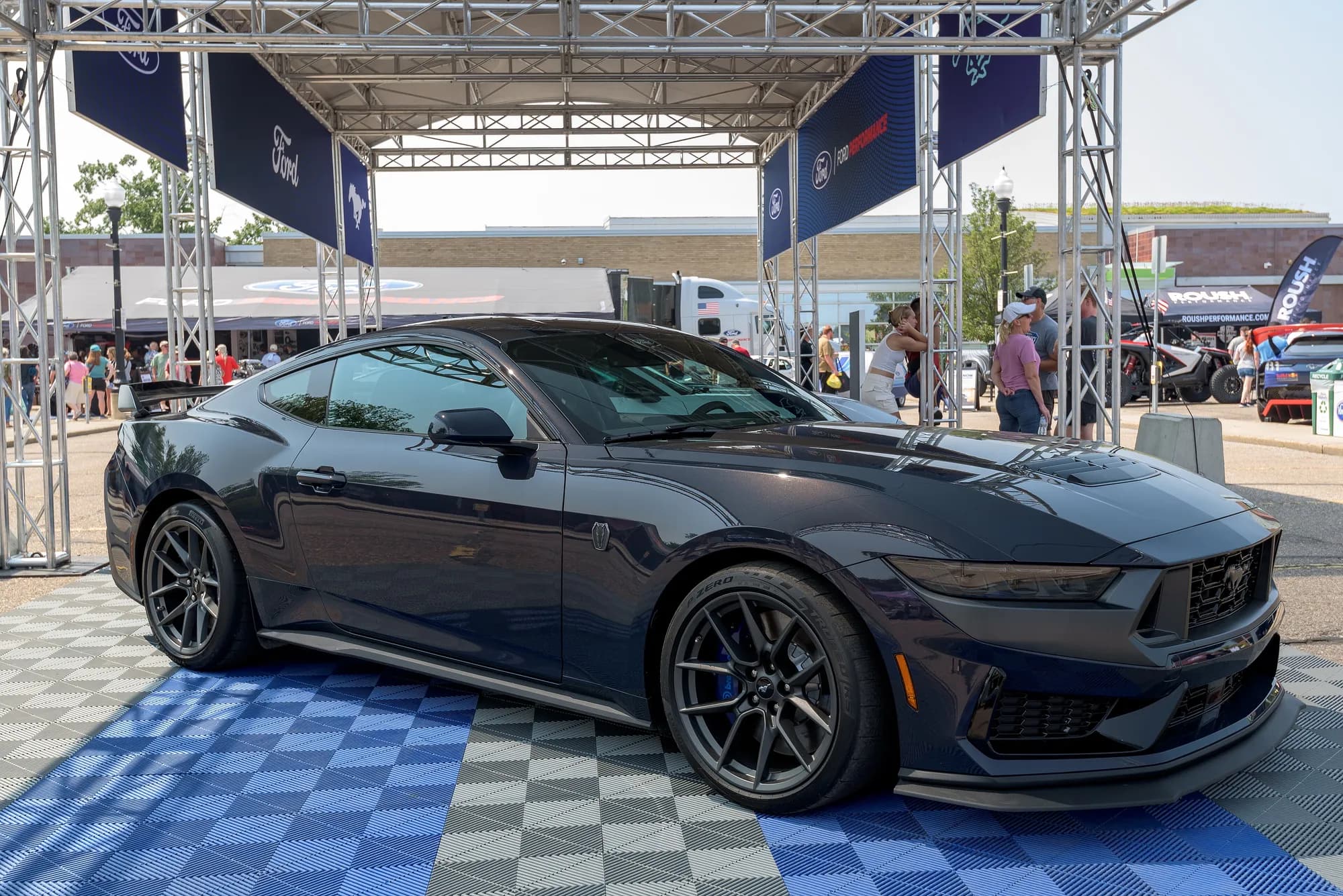
The Mustang Dark Horse makes 20 more horsepower than a Mustang GT and costs about $16,000 more. Add the GT's active exhaust and the power gap shrinks to 14 hp, with torque dead even at 418 lb-ft. Measured to 60 mph, the Dark Horse takes about 4.6 seconds, only 0.2 second ahead of a manual GT.
So the engine rating isn't why this car exists. The Dark Horse is the S650 Mustang built for repeated hard laps, and nearly everything that justifies its price is about heat, the gearbox and the chassis.
Where it differs from the GT
Both cars use a 5.0-liter Coyote V8 with dual air boxes and dual throttle bodies. Ford rates the GT at 480 hp and 415 lb-ft, or 486 hp and 418 lb-ft with the active valve exhaust. The Dark Horse gets 500 hp and 418 lb-ft, using connecting rods first introduced in the 760-hp Shelby GT500.
A GT with the $5,445 Performance Package already shares a lot of the expensive stuff. That means Brembo six-piston front and four-piston rear calipers, a Torsen limited-slip differential with 3.73 gearing on manuals and 3.55 on automatics, a strut tower brace and a K-brace. MagneRide is optional on that car and standard on the Dark Horse.
The differences that remain are the ones you feel in the third session of a track day:
- Cooling: engine oil, transmission and differential coolers, a lighter and higher-capacity radiator, beefier fans and NACA brake ducts.
- Gearbox: a Tremec six-speed instead of the GT's Getrag.
- Wheels: 19 x 9.5 front and 19 x 10 rear, against 19 x 9 and 19 x 9.5 on the Performance Package.
- Option access: the Dark Horse Handling Package isn't offered on a GT.
The track hardware that matters
The cooling list is the heart of the car. A Mustang GT can post a quick lap, but a car on a hot track for 20 minutes needs to shed heat from the engine oil, the gearbox and the rear axle all at once. The Dark Horse has factory hardware for all three, which is work a GT owner would otherwise have to pay to engineer and install.
The $5,495 Handling Package is the option serious track buyers want. It brings 19 x 10.5 front and 19 x 11 rear wheels with 305/30R19 and 315/30R19 Michelin Pilot Sport Cup 2 tires, stiffer springs, larger anti-roll bars and adjustable strut top mounts. It also adds a front splitter that ships inside the car for installation after delivery, a rear spoiler with a Gurney flap and front tow hooks.
Think of those tires as a commitment. Cup 2s are at home on a warm track and much less happy on a cold, wet commute, so this package suits a car that really will see laps. Budget for replacement rubber, since a 305 and 315 set won't be cheap.
The manual and the Tremec
The Dark Horse manual is a Tremec TR-3160, a gearbox that came to Ford through the 2016 to 2020 Shelby GT350 and the Mach 1. Tremec says it remains the manual in the 2026 Dark Horse and the same unit used in the Dark Horse R race car in the Mustang Challenge series. It has closer spacing between gears and a single overdrive, and Ford fits rev matching, a titanium shift knob and a dedicated transmission oil cooler.
The GT's manual is the Getrag MT82-D4, which also has rev matching. The MT82 family has a harder history: owners of earlier Mustangs filed a class-action lawsuit in 2020 over slipping and harsh engagement. For someone choosing a stick for track use, the Tremec is a clear part of what the extra money pays for.
One thing changed along the way. On the 2024 and 2025 cars, the manual was standard. For 2026, Ford lists the 10-speed SelectShift automatic as standard and the Tremec as available, so check what's on any specific car rather than assuming. The automatic isn't a slow choice, and it gets 3.55 gearing against the manual's 3.73. But if you want to shift for yourself, the TR-3160 is the reason to step up from a GT.
Don't confuse any of this with the Dark Horse SC. That's a 5.2-liter supercharged car with 795 hp, 660 lb-ft and a seven-speed dual-clutch, priced above $100,000. It's a separate machine with the same name.
Whether it's worth the money
Order-bank pricing for 2027 puts the GT at about $47,800, the GT Premium at about $52,100, the Dark Horse at about $64,100 and the Dark Horse Premium at about $69,100, all before a destination charge of about $2,000. Ford hasn't published a full consumer list for 2027, so treat those as close rather than final.
The fair comparison isn't a base GT. Add the Performance Package to a GT Premium and you're at about $57,500 before MagneRide. That leaves the Dark Horse's premium at about $6,600, for the coolers, the Tremec, standard MagneRide, the GT500 rods and the option of the Handling Package. Add the Handling Package and the Dark Horse is about $69,600 before destination.
Here's how the decision breaks down:
- Mostly street driving, the odd track day: buy the GT Premium with the Performance Package and MagneRide. It has the same brakes and differential, and on the road you won't feel the coolers.
- Regular track days, and you want a stick: buy the Dark Horse with the Tremec. The cooling and gearbox would cost real money and effort to approximate on a GT.
- A dedicated weekend car: add the Handling Package and plan your tire budget accordingly.
The Dark Horse doesn't win on the spec sheet, and it isn't meant to. Its value shows up late on a hot track day, when heat is what limits a car. If you won't put it in that situation, the GT is the smarter purchase. If you will, about $6,600 is a fair price for not having to engineer the fix yourself.