Before you check the paint on an early Miata, check the last six digits of the VIN. On cars with numbers ending 209446 or lower, which covers 1990 models and some 1991s, the engine has the short-nose crankshaft. The crank pulley can work loose and damage the keyway, and a wobbling pulley at idle is the warning sign.
It's the best-known problem on the most famous cheap sports car, and a reminder that an old Miata is bought on condition and history. Here's how the first three generations differ, what goes wrong and which to pick.
NA, 1990 to 1997: the lightest and the simplest
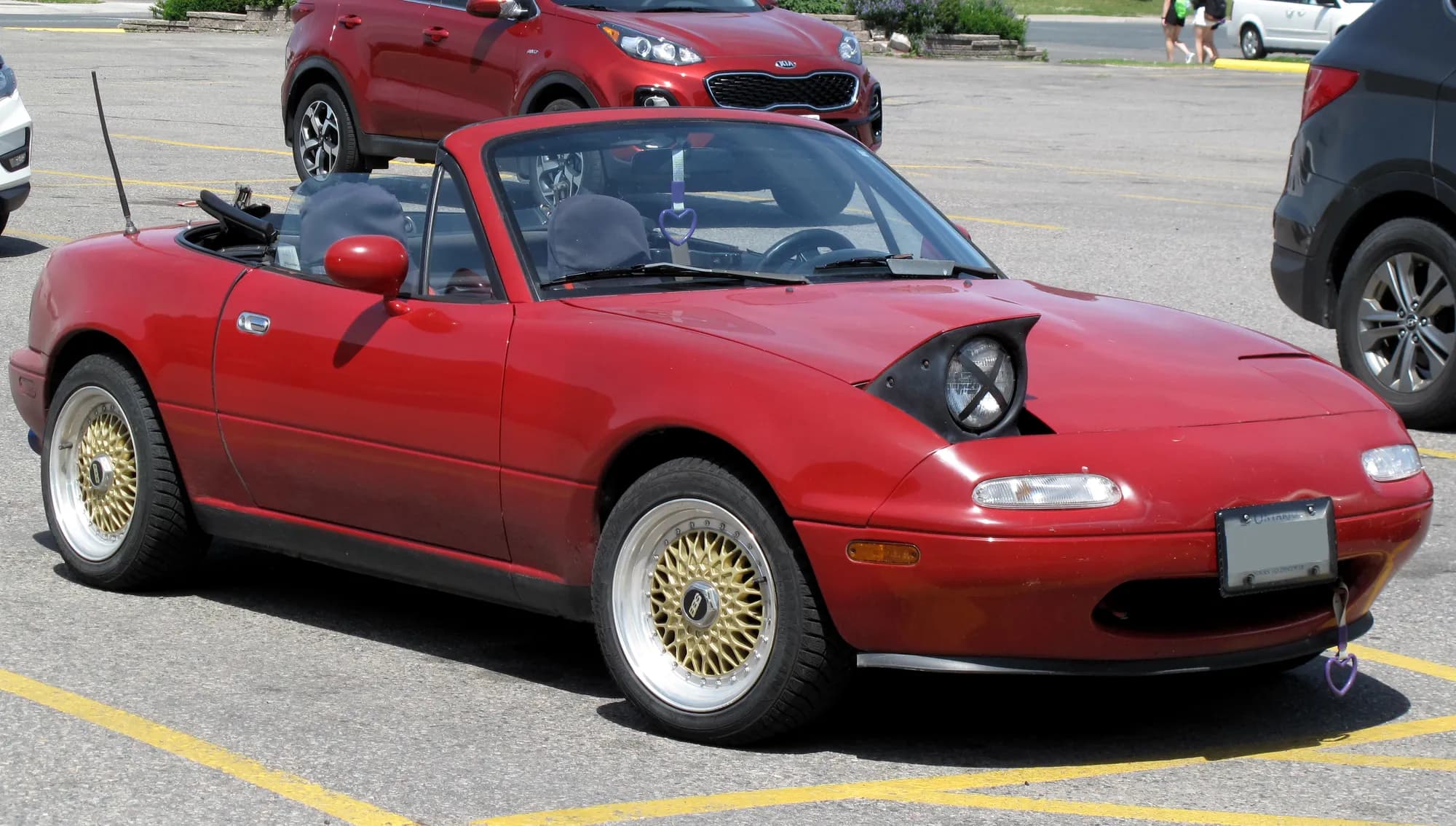
The original went on sale in the U.S. in 1989 as a 1990 model, with pop-up headlights and a 1.6-liter four rated at 116 hp. A 1990 car with no options weighed about 2,160 lb. It's lively below 60 mph and strains above 70.
The 1.8-liter arrived for 1994 with 128 hp, rising to 133 hp from 1996. The 1.8 cars also got extra chassis bracing and an available Torsen limited-slip, a better unit than the viscous differential offered on 1.6 manuals.
What to check beyond the crank:
- Rust: rockers and rear fender arches. If a rocker shows bubbles, assume the damage underneath is worse.
- Lifter tick: hydraulic lash adjusters often tick on both the 1.6 and 1.8.
- Crank angle sensor leak: often a cheap O-ring, but it can point to coolant trouble.
- Age items: soft top, rubber bump stops and bushings have mostly outlived their service life.
NB, 1999 to 2005: stiffer and more usable
There was no 1998 model in the U.S. The NB kept the NA's basic chassis and wheelbase with fixed headlights, a 140-hp 1.8 and a stiffer body. It weighs more, at about 2,348 lb, but it stays more composed on bad pavement and it was the first with an available six-speed.
The 2001 update, known as the NB2, added variable valve timing on the intake cam for 142 hp and a fuller midrange, along with an immobilizer and a stiffer shell. The 2004 to 2005 Mazdaspeed is the only factory-turbocharged MX-5, with 178 hp, 166 lb-ft, a six-speed, a Torsen differential and 17-inch wheels. Check any Mazdaspeed for boost upgrades and non-stock tunes before paying a premium for it.
The NB's serious problem is structural:
- Front frame rails: rust just ahead of the lower control arms, where the front sway bar mounts, can be terminal. Take a flashlight and a magnet, and be suspicious of fresh undercoating on a northern car.
- Rockers and rear arches: look in front of each rear wheel, and check the trunk floor as well.
- Top drains: when they clog, water rots the body from the inside out.
- Mechanical items: the plastic radiator tank goes brown and brittle, timing belt receipts matter, and aging coils or plug wires bring cold misfires. Some 2001 to 2002 cars have a cold clutch shudder, which Mazda covered with a bulletin.
A newer NB can be more corroded than an older NA, so judge the car, not the badge.
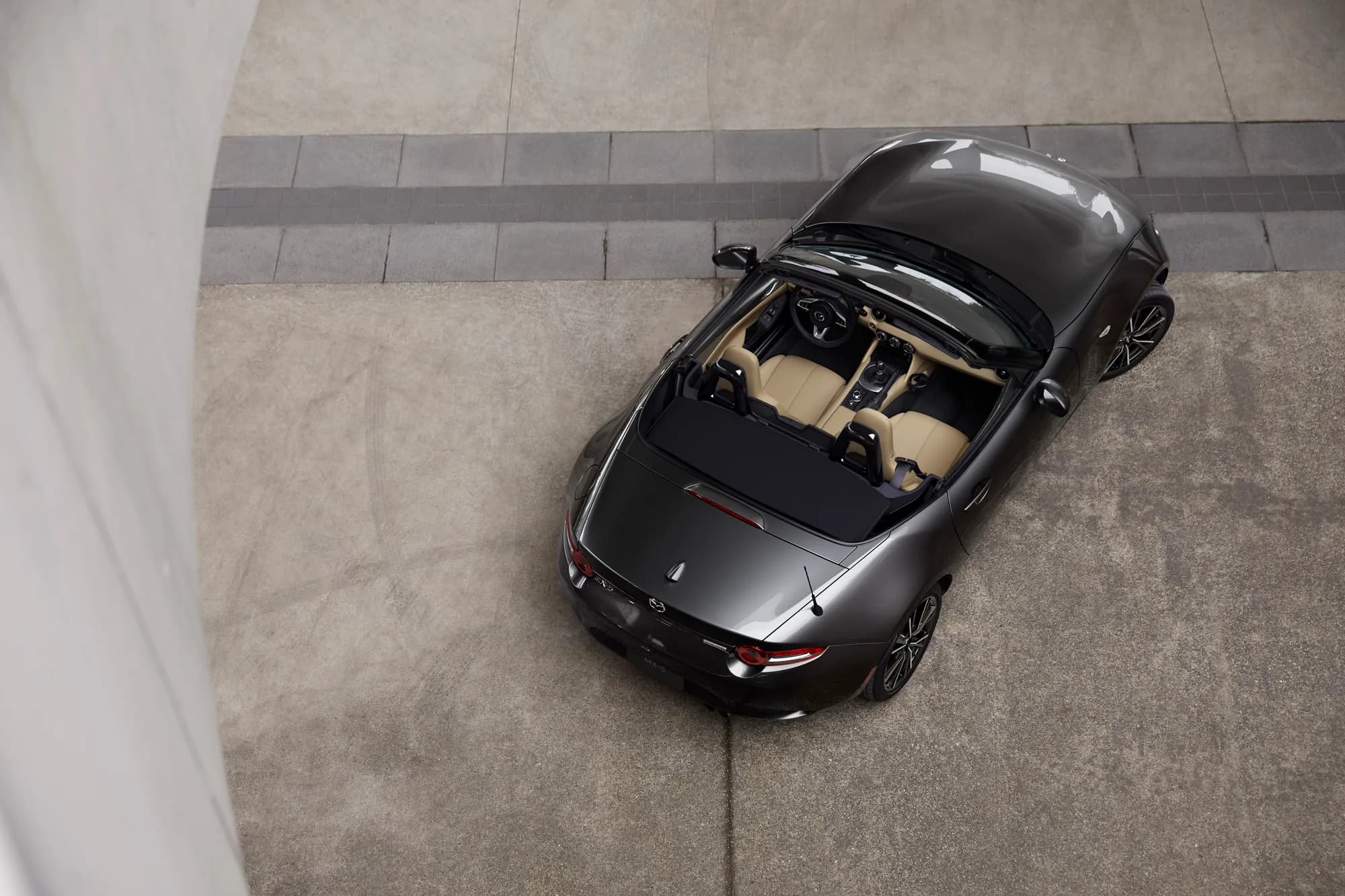
NC, 2006 to 2015: the one you can live with
The NC was the first full redesign. It shares its platform with a shortened RX-8, gets a 2.0-liter MZR four with 170 hp and a six-speed manual, and offers more cabin room than either earlier car. It's also the heaviest of the three. The power retractable hardtop, offered from the 2007 model year, weighs about 2,540 lb, about 80 lb more than a comparable soft top.
The generation splits into three. The NC1 ran through 2008. The NC2 arrived for 2009 with a forged crankshaft and rods, stronger pistons, stiffer valve springs, an oil cooler and a 7,200 rpm redline on manual cars. Its 167-hp rating is a change in measurement rather than lost power. The NC3, 2013 to 2015, added standard stability control and simplified the trims, and the Club with the Suspension Package has Bilstein dampers and a limited-slip differential. Automatics make about 158 hp and have no factory limited-slip.
Unlike the NA and NB, the MZR has a timing chain rather than a belt. What to look for instead:
- Coolant expansion tank: the plastic tank goes brittle and cracks at the neck, below the cap. A small crack can become rapid coolant loss and overheating, so inspect it and consider an aluminum replacement.
- Rust: rockers and rear fender arches again, with cars from salted states needing the closest look.
- Early hardtops: plastic roof gears can fail. Cycle the roof several times and listen for grinding or hesitation.
- Water and oil: clogged cowl drains can soak the carpet, so press the padding with your hand. Check the oil level and ask for records, since some 2.0s use oil when driven hard.
- Differential whine: common, often fixed by fresh fluid, and rarely a sign of outright failure.
What they cost and which to buy
Driver-condition prices in 2026 are closer than you might expect. Good NAs run about $8,000 to $10,600, with early 1.6 cars at the low end and 1996 to 1997 cars at the top. Good NBs sit in the mid-$9,000s to about $10,000, though actual NB sales average closer to $13,000, with Mazdaspeeds around $15,500. A good NC averages about $14,600. Suspiciously cheap examples of any of them may carry salvage or rebuilt titles, so confirm the title first.
Here's how we'd choose:
- The purest back-road car: a 1994 to 1997 NA 1.8. You get the lightness, the pop-up headlights and more torque than a 1.6, with no short-nose crank to worry about.
- The best all-around older Miata: a 2001 to 2005 NB2. It has the stiffer body, better midrange and a glass rear window. Inspect those frame rails before anything else.
- The daily driver or the tall driver: a 2009 or later NC manual. The forged internals and the higher redline make it the stronger buy, and NC2s often cost about the same as NC1s. A 2013 to 2015 Club manual with the Suspension Package is the one to hunt for.
A short-nose 1.6 isn't automatically a car to avoid, as long as the pulley is steady and the price reflects the risk. The same logic applies across all three generations. A rust-free, documented car of the wrong year beats a rusty one of the right year, because rust in the rockers or frame rails is the one problem no parts catalog fixes cheaply.