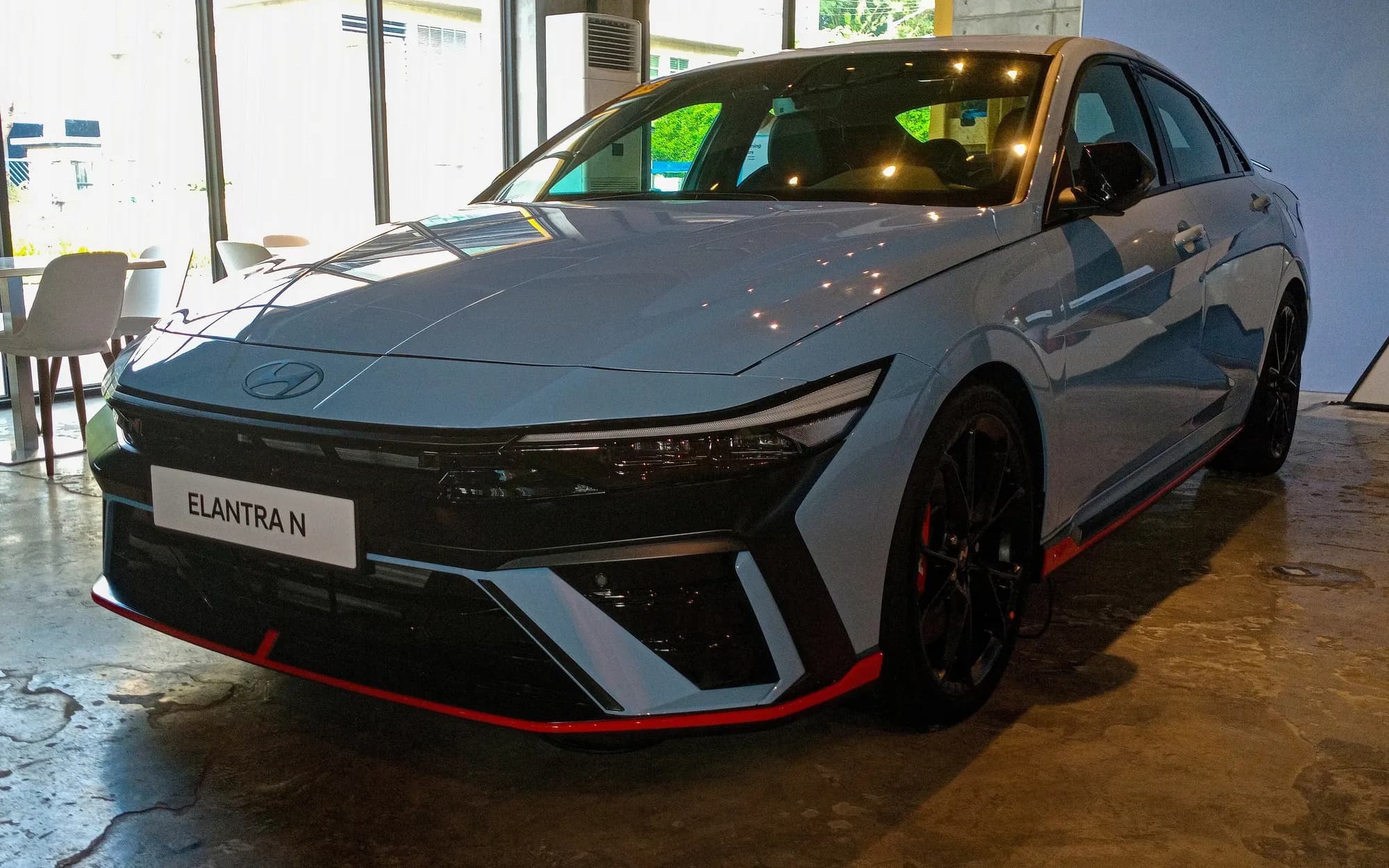
A manual 2026 Hyundai Elantra N costs $36,345 delivered. That buys 276 hp, 289 lb-ft, an electronic limited-slip differential and 14.2-inch front rotors, in a four-door with a back seat and a trunk. It's $4,770 less than the cheapest GR Corolla, and it gives up only 24 hp and 6 lb-ft to it.
That's the whole case for the car. Here's where Hyundai spent the money, what it left out, and where the limits show up on track.
The hardware behind the price
The engine is a 2.0-liter turbo four, and it powers the front wheels only. Hyundai pairs it with its N Corner Carving Differential, an electronic limited-slip that's standard on every car, which is what makes 289 lb-ft usable coming off a corner. The brakes are 14.2-inch ventilated rotors in front and 12.4-inch ventilated rotors in back, and Hyundai fits an adaptive suspension with custom N modes, launch control on both gearboxes and dedicated oil cooling.
Curb weight is 3,186 lb with the manual and 3,296 lb with the dual-clutch. Warranty coverage is five years or 60,000 miles limited, with a 10-year or 100,000-mile powertrain term.
For 2026 the standard car carries over essentially unchanged, and the news is the limited-run TCR Edition. It adds an adjustable carbon-fiber swan-neck wing, gloss-black 19-inch forged wheels, four-piston monobloc front calipers and two-piece front rotors, and Alcantara on the wheel, shift knob, handbrake lever and armrest. Hyundai prices it at $39,250 for the manual and $40,750 for the DCT, or $40,495 and $41,995 with the $1,245 destination charge. It keeps the 276-hp rating, so you're paying for brakes, wheels and looks rather than speed.
Manual or DCT
The eight-speed wet dual-clutch adds $1,500 and 110 lb. In exchange you get the N Grin Shift function in its strongest form, a temporary bump to 286 hp at the press of a red button on the wheel. The dual-clutch tends to be the quicker car in a straight line, and either version runs to 60 mph in roughly five seconds. EPA estimates slightly favor the manual, at 21 city and 29 highway mpg against 20 and 27.
The six-speed's case is simple: it's cheaper, it's lighter and it's the more involving car. On manual cars the same red button switches on automatic rev matching rather than adding power.
If this is your only car and you commute in traffic, the DCT is a perfectly honest choice. If the point of the car is driving it, the manual costs less and you won't miss 10 hp you only get for a moment.
Where the track limits show up
The Elantra N's real limit on track is heat, not power. The radiator is the main cooling bottleneck, with oil temperature close behind. About 260 degrees Fahrenheit on the oil is a sensible line, and past it you should back off.
The brakes are next. The factory pads have good bite, but extended sessions can bring fade, and the stock rubber lines can swell as fluid heats up, softening the pedal. The typical first fixes are cheap and well known:
- Track-appropriate pads and high-temperature brake fluid
- Stainless braided brake lines
- Sticky tires, keeping in mind that everything goes through the fronts
- Radiator and oil-cooling upgrades if you run long sessions in hot weather
Front drive is the other ceiling. The differential does a lot of clever work, but in a long, hard session the front tires handle all of the steering, all of the power and most of the braking. Hyundai has also launched an N Performance Parts catalog, so factory-backed upgrades exist as well as aftermarket ones.
None of this makes the car a bad track tool. It means a stock Elantra N is great for short sessions and first track days, and that a serious regular will spend money on heat management.
How it stacks up on price
These are 2026 U.S. prices with destination included.
- Honda Civic Si: about $32,690. 200 hp, 192 lb-ft, front drive, manual only.
- Hyundai Elantra N manual: $36,345. 276 hp, 289 lb-ft, front drive.
- Hyundai Elantra N DCT: $37,845.
- Hyundai Elantra N TCR Edition manual: $40,495.
- Toyota GR Corolla manual: $41,115. 300 hp, 295 lb-ft, all-wheel drive, 1.6-liter turbo three.
- Toyota GR Corolla automatic: $43,115.
- Toyota GR Corolla Premium Plus manual: $47,160.
The Si is the cheaper car, and for street driving at normal speeds its smaller engine is plenty. But the gap to an Elantra N is only about $3,700, and that buys 76 more horsepower and 97 more lb-ft. If you were already stretching to a new Si, that's a very persuasive upsell.
The GR Corolla is the harder comparison. Its all-wheel-drive system gives traction the Elantra can't match, and in bad weather or on a tight, wet course that's worth real money. Still, the base GR Corolla costs $4,770 more than the N manual, and a Premium Plus is $10,815 more. Even the TCR Edition, with its forged wheels and big brakes, comes in $620 below the base GR Corolla.
So buy the Si if you want the cheapest fun, and the GR Corolla if you want all-wheel drive and don't mind paying for it. For most buyers who want the most speed per dollar in this class, the Elantra N is the answer, and the manual is the version we'd pick.
A replacement is on the way. Hyundai has unveiled a redesigned 2027 Elantra in South Korea with a new N expected to follow, and no U.S. price for it has been announced. Today's car is a known quantity at a known price, which is worth something if you're ready to buy.