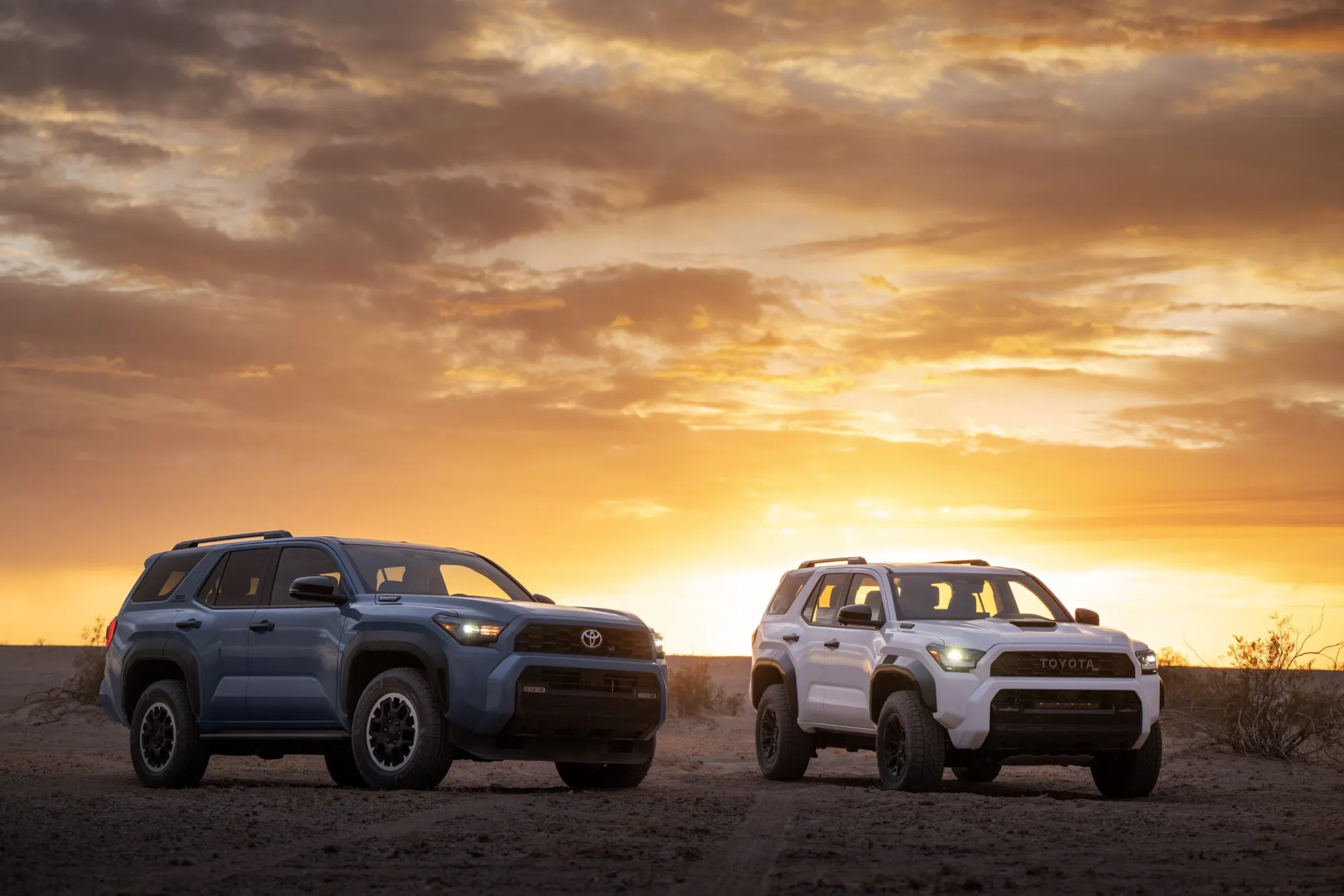
The old 4Runner's V6 made 278 lb-ft of torque. The new one's base turbo four makes 278 hp. That coincidence sums up the change: Toyota swapped a 15-model-year formula known for being slow and nearly unkillable for a stronger, more efficient one that hasn't had time to earn the same reputation.
Toyota built the fifth generation from 2010 through 2024. The sixth arrived for 2025, and for 2027 it carries over almost unchanged. New and late-used trucks now overlap in price, so the choice is a real one.
Two very different ways to make power
The fifth generation's 4.0-liter DOHC V6 makes 270 hp and 278 lb-ft, sent through a five-speed automatic. It is naturally aspirated and known for high mileage, with trucks past 250,000 miles a familiar sight. It is also thirsty, at 16 mpg city and 19 highway.
The sixth generation offers two versions of a 2.4-liter turbo four, both with an eight-speed automatic:
- i-Force: 278 hp and 317 lb-ft, rated at 19 mpg city and 25 highway with 4WD.
- i-Force Max: a 48-hp electric motor brings the total to 326 hp and 465 lb-ft, rated at 23 city and 24 highway.
On paper, the base engine adds only 8 hp to the V6, but its extra 39 lb-ft comes with three more gears to keep it in the right place. The hybrid is the real step. Its 465 lb-ft is 187 more than the V6 ever offered, which matters most on a grade with a loaded truck. Toyota covers the hybrid battery for 10 years or 150,000 miles.
What the new engines lack is history. They have held up so far, and early owners tend to complain about refinement rather than breakage. But no one can yet show what they do at 200,000 miles, and turbos and hybrid systems add parts the V6 never needed. If you plan to keep the truck for decades, that uncertainty is the fifth generation's strongest argument.
What else changed underneath
The sixth generation moved to Toyota's TNGA-F platform, shared with the Tacoma, Tundra, Land Cruiser and Sequoia. It keeps a ladder frame, with multi-link coil rear suspension and double wishbones in front. Most of the changes favor the new truck, but not all of them.
- Wheelbase: 112.2 inches against 109.8. The longer one adds rear-seat legroom, but the old truck's shorter wheelbase helps on breakover.
- Towing: 6,000 pounds against 5,000.
- Articulation: the old truck offered KDSS as an option on TRD Off-Road. The new one uses a button-operated Stabilizer Disconnect Mechanism, standard on TRD Pro and Trailhunter and optional on the hybrid TRD Off-Road Premium.
- Seats and cargo: the optional third row remains, but only on the gas SR5 and Limited. Every i-Force Max is a five-seater because the battery sits under the cargo floor. That cuts space behind the second row to 42.6 cubic feet, from 48.4 in the gas truck.
- Rear window: both generations keep the roll-down rear glass.
- Tech: Toyota Safety Sense 3.0 is standard across the 2026 lineup, and a 14-inch touchscreen is available. The fifth generation only got Android Auto and Apple CarPlay for 2020.
TRD Pro or Trailhunter
Toyota makes both sixth-generation flagships hybrid-only, and they cost nearly the same: $67,900 for the 2026 TRD Pro and $67,700 for the Trailhunter, before destination. Both get 33-inch Toyo tires on 18-inch wheels, a rear locker and the stabilizer disconnect. The difference is what you do after the pavement ends.
The TRD Pro leans toward speed and control. It uses TRD-tuned Fox QS3 internal-bypass shocks with 2.5-inch aluminum bodies, rear remote reservoirs and adjustable compression, plus a TRD intake and exhaust and black wheels. For 2027 it gets a new exclusive color, Hot Honey, a golden yellow that replaces Wave Maker blue, along with red tow hooks.
The Trailhunter is the overlander. It gets Old Man Emu 2.5-inch forged monotube shocks with remote reservoirs and about 2 inches of extra ground clearance. It also adds a low-profile high-mount intake, an onboard air compressor, an ARB roof rack, Rigid LED fog lights and bronze wheels. Most of that is gear buyers would otherwise bolt on themselves.
If you drive fast on dirt, take the TRD Pro. If you travel slowly with a load and sleep out there, take the Trailhunter.
The fifth-generation TRD Pro is a simpler take on the same idea: Fox internal-bypass shocks with rear piggyback reservoirs, about an inch of front lift, an electronic rear locker and a quarter-inch aluminum front skid plate. That generation has no Trailhunter equivalent.
What each costs
A new 2026 4Runner starts at $41,570 for a 2WD SR5. Useful 4x4 reference points are $49,990 for a gas TRD Off-Road and $52,790 for the same truck with i-Force Max, a $2,800 step. Destination adds about $1,500, and 2027 prices will likely run a little higher.
Used 4Runners hold their value stubbornly. Private-party values for TRD Pro models run about $51,800 for a 2024, $40,800 for a 2022, $35,200 for a 2020 and $28,600 for a 2018. So the last fifth-generation TRD Pro costs about as much as a brand-new hybrid TRD Off-Road, which is the comparison worth making.
Which to buy
- Buy a fifth generation if you want the simplest, most proven drivetrain, plan on very high mileage or want the shorter wheelbase. A late TRD Off-Road with KDSS is the sweet spot. Accept the fuel bills and the five-speed.
- Buy a gas sixth generation if you tow a little, want better fuel economy and modern safety tech, or need a third row in a new truck.
- Buy an i-Force Max if you want the torque and tow regularly. The $2,800 step on a TRD Off-Road is the best value in the lineup, with one catch: you give up cargo space and any third row.
- Buy a TRD Pro or Trailhunter only if you will use the hardware. Those trucks sit close to $70,000 with destination.
If you are torn, base the decision on how long you plan to keep the truck. If you trade every several years, the new engines' extra power and efficiency make the sixth generation the better buy. If you plan to run one into six figures and well beyond, the V6's long record is hard to argue with.