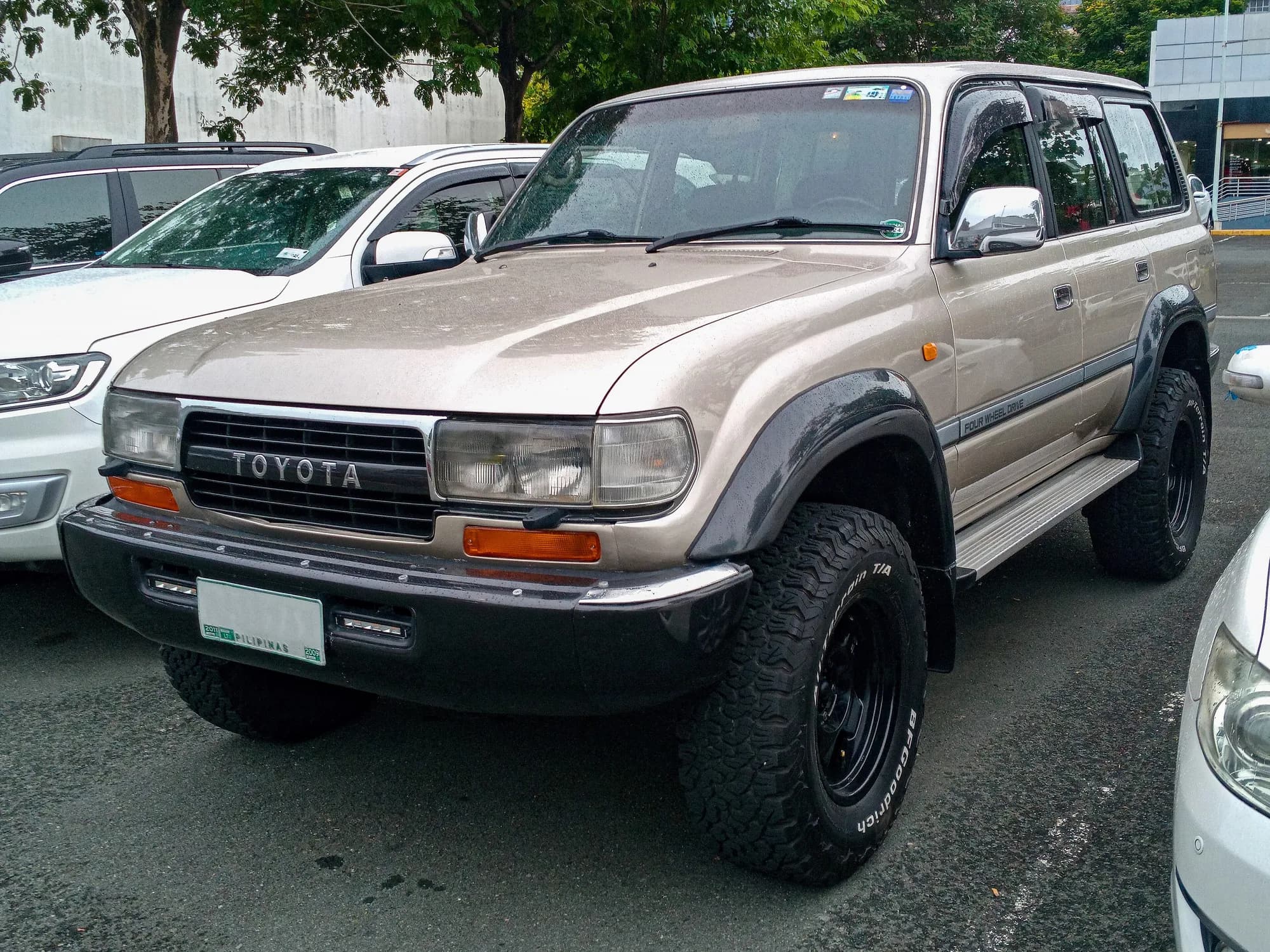
In the space of one week in April 2026, a 1992 Land Cruiser sold for $4,300 and a 1997 sold for $94,500. Both were U.S. 80 Series trucks, built a few years apart on the same basic design.
That spread is the reason to buy carefully. Age has separated these trucks by condition, engine and equipment far more than by model year, and a cheap one can end up costing more than a clean one within a couple of years.
FJ80 or FZJ80: start with the engine
Toyota introduced the 80 Series in the U.S. in spring 1990 as a 1991 model. It brought coil springs, solid axles front and rear, and the first Land Cruiser full-time 4WD system that could stay engaged on dry pavement, with a locking center differential to back it up.
The first trucks used the 3F-E, a 4.0-liter pushrod six with fuel injection and 155 hp, essentially carried over from the 60 Series. For 1993, Toyota replaced it with the 1FZ-FE, a 4.5-liter, 24-valve DOHC six rated at 212 hp and 275 lb-ft. The new engine made it a much better tow vehicle, and 57 more horsepower is a big step in a truck this heavy.
- FJ80 (1991 to 1992): simpler, slower, often cheaper, and without factory front or rear lockers.
- FZJ80 (1993 to 1994): the 4.5-liter engine and the first chance at factory lockers, in the earlier interior.
- FZJ80 (1995 to 1997): a redesigned dash with airbags. These are generally the most wanted years.
- Lexus LX 450 (1996 to 1997): the same platform and Lexus's first SUV. Clean examples carry a premium.
Sellers use "FJ80" loosely for all of these, so read the VIN. A 1992 starts JT3FJ80, a 1993 or 1994 JT3DJ81, and a 1996 or 1997 JT3HJ85.
The locker question
Every U.S. truck has the lockable center differential. Factory electric front and rear lockers were optional from 1993 through 1997, and few buyers ticked the box. A commonly repeated estimate puts the share at about 7 percent of U.S. trucks in those years, with other guesses as high as 20 percent. No factory count is public.
That scarcity is why you should verify a locked truck physically. A dash switch alone proves little: owners have found a switch in place and the rear actuator missing, and switches, harnesses and control units get sold and moved between trucks. Look for an actuator on each differential, then confirm on a loose surface that each one engages.
Keep the premium in perspective. Aftermarket lockers cost about $2,000 to $4,000 installed. Factory lockers matter to a collector, but if you plan to use the truck, a clean unlocked example with good aftermarket units gives up little on the trail.
Head gaskets: the 1FZ-FE's known weak spot
The 1FZ-FE's reputation has one real blemish. Its head gasket can leak between coolant passages, with the area around cylinder 6 the usual trouble spot. Owners' rough estimates put failures at about one truck in ten by around 150,000 miles. That is a guide, not data, but treat an untouched 150,000-mile engine as a bill that may still be coming.
Expect $2,500 to $5,500 for the job at a shop, and cracked heads sometimes turn up along the way. The engine uses a timing chain rather than a belt, so the head job and a cooling refresh are the main long-term investments.
Heat is the killer here, and neglected cooling systems are the usual suspect. A failed gasket isn't fatal in itself. Continuing to drive afterward is what destroys the motor. Check for:
- Falling coolant level with no visible external leak
- A misfire on cylinder 6
- Combustion gas in the radiator, which a chemical block tester will show
- Milky oil, or any history of overheating
Ask for receipts covering the radiator, hoses, thermostat, fan clutch and heater hoses.
The 3F-E is less troubled but not immune. It has its own cooling headaches too: some hoses are harder to source than 1FZ parts, and owners have found the metal coolant pipe along the block badly corroded. On a truck up to 35 years old, assume the rubber is due unless someone can prove otherwise.
Rust, axles and steering
The frame generally holds up better than most trucks of its age, but climate decides the matter. In the Northeast, a truck past 200,000 miles can be parts-only depending on rust.
Inspect the frame rails, suspension mounts, floor pans, rear wheel wells, rear hatch, window seams and brake lines. Look hard at the frame around the steering box too, for cracks as well as rust. A reinforcing plate there doesn't prove the damage under it was fixed. Fresh paint or heavy undercoating underneath means you should ask what it covers.
Mechanical checks cost little compared with what they can save:
- Front axle: look for grease leaks and listen for clicking at full lock. A rebuild is common and runs about $1,800 to $3,200.
- Steering: wander or play can point to a box costing up to $3,000.
- Drivetrain: shifts should be smooth with no slipping. Repairs can run $2,000 to $3,500.
- Rear axle and brakes: check the rear axle studs and handbrake.
- Modifications: don't pay extra for lifts, tires and lights. They tell you nothing about engine or chassis health.
Pay an independent mechanic who knows these trucks to inspect yours, and budget $3,000 to $8,000 for first-year catch-up even on a good one.
What to pay in 2026
Recent sales show how wide the range runs:
- FJ80: a 1991 sold for $14,000 in April 2026 and another for $27,500 in May. That same May, a 1992 made $15,750 and another made $33,000.
- FZJ80: a 1996 brought $23,000 in March 2026, and a 1997 brought $38,500 in February. A 1995 made $55,555 in May.
- Special editions: 1997 40th Anniversary trucks sold for $59,000 in February 2026 and $45,000 in March. Collector's Editions made $43,750 and $27,000 in May.
The average recorded sale sits around $23,000, and asking prices for FZJ80s this spring mostly ran from about $16,000 to $38,000. Prices have cooled a little since the 2022 peak, especially for average trucks.
The order of priorities follows from all this. Pay for rust-free metal and paperwork first, the engine second and lockers third. Parts and labor can fix almost everything on an 80 Series except a rotten frame, and that is the one repair no amount of money makes sensible.