There was a time when telling someone your car ran a ten meant something specific. It meant years and money you didn't have, broken parts, learning to weld, and at least one night sleeping in a trailer at a track. The number was a receipt.
Now a ten-second car is a finance application.
What the EV actually did
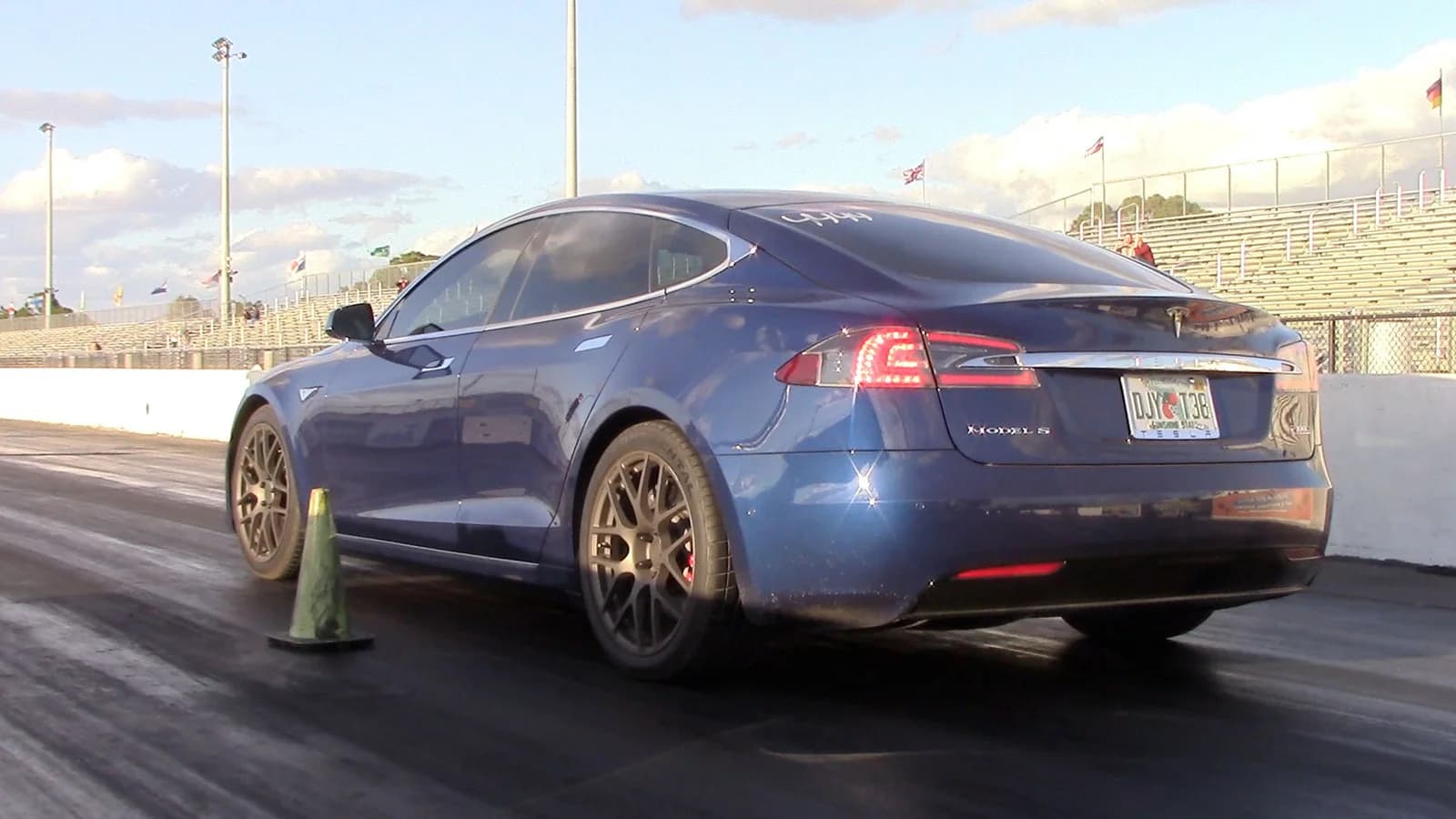
A dual-motor electric sedan will run deep into the elevens straight off a dealer lot, driven by somebody who has never launched a car in their life. A tri-motor one gets into the nines on a prepped surface. No tuning, no practice, no bottle, no clutch.
That isn't an insult to the cars. It's an extraordinary piece of engineering, and the consistency should impress you more than the elapsed time does. A properly cooled EV repeats the same 60-foot run after run because there's no torque curve to manage and no clutch to slip. Traction control on an electric car is instant in a way no mechanical setup can match, because the motor making the power is the same device cutting it.
But it does mean the quarter mile has lost its function as a filter. When the number can simply be purchased, the number stops telling you anything about the owner.
The strongest version of the other side
Drag culture has always absorbed shortcuts and then decided, a few years later, that they were legitimate.
Nitrous was cheating until it wasn't. Turbos were cheating until everyone had one. The LS swap took decades of hard-won small-block knowledge and turned it into a catalog order. Dual-clutch gearboxes deleted the single hardest skill in drag racing, the launch, and nobody's handing back trophies over it.
Every one of those made a fast car more accessible, and every time, the culture swallowed the technology and moved the goalposts to whatever remained difficult. The EV is that same move at a larger scale and a faster pace. Being annoyed at it is being annoyed at the last twenty years arriving all at once.
Where EVs still lose
Do it twice.
That's where the argument gets honest. Heat is the enemy, and a hard pass dumps serious energy into a pack. Most street EVs will give you one or two proper runs before the software starts managing temperature, which at a test-and-tune night means watching everybody else while your car cools down. A built combustion car with a decent intercooler and a bag of ice will run all evening.
State of charge matters too. Peak output usually needs a high state of charge, so your fifth run isn't your first run.
And there's almost no craft in it. Press the pedal, keep the wheel straight, read the number. There is nothing to be good at, and that's what people are really complaining about when they say EV drag racing is boring. They aren't wrong. Two cars that demand nothing from their drivers going very fast in a straight line is a thing that happens rather than a thing you follow.
What replaced it
The culture didn't die, it relocated. The metrics carrying status now are the ones EVs are worse at, or the ones that still require something from the driver.
- Roll racing. 60 to 130 mph is the figure that circulates, and it rewards sustained power over launch, which is exactly where single-speed EVs fade.
- Repeatability. Did it do it twice, at the same track, on the same day, is now a real question people ask out loud.
- Corners. A generation raised on drift and time attack content keeps a different scoreboard than one raised on 1320 videos.
None of that is coincidence. Status attaches itself to whatever is still hard, and it always has.
The take
The quarter mile didn't stop mattering. It stopped being a personality.
It remains the fairest and most brutally honest measurement in car culture. You can't argue with a timeslip, and there's no dyno-graph nonsense in it. What changed is that an elapsed time no longer implies anything about the effort behind it, so it can't carry your whole identity anymore.
If you built a ten-second car, you know what it cost. If you bought one, you also know what it cost. Those are two very different sentences, everyone can tell them apart, and honestly that's a healthier place for the scene to be than it was when a number on a piece of paper was allowed to speak for you.