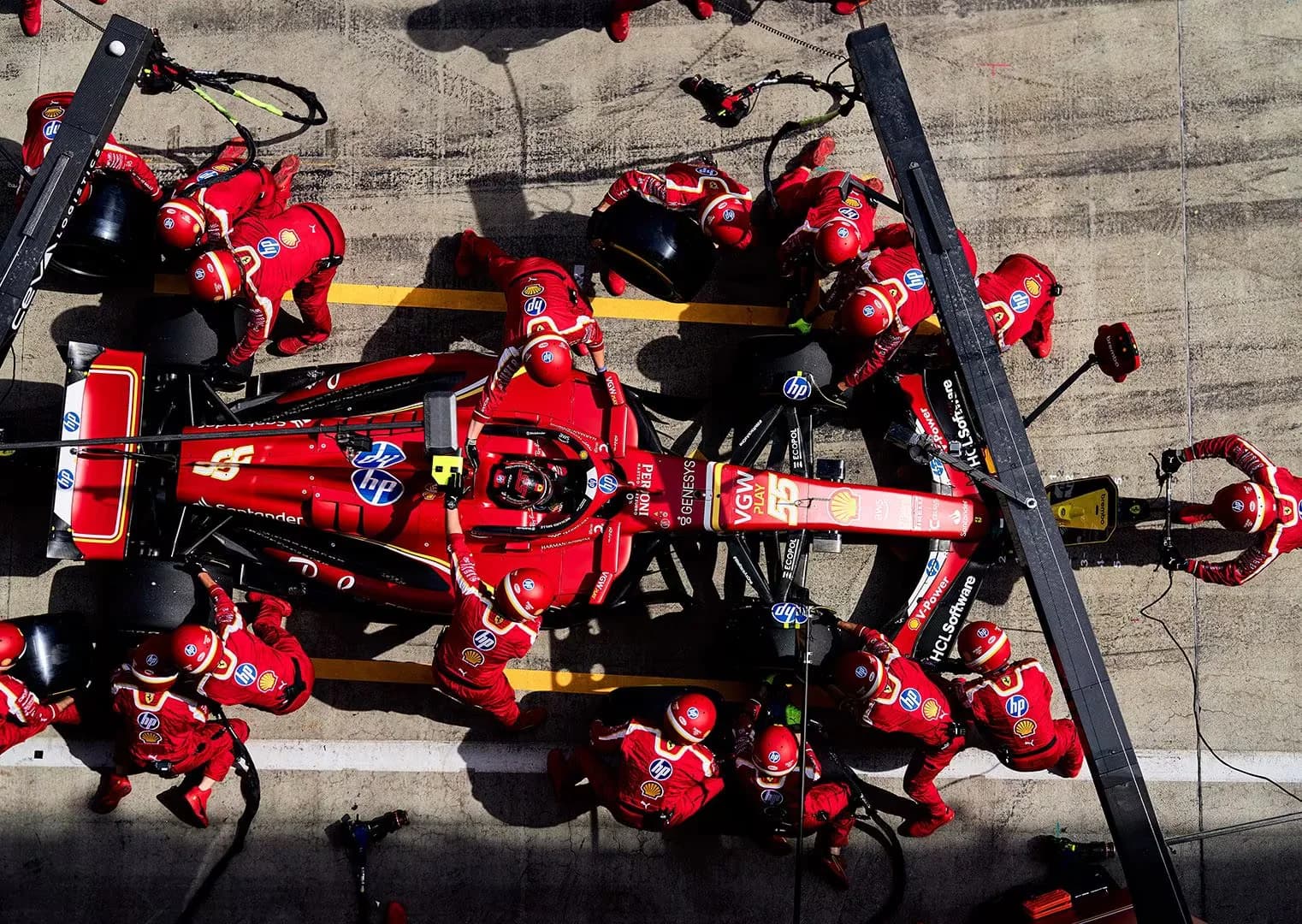
A pit stop is a trade: lose time leaving the circuit, servicing the car and returning, in exchange for something useful. In Formula 1 that often means a different tire state. The interesting part is whether the benefit arrives soon enough, and in the right place, to recover the loss.
There is no universal twenty-second answer. Pit-lane layout, the applicable speed limit, service time and the state of the race all affect the calculation.
Start with a simplified example
Imagine a stop costs 20 seconds relative to continuing on track. If fresh tires then save exactly one second per lap for 20 laps, that advantage would repay the loss.
Those are illustrative numbers, not a typical result or a prediction. Real tire performance changes over a stint. Traffic can consume the advantage, a slow stop can enlarge the loss, and the race may end before the investment pays back.
The useful habit is to compare the whole sequence. A quick stop is valuable, but it cannot rescue every poor decision about when to make it.
The undercut uses the earlier stop
An undercut attempts to gain position by stopping before a rival and using the subsequent pace advantage while that rival is still on older tires. When both have completed their stops, the order may have changed.
It depends on the new tires providing useful performance quickly enough. An out-lap spent warming them, or following traffic, can prevent the expected gain.
Formula 1's analysis of the 2021 Monaco strategy battle explains the relationship between the old-tire in-lap and new-tire out-lap.
The overcut uses the laps left available
An overcut attempts the opposite sequence: stay out after the rival stops and gain enough time before making your own stop.
That can work when the existing tires remain effective and the rival's new set takes time to perform. Clear air matters too. The same choice can produce a different result if the driver rejoins behind a slower group.
Neither tactic guarantees a pass. They are ways to use a temporary difference in pace, with the pit stop completing the comparison.
Tire condition is more than wear
The remaining tread does not tell the whole story about performance. Temperature, surface condition and the loads imposed by the car also matter.
A driver who temporarily eases the pace may be managing temperature or preparing for a later phase of the race. That should not be confused with a claim that all degradation is reversible. The team needs evidence about the actual tire behavior, rather than treating every loss of grip as the same problem.
Neutralization changes the calculation
A safety car or virtual safety car changes how quickly cars circulate outside the pit lane. That can reduce the relative cost of a stop, subject to the situation and the applicable rules.
The opportunity is not literally free. Position, traffic, pit access and the timing of the neutralization still matter. A driver who stopped shortly before it may be disadvantaged, but the effect has to be assessed from the actual race sequence.
Watch the gaps, the recent lap trend and the likely rejoining position. The wheel-gun work is the visible moment; much of the result comes from the decision made before the car reaches the box.
Updated September 5, 2026: made the timing example explicit and removed unsupported universal costs, tire rules and claims about strategy deciding every race.