The engine that lets go on the dyno usually does not die from too much air. It dies from not enough fuel arriving at the exact moment it needed the most, and the failure was designed into the plumbing weeks before anyone touched a boost controller.
Fuel systems are the least glamorous part of a build and the most reliably skipped. Here is the whole chain, in the order the fuel travels.
The pump, and why voltage matters
A pump's flow rating is a headline number measured at one specific pressure and one specific voltage. Real flow drops as pressure rises, which is precisely what happens under boost, and drops again when tired wiring sags voltage under load.
That is why people running a well-known 255 still go lean. A pump near its ceiling at roughly 43psi base pressure is well past comfortable once boost pressure gets added on top through the regulator. If you are approaching the limit, the fix is a bigger pump, better wiring with a relay and heavier gauge, or both.
Lines, filters, and everything between
Restriction anywhere is restriction everywhere. A clogged sock in the tank, an original filter nobody has ever changed, or a factory feed line sized for a factory engine will all cap a pump that is otherwise perfectly healthy.
Return-style systems hold pressure more consistently under sustained load than returnless ones. Direct injection cars add a second bottleneck: the cam-driven high pressure pump is often the real limit, and a bigger in-tank pump does absolutely nothing about it.
Injector sizing without the mystery
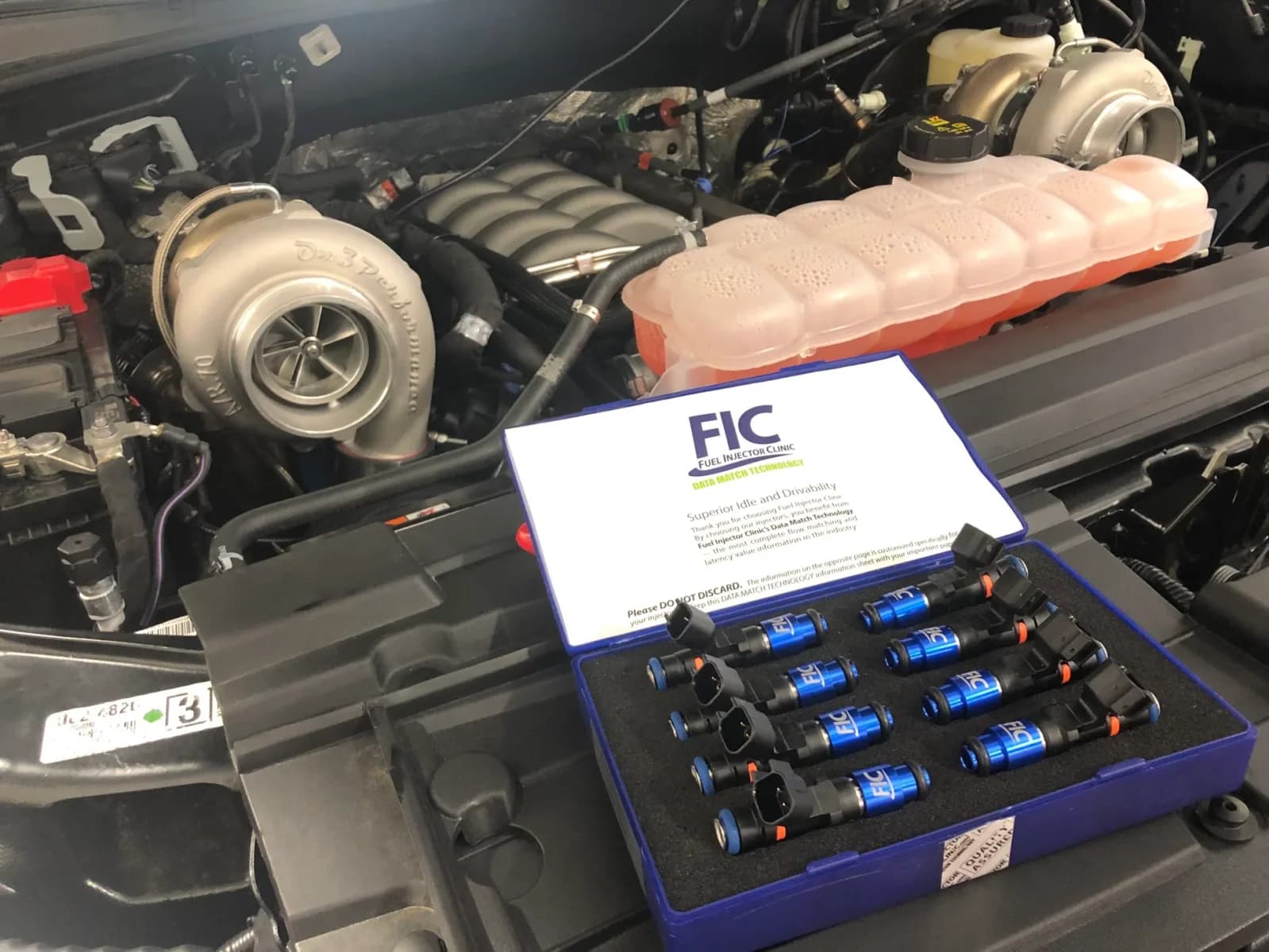
Injectors are rated in cc/min or lb/hr and sized against a power target and a duty cycle. Most tuners work to keeping steady-state duty below roughly 85 percent, because an injector held near fully open has no reserve when something goes wrong.
Two things people get wrong:
- Bigger is not automatically better. An oversized injector has poor control at small pulse widths, which shows up as a rough idle and miserable cold starts unless the ECU has proper characterization data for it.
- Dead time is not optional. Injectors take milliseconds to open and close, and that latency shifts with voltage. An ECU without correct dead time data will be wrong at idle even when it is right at redline.
What E85 actually asks for
Ethanol carries less energy per unit volume and burns at a richer stoichiometric ratio, roughly 9.8:1 against gasoline's 14.7:1. In practice you need somewhere in the region of 30 to 40 percent more fuel volume for the same amount of air.
That single fact drives the entire shopping list: bigger injectors, bigger pump, sometimes bigger lines. In exchange you get serious evaporative charge cooling and excellent knock resistance, which is why E85 remains the cheapest real power adder available to a boosted car.
The catches are real:
- Pump E85 is not a fixed blend. Content varies by station and by season, sometimes a lot.
- Cold starts get worse, and get worse faster the colder it is.
- Older fuel systems with aged rubber and unlined steel tanks do not always tolerate it.
- Range drops noticeably, because you are burning more of it.
A flex fuel sensor solves the blend problem by letting the ECU read ethanol content and adjust fueling and timing in real time. On any car that will see mixed fuel, it is the best money in the system.
Why a tune is not optional
Every component above changes what the ECU believes it is doing. New injectors change the relationship between pulse width and fuel mass. A new pump changes pressure behavior. A different fuel changes both the target ratio and the safe ignition timing.
An untuned car compensates through closed-loop fuel trims, which only operate across a narrow range and only while the oxygen sensor is in the loop. Wide open throttle is usually open loop, meaning the ECU is executing a table someone wrote for the factory configuration on factory fuel. That is the exact condition under which engines break.
A tune is not a power upgrade you add at the end. It is the thing that makes everything you already bought safe to use.
Do it in this order
Fuel system headroom first, then the power. Build for where the car is going rather than where it is, because dropping the tank twice costs more than doing it properly once.
The cars that survive years of hard use share one trait: their owners spent money on the boring end of the fuel rail before they spent it on the loud end of the engine.