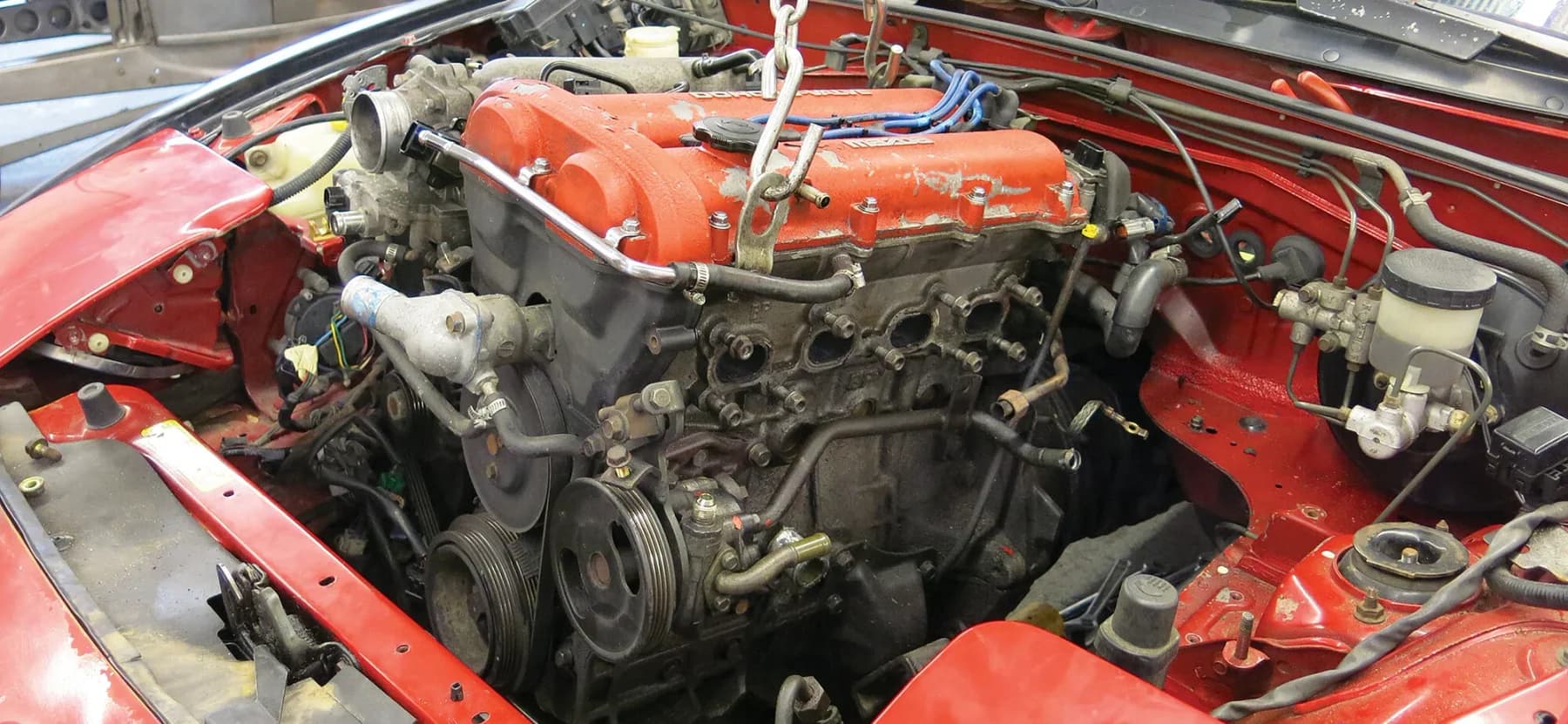
The engine is the cheap part. That sounds wrong until you have priced out everything that has to exist around it, at which point it becomes the truest sentence in the hobby.
A used donor motor is a known number you can find in ten minutes of scrolling classifieds. Everything below is what actually eats the budget, and most of it does not exist as a single item you can put in a cart.
Mounts and the space they live in
Swap mounts are the easy version of the problem. Either a company makes a kit for your combination or nobody does, and if nobody does, you are making brackets. That means fabrication, which means either a welder and skill you may not have, or shop hours.
Even with a kit, budget for knock-on effects: steering shaft clearance, oil pan versus crossmember, hood clearance, and accessory brackets that suddenly touch the frame rail. A kit solves the mount. It does not solve the packaging.
Wiring, the actual boss fight
This is where swaps die. An engine needs its ECU, its sensors, clean grounds, its immobilizer sorted out, and a working handshake with a chassis built to talk to a different computer entirely.
Three options, roughly:
- Standalone ECU. Clean, expensive, and useless without someone competent to configure it.
- Reworked factory harness. Cheapest in dollars, most expensive in hours, and it punishes sloppy work with intermittent faults you will chase for months.
- Plug-and-play harness from a specialist. Real money, enormous sanity savings, and worth it more often than pride will admit.
Gauges, ABS, traction control and half your dash lights all live downstream of this one decision.
Cooling, which everyone underestimates
A bigger engine makes more heat than the original cooling system was designed to remove, and the radiator that fits is not always the radiator you need. Expect to sort out core sizing, fan control that now has to come from somewhere, hose routing that probably needs custom lines, and a heater circuit that still has to work if you plan to drive this thing in winter.
Overheating is the single most common reason a freshly finished swap goes straight back on the lift.
The driveline behind it
More torque arriving at a transmission that was never asked to handle it ends one way. Budget for the gearbox, then budget again for what connects it: an adapter plate or bellhousing, clutch and flywheel, a custom driveshaft, shifter relocation, and axles that may or may not survive the first clutch dump.
Final drive ratio matters too. A swap that changes redline or power delivery can leave you with gearing that makes the car feel worse in traffic than it did before.
Fuel, exhaust, and the small stuff
The factory pump was sized for the factory engine. New engine, new demand, and on any boosted swap that means a pump, probably injectors, possibly larger lines.
Exhaust from the head back is almost always custom. Even with off-the-shelf headers, somebody is fabricating a mid-pipe. Then the small stuff: fluids, filters, sensors, hardware, hose, connectors, and the four trips to the parts store every weekend that quietly total more than the engine did.
Legality and the paperwork nobody mentions
Emissions rules vary wildly by state and country, and "it passes the visual" is a strategy rather than a plan. Some jurisdictions require the swapped engine to be the same year or newer than the chassis with its emissions equipment intact. Some do not care at all. Find out which one you live in before the old motor comes out.
Insurance is the other half. A modified car with an undeclared engine is a denied claim waiting to happen, and the conversation you want to have with an underwriter is the one before the crash.
What this actually means
Take the number in your head, double it, then add the cost of not having the car for a year.
None of this is an argument against swapping. Swaps are one of the great expressions of this hobby and a good one is worth every hour. It is an argument against starting one with engine money and nothing else, because a shell on stands for three years with a perfect motor sitting in it is not a build. It is furniture.