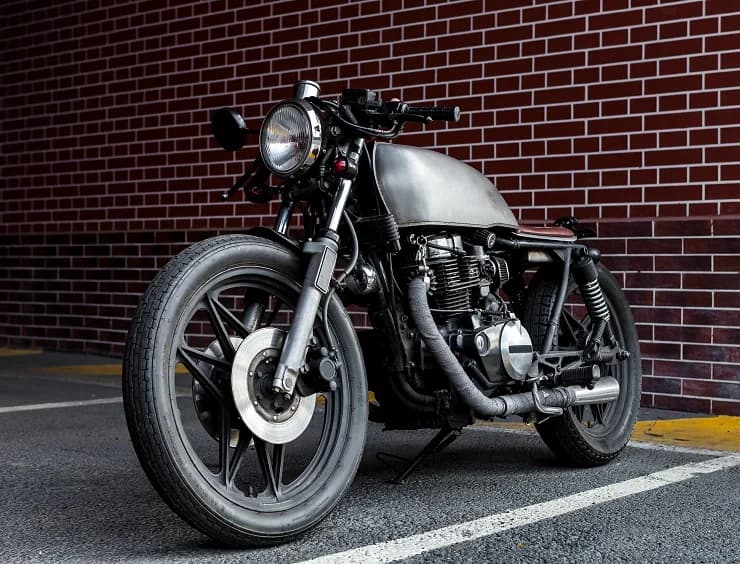
You've seen the build. Bare metal tank, stubby seat with a welded loop, clip-ons, no signals, pod filters, tires with about as much sidewall as a dinner plate. It photographs beautifully. It also gets ridden roughly twice a month, for twenty minutes, on a road with no bumps.
There's nothing wrong with building a bike for looks. There's something wrong with building a bike for looks and then telling yourself it's a cafe racer, because the original ones were solving problems, and the modern ones mostly create them.
What the originals were actually for
Late-1950s Britain, transport cafes on the arterial roads, riders on stripped production bikes trying to see 100mph. That's the ton, and that's the whole scene in a sentence.
Every part of the look was function. Clip-ons and rearsets let you get into a tuck and gain lean clearance. Alloy tanks and cut-down seats removed weight. A Triton — Triumph engine in a Norton Featherbed frame — existed because one company built the better motor and the other built the better chassis. Nobody welded a seat hoop because it looked good on a phone screen.
The bolt-on identity kit
Modern version: buy a tired CB550 or XS650 or GS500, cut the subframe, weld a hoop, fit a thin seat, bin the airbox for pod filters, fit a headlight the size of a coin, delete the signals.
Result: a bike that's uncomfortable in fifteen minutes, runs badly because pods without a rejet or remap lean it out through the midrange, is illegal in most jurisdictions without indicators, and still has the same forty-year-old suspension and brakes it had before you spent $3,000.
The parts weren't chosen for what you do on the bike. They were chosen for what the bike says. That's a costume, not a build, and the giveaway is always the same: the suspension is untouched.
Scramblers have the same disease
High pipes that cook your right calf. Knobby tires that squirm on tarmac and wear out in 3,000 miles. A 19-inch front on a bike with four inches of travel and no bash plate, sold as off-road capability by people who have never taken it off road.
The desert sleds this look descends from were street bikes stripped for genuine rough-terrain use: real ground clearance, protected cases, suspension that could absorb a hit. The modern equivalent of that spirit is a used dual-sport, and it costs less.
What a good build looks like
Decide what ride you actually take, then mod in this order: tires, suspension, brakes, ergonomics, aesthetics. Suspension first is the least Instagram-friendly and most transformative money you can spend on any older bike — fresh fork oil, correct-rate springs, a rear shock built in this century.
Keep the airbox unless you're paying for a dyno session. Keep the signals. Get the seat height and bar position right for your body and your commute. Then, once the bike is genuinely good to ride, make it look like whatever you want. A cafe racer built in that order is a joy. Built in reverse, it's a garage ornament with a battery tender on it.
Supermoto is the honest version
The build that actually delivers on the promise is a supermoto. Take a dirt bike, fit 17-inch wheels and sticky rubber, add a big front disc, and you have a machine that is genuinely better than anything else in a city: light, upright, huge steering lock, brakes that will stand it on the nose, suspension that treats potholes as suggestions.
Suzuki sold the DR-Z400SM ready-made for years, which is why used ones hold their money. A converted WR250 or a KTM enduro does the same job. Nobody builds one to look good. They look good because everything on them is there for a reason, which is the same accident that made cafe racers cool in the first place.
The two-stroke thing sits in a similar place. An RD350 or an RGV250 is a genuinely thrilling object and the smell of premix will outlive us all, but parts are scarce and expensive and it is a project, not transport. Go in knowing that and it's a wonderful way to spend a winter. Go in thinking it's a commuter and you'll be pushing it home.
Build what you'll ride. The people whose bikes look best are almost always the people whose bikes have chain lube slung on the swingarm, and that isn't a coincidence.