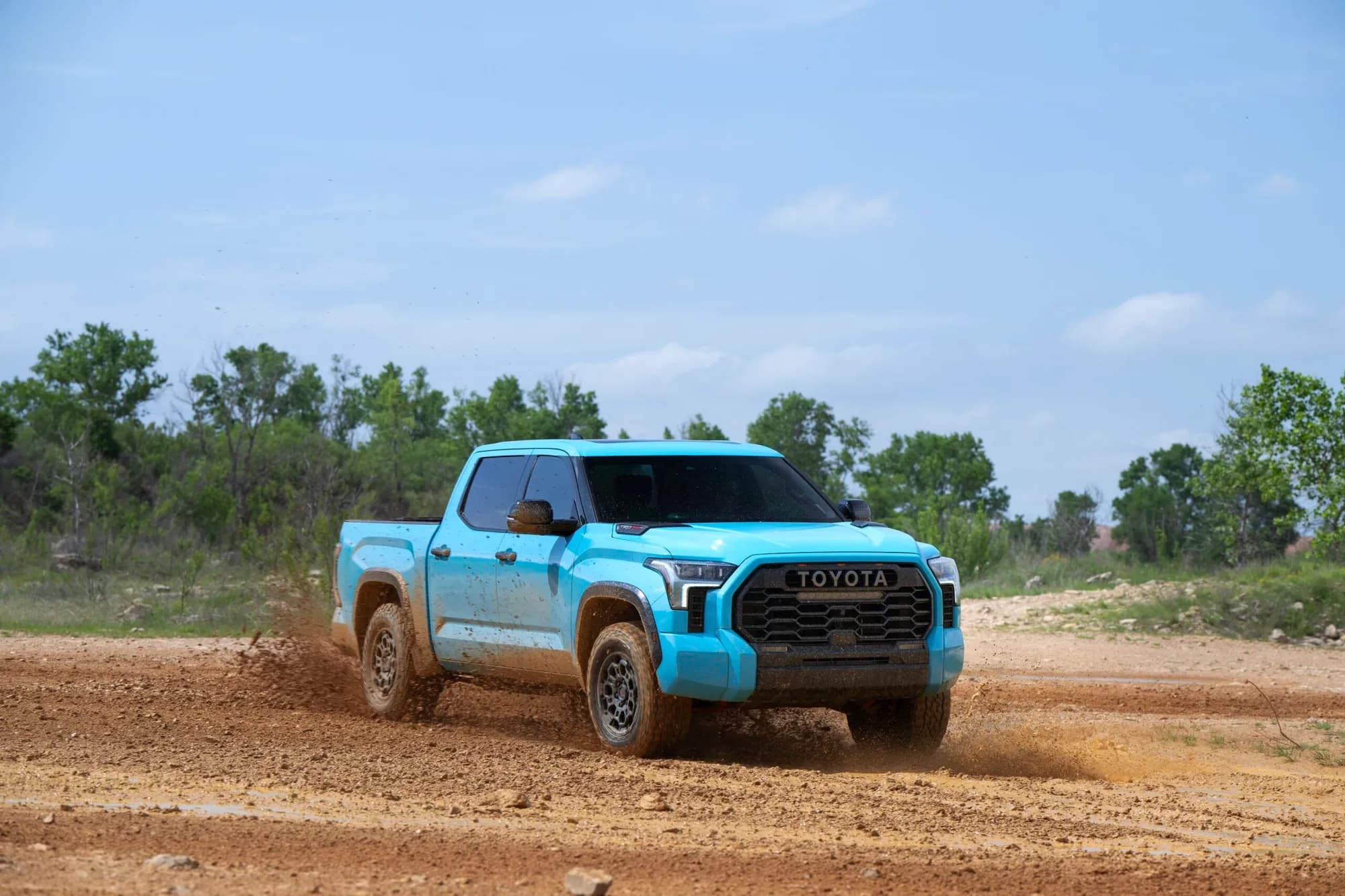
Toyota has now recalled the third-generation Tundra's twin-turbo V6 three times for the same basic reason: metal debris left over from machining inside the engine. The campaigns cover about 102,000 vehicles in 2024, nearly 127,000 in 2025 and more than 43,500 in 2026, and they are the first thing anyone shopping a used Tundra needs to understand.
That matters because the engine itself was the headline of this truck. When Toyota dropped the 5.7-liter V8 for 2022, it replaced the old truck's most beloved feature with a smaller engine that, above the base SR, beat it on both horsepower and torque.
What replaced the V8
The outgoing 5.7-liter made 381 hp and 401 lb-ft. Its replacement is the V35A, a 3,445-cc twin-turbo V6 that Toyota sells in three states of tune:
- SR: 348 hp and 405 lb-ft
- i-Force, in most trims: 389 hp and 479 lb-ft
- i-Force Max hybrid: 437 hp and 583 lb-ft
All of them use a 10-speed automatic. The headline gain is torque. The i-Force Max makes 182 lb-ft more than the V8 did, and it peaks at just 2,400 rpm, so the truck doesn't have to rev or kick down to pull hard.
The hybrid hardware is simple in concept. An electric motor-generator rated at 48 hp and 184 lb-ft sits in the bell housing between the engine and the transmission, fed by a 288-volt nickel-metal hydride battery of 1.87 kWh under the rear seat. It isn't a plug-in and won't go far on electric power. Its job is filling in low-speed torque.
The rest of the truck moved on too. A multi-link rear suspension with coil springs replaced the old leaf springs, and Toyota raised maximum towing 17.6 percent to 12,000 pounds, with payload up to 1,940 pounds. The top tow rating belongs to the non-hybrid truck, though. Toyota rates the hybrid at up to 11,450 pounds.
Fuel economy is modest for a hybrid. A two-wheel-drive i-Force Max is EPA-rated at 20 mpg city, 24 highway and 22 combined.
What went wrong inside the engine
The fault centers on the crankshaft main bearings. During a specific production period, machining debris of a particular size and amount may not have been cleared from the engine. If that debris sticks to a bearing and the engine keeps working at higher loads over time, the bearing can fail, and Toyota has narrowed the problem to the No. 1 main bearing.
The symptoms are engine knocking, rough running, failure to start or a stall while driving, and the risk of losing power at speed is why this is a safety recall. Toyota told NHTSA it can't estimate how many of the recalled vehicles actually contain the defect.
The recall has grown in stages, and each one reached later trucks:
- May 2024 (24V-381): 102,092 model-year 2022 and 2023 Tundras and Lexus LX SUVs.
- November 2025 (25V-767): 126,691 vehicles, including 113,079 Tundras from model years 2022 through 2024, built from November 22, 2021 to February 14, 2024. It also covers 9,895 Lexus LX and 3,717 Lexus GX models.
- May 2026 (26V-320): 43,566 model-year 2024 Tundras, built before Toyota introduced an improved No. 1 main bearing.
In that third campaign, Toyota counted 30 field technical reports and 360 warranty claims potentially tied to the condition. The engines in question come from plants in Huntsville, Alabama, and Tahara, Japan.
The fix has changed too. Under the first recall, dealers replaced engines. For the two later campaigns, dealers use inspection software and drive data to assess the No. 1 main bearing, and they replace the engine at no charge only if the bearing can't be cleared. A truck can therefore come through the recall with its original engine, and that isn't necessarily a problem, but a buyer should know which outcome applies.
What to check before you buy
The campaigns cover non-hybrid engines. A hybrid i-Force Max truck falls outside them, which is a real point in its favor on the used market, though every truck deserves the same check.
For any 2022 to 2024 Tundra, do this before you talk price:
- Enter the VIN at NHTSA's recall lookup and note every open campaign.
- Ask for dealer paperwork showing the inspection result or the engine replacement.
- Listen for knocking or rough running on a cold start and under load.
- Treat any truck with an open recall and no paperwork as an unresolved risk, and price it that way.
A truck with a documented replacement engine may be the safer used buy, since it has moved on from the original debris problem. Remember that the recall also covers some service-part engines, so a replacement alone doesn't settle the question unless the recall work has been recorded against that VIN.
Don't treat a quiet engine as a clean one. Toyota says the failure develops at higher loads over time, so a truck that has spent its life towing deserves more questions, not fewer.
Which Tundra makes sense now
For 2026, the lineup starts at $43,355 for the SR and $48,605 for the SR5, with the Limited at $56,955, including a $2,095 destination charge. The hybrid adds $3,700 to $3,925 on the Limited, Platinum and 1794, and it's standard on the $74,660 TRD Pro and $82,895 Capstone.
The 2027 refresh brings a reshaped front end, a standard 14-inch touchscreen, a digital cluster and a new Trailhunter package based on the SR5 with Old Man Emu suspension. Because it's built on the SR5, the Trailhunter uses the non-hybrid engine. The V8 isn't coming back, and the V35A carries on with its improved bearing and manufacturing changes.
That makes the choice fairly clear. If you want a new one, the i-Force Max is worth its modest premium for the torque alone, and a late-build truck comes with the updated bearing. If you want a used one, the price should reflect exactly where that truck stands in the recall, because in this generation the VIN matters more than the trim badge.