In the third quarter of 2026, Ford sold 27,793 Maverick Hybrids. In the first nine months of the year, Hyundai sold 14,811 Santa Cruz trucks of every kind.
That single comparison sums up the compact pickup market. Both trucks launched for 2022 with the same basic idea, a crossover-based pickup that fits in a garage and costs far less than a full-size truck. One has become one of the most important vehicles Ford sells, while the other is fighting for its future.
The sales gap keeps growing
Ford sold a record 155,051 Mavericks in 2025, up 18.2 percent, and 81,034 of them were hybrids. Through September 2026, it had added another 123,681, up 2.3 percent, with a third-quarter jump of 20.4 percent to 41,970.
Hyundai sold 25,499 Santa Cruz trucks in 2025, down about 20 percent, which put it at roughly one for every six Mavericks. Its 2026 total through September is down another 28 percent. Third-quarter sales were 4,830, against 6,412 a year earlier.
Hyundai hasn't confirmed any end date and has said its lifecycle plans remain unchanged. It has published pricing for a 2027 model, though with fewer trims, and the truck has stopped being imported into Canada. Hyundai's next pickup for North America is a different idea altogether, a body-on-frame midsize truck planned for before 2030. Treat the 2027 as what it looks like, a carryover truck near the end of its run.
Where the two trucks actually differ
On paper the Santa Cruz isn't the weaker truck, and in some respects it's the stronger one:
- Base engine: Maverick 191-hp hybrid or 250-hp 2.0-liter turbo. Santa Cruz 191-hp 2.5-liter, no hybrid offered.
- Top engine: Maverick 250-hp turbo. Santa Cruz 281-hp turbo with 311 lb-ft.
- Maximum towing: Maverick 4,000 pounds with the 4K Tow Package. Santa Cruz 3,500 pounds, or 5,000 with the turbo.
- Bed: Maverick 4 feet 5 inches and 33.3 cubic feet. Santa Cruz about 52 inches and 27 cubic feet, with a lockable under-bed trunk.
- Fuel economy: Maverick Hybrid 42 mpg city with front-wheel drive and 40 with all-wheel drive. Santa Cruz XRT 18 city, 25 highway and 20 combined.
Hyundai's turbo truck has more power and more towing than anything in the Maverick range, and the trunk under the bed is a good idea. The sales suggest compact-pickup buyers care about something else. A truck rated for up to 1,500 pounds of payload that can pull a small trailer and return 42 mpg in the city gives a homeowner most of what a pickup is for, at a running cost that makes sense for a daily driver.
That's the Santa Cruz's central problem. It has never offered a hybrid. It also looks more like a sport-styled crossover than a truck, an appealing idea to some shoppers and a turnoff to the many who want their pickup to look like one.
Pricing does the rest. For 2027, the Santa Cruz starts at $31,950 for the SE, $36,350 for the SEL Activity and $44,425 for the XRT, including $1,650 freight. Hyundai has dropped the SEL and Limited, which leaves the turbo only in the XRT, so the strongest Santa Cruz now costs well over $40,000. The XL Maverick Hybrid is expected at about $29,990 delivered for 2027.
Lobo and Tremor, the Mavericks with personality
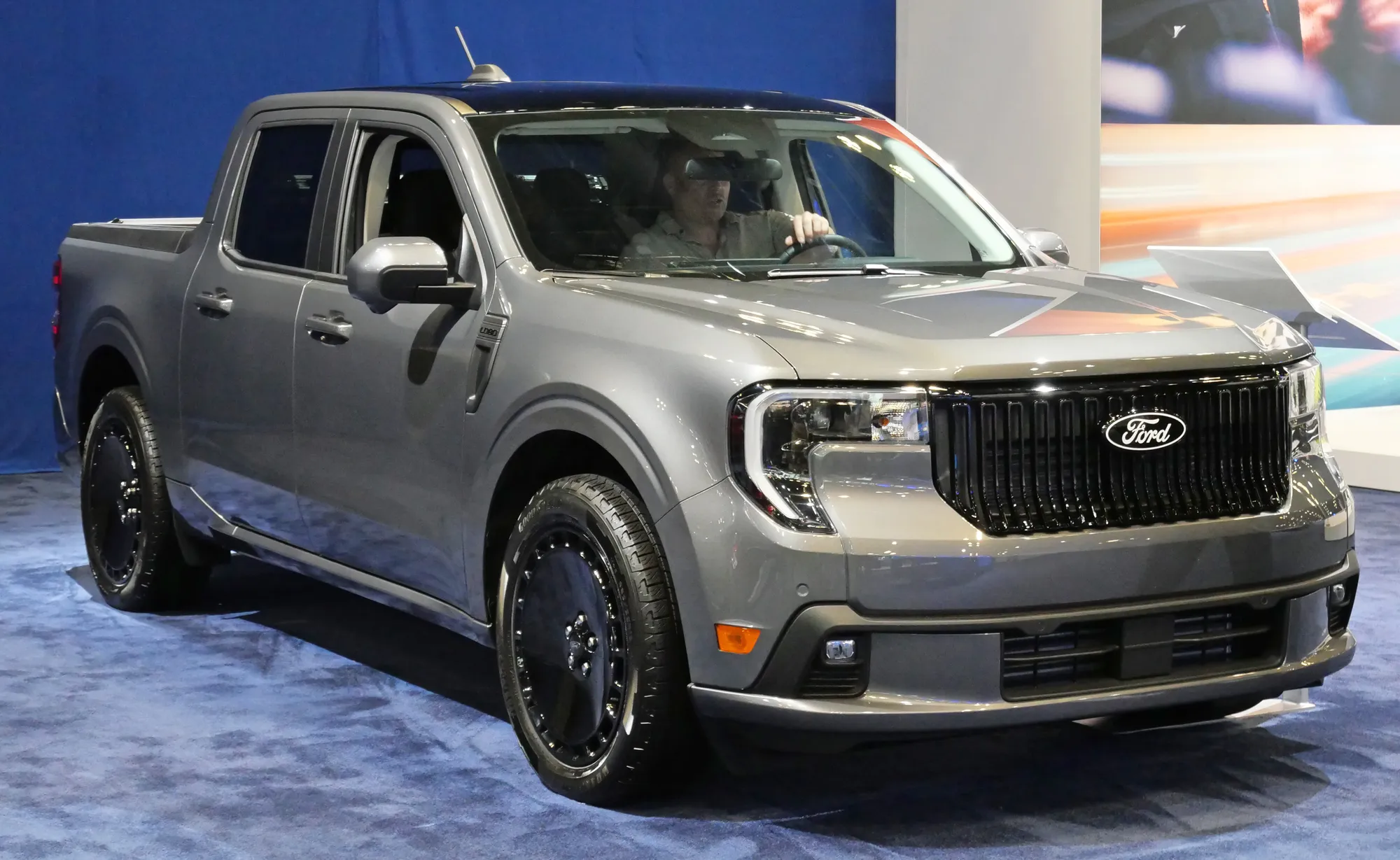
Ford also gave enthusiasts something to want, in two very different directions. Both use the 250-hp EcoBoost with four-wheel drive, and both are limited to 2,000 pounds of towing, since the 4K Tow Package isn't offered on them.
The Lobo is a factory street truck, the sort of thing nobody expected from a compact pickup. It sits half an inch lower in front and 1.12 inches lower in the rear than a standard Maverick, with a roof 0.8 inches lower, tuned springs and shocks, 19-inch wheels and a 7-speed automatic. It also gets larger brakes with dual-piston front calipers, a design from the European Focus ST, and a twin-clutch rear drive unit for torque vectoring. A dedicated Lobo mode reduces understeer and dials back the stability control, and Ford limits it to closed courses.
The Tremor goes the other way. Its off-road tuned suspension adds ground clearance, and it gets 235/65R17 all-terrain tires, an electronic locking rear drive unit and Trail Control, an off-road cruise control for low-speed driving. Ford rates it at 1,140 pounds of payload and 21 mpg city and 27 highway. It suits gravel roads and rutted trails rather than serious rock, but in a truck this size that's what most owners will actually do.
Their pricing has moved in the buyer's favor. For 2026, the Lobo started at $37,625 and the Tremor at $42,340, both with destination. For 2027, the order pricing cuts the base Lobo to about $34,000 and both the Lobo High and Tremor to about $39,000. Ford has also rearranged the range, with the XL and Lariat going hybrid-only and the EcoBoost now paired only with all-wheel drive. Ford hasn't publicly explained those changes, so confirm the numbers on an actual build before you plan around them.
Which one to buy
For most people, it's the Maverick, and specifically the hybrid. It's cheaper to buy and much cheaper to run, the truck has an obviously secure future in Ford's lineup, and it's easy to live with. Pick the Lobo if you want a compact truck that's fun on a back road at around $34,000, and the Tremor if your weekends involve dirt.
The case for the Santa Cruz is narrow but genuine. If you want to tow up to 5,000 pounds with a compact truck, want more power than any Maverick offers or simply prefer the way it looks, the XRT is the only truck here that does all three. A lockable trunk and a tonneau cover that come from the factory on SEL Activity and XRT trucks also help anyone who carries gear they'd rather not leave exposed.
Just go in knowing where it stands. With sales falling and a very different Hyundai pickup planned, this may be the last truck of its kind from the brand, and that should show up in the price you negotiate.