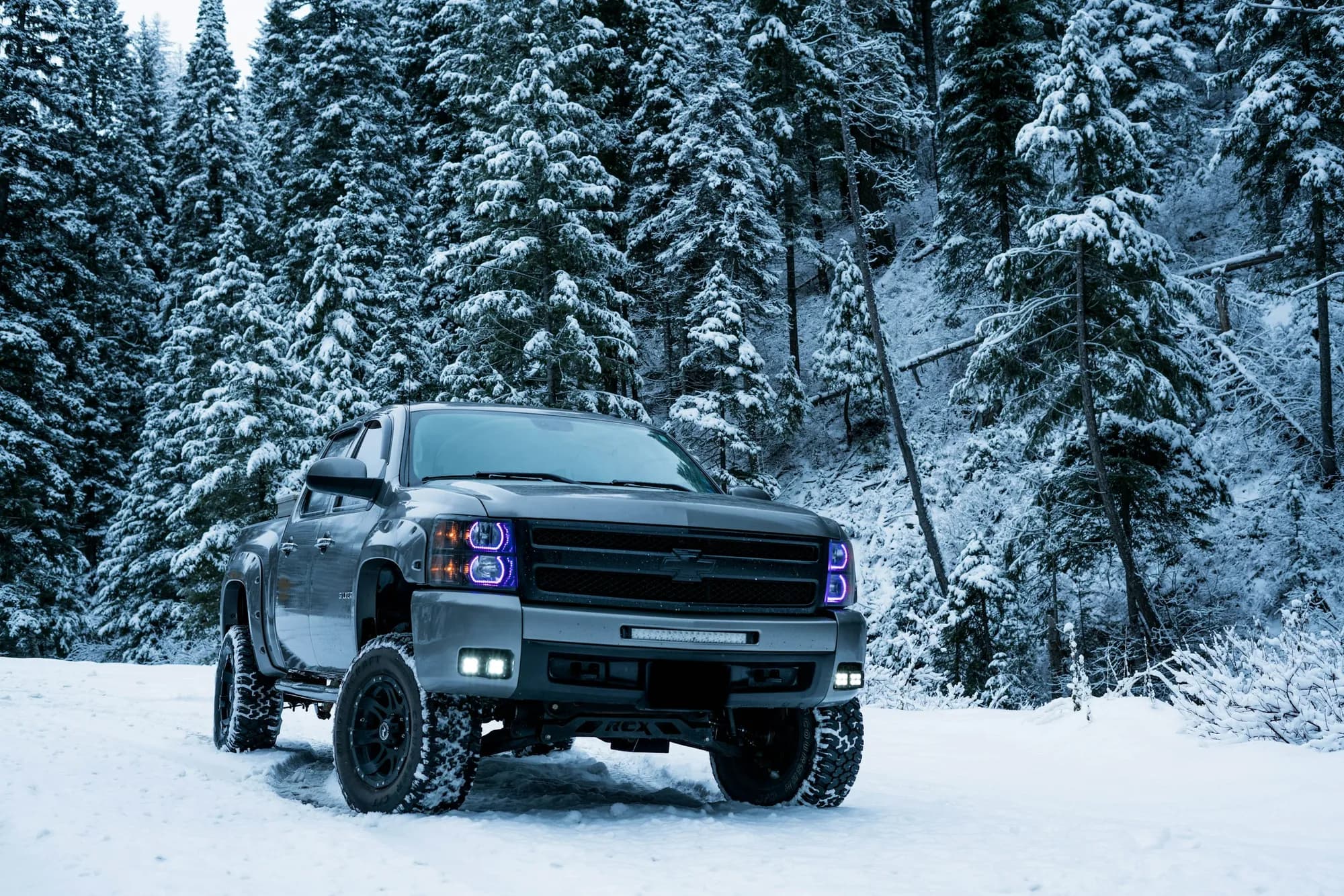
Photo: Drew Lindsley / Unsplash. A lifted pickup in the snow near McCall, Idaho.
If your pickup's all-terrains also serve as its winter tires, two small sidewall markings deserve a closer look. They look similar from a few feet away and mean different things. Before the first mountain trip of the season, it's worth knowing which one your tires carry and what the rules at your destination accept.
Two markings, two meanings
The older marking is M+S, also molded as M&S or M/S. Toyo describes it as identifying a tire designed for mud and snow applications. Toyo's sidewall guide California's chain-control rules lean on the same marking. Caltrans tells drivers to look for MS, M/S, M+S or the words MUD AND SNOW, and cites the state vehicle code's description of a snow-tread tire as one with a relatively deep, aggressive tread pattern. Caltrans chain controls
The newer marking is the three-peak mountain snowflake. BFGoodrich explains that it signifies a tire that meets or exceeds industry-established snow traction performance requirements. BFGoodrich's sidewall guide
The distinction is the useful part. In these definitions, M+S describes how the tread is designed, while the snowflake is tied to a snow-traction performance requirement.
Where all-terrains and mud-terrains land
Several current all-terrains carry the snowflake. BFGoodrich credits a new tread compound and full-depth 3D sipes with allowing the All-Terrain T/A KO3 to wear the symbol. BFGoodrich All-Terrain T/A KO3 Toyo lists its Open Country A/T III as Three-Peak Mountain Snowflake qualified for severe snow conditions. Toyo Open Country A/T III
Mud-terrains are built around different priorities. BFGoodrich's page for the Mud-Terrain T/A KM3 emphasizes mud-release bars, a compound aimed at grip on rock and other slick surfaces, and sidewall protection. It mentions mud and snow traction from the shoulder design but does not claim the snowflake. BFGoodrich Mud-Terrain T/A KM3 Toyo's Open Country M/T page likewise talks about traction in deep mud and snow without claiming the symbol. Toyo Open Country M/T
Treat those as examples rather than a rule for every tire in each category. The marking that counts is the one molded into the sidewall of the exact tire on your truck.
What the road rules ask for
Mountain states set their own requirements, and two western examples show how differently they treat these markings.
Colorado's traction law covers I-70 between Morrison and Dotsero from September 1 through May 31, and CDOT can put it into effect on any state highway when conditions require. Passenger vehicles need tires with at least 3/16 inch of tread that are winter tires or carry the mountain-snowflake or M+S marking, or they must carry chains or an approved alternative traction device. CDOT recommends four- or all-wheel drive in the mountains but does not offer it as a substitute for the tire requirement. A violation costs $100 plus a $33 surcharge, rising to $500 plus a $157 surcharge if it leads to a lane closure. When the separate chain law is in effect, every vehicle needs chains or an approved device. CDOT traction and chain laws
California works in levels. Under R-1, chains are required on all vehicles except passenger vehicles and light-duty trucks under 6,000 pounds gross weight, and vehicles running snow tires must carry chains. Under R-2, four- and all-wheel-drive vehicles with snow-tread tires on all four wheels are exempt, but they must still carry traction devices in chain-control areas. Under R-3, chains or traction devices are required on every vehicle with no exceptions. Caltrans chain controls
The pattern is worth remembering. Properly marked tires with enough tread go a long way under these rules, but in California they don't excuse you from carrying chains, and at the strictest level in both states every vehicle needs chains or an approved device.
A pre-season checklist
Measure tread depth instead of judging it by eye. Colorado's 3/16-inch minimum is a specific number, and a gauge settles it in seconds.
Buy chains or approved devices for your actual tire size and test-fit them at home. BFGoodrich's winter guidance calls for checking clearance between the tire and the vehicle when chains are fitted, which deserves extra attention on trucks running oversized tires. BFGoodrich winter driving tips
Keep expectations realistic. Even BFGoodrich, which sells a snowflake-marked all-terrain, says safe winter driving calls for four winter tires with proper tread. It also notes that all-season and summer compounds harden and lose grip once temperatures stay below 45°F. BFGoodrich winter driving tips A snowflake-rated all-terrain is a capable compromise for mixed use. If your winter means regular ice and frequent mountain passes, a dedicated winter set may still earn its storage space.
Read the sidewall, measure the tread and pack the chains. That covers most of what mountain rules ask of a truck on all-terrains.
Rules summarized from Colorado and California transportation department pages; requirements can change, so check the agency for your route before you travel.