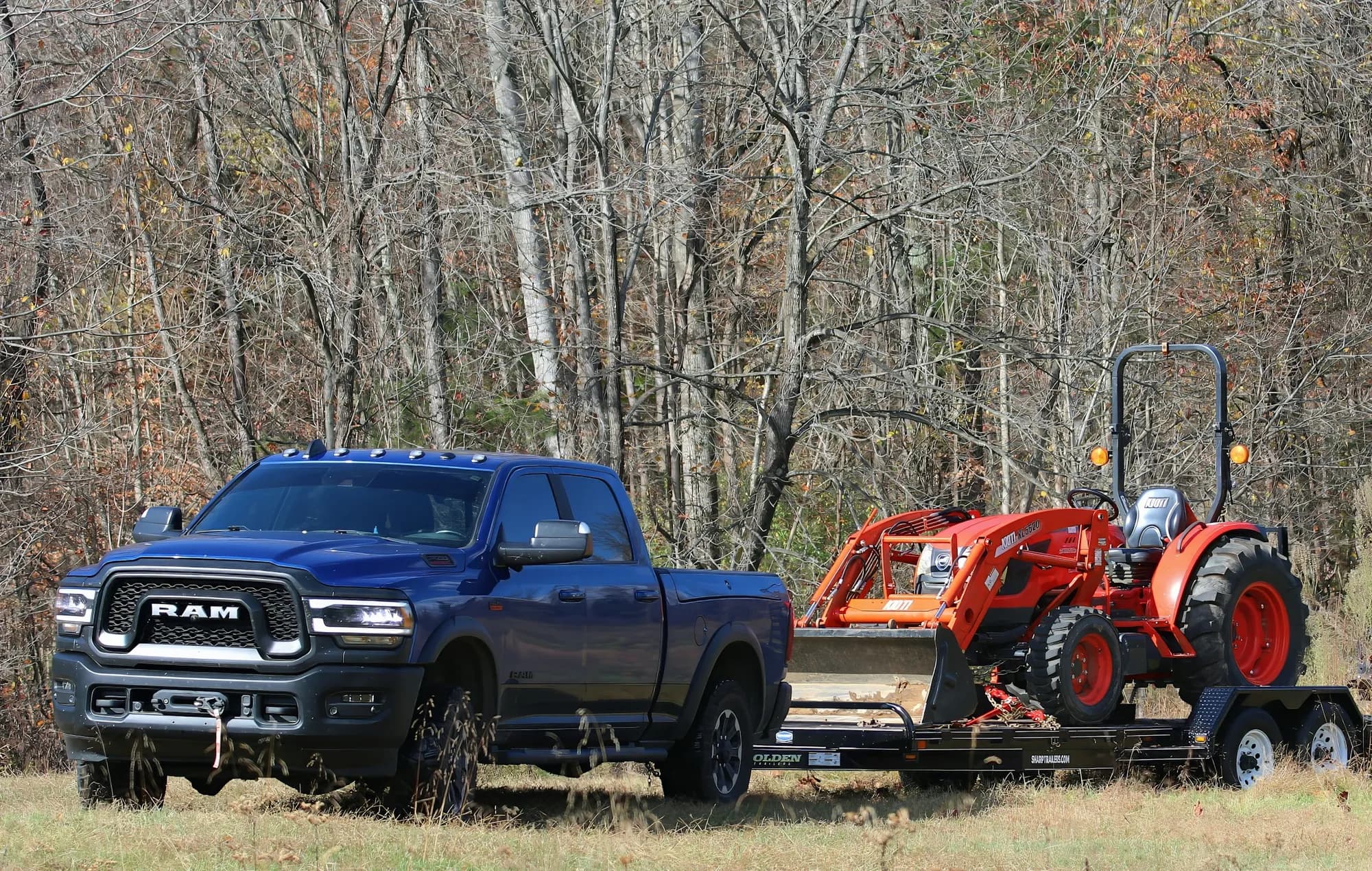
Photo: Preston A Larimer / Unsplash. A Ram Power Wagon towing a tractor in southern Indiana.
A late-model diesel pickup is two machines sharing one exhaust. The engine makes the torque. The aftertreatment system behind it cleans up what the engine leaves behind, and it has its own needs, its own dash messages and its own ways of slowing the truck down when those needs go unmet.
Owners who understand the second machine get fewer surprises. Ram's manuals for its Cummins-powered heavy-duty trucks spell out the messages and thresholds plainly, so they serve as the example here. Other makers publish their own procedures, and your truck's manual is the final word.
What sits in the exhaust
Exhaust gas recirculation works upstream, inside the engine. It routes some exhaust back into the intake charge and cuts nitrogen oxide formation mainly by lowering the oxygen concentration in the combustion chamber. DieselNet's EGR overview
The diesel particulate filter traps soot and periodically burns it off. DieselNet separates passive regeneration, where normal exhaust heat keeps the filter clean, from active regeneration, where the control system adds heat when the filter needs it. DieselNet's DPF overview
Selective catalytic reduction goes after NOx in the exhaust stream. A small dose of diesel exhaust fluid is injected ahead of a catalyst, where it converts nitrogen oxides into nitrogen and water vapor. Ram's 2019 diesel supplement lists hardware including the DEF tank, pump and injector, electrically heated lines, NOx and temperature sensors and the SCR catalyst. It also says an occasional clicking sound from the DEF system is normal. Ram's 2019 diesel supplement
Fuel and oil feed into all of it. Ram notes that federal law requires ultra-low-sulfur highway diesel, 15 ppm sulfur maximum, to avoid damaging the emissions system. It recommends engine oil with no more than 1.00 percent sulfated ash by mass and warns that high-ash oils can damage the aftertreatment hardware. Ram's 2019 diesel supplement
Why short trips and idling cause trouble
A particulate filter needs heat to clean itself. Ram's 2022 manual warns that a truck driven only on short, low-speed trips may never reach the conditions needed to burn off trapped soot. When the filter reaches 80 percent of its storage capacity, the cluster asks the driver to drive at highway speeds, and Ram says as little as 45 minutes can clear the condition. If a regeneration message appears, the advice is to keep driving as you are until it completes. Ram's DPF messages
Ignoring those prompts has consequences. The same manual describes a later stage in which the engine is derated to protect the aftertreatment system and the truck needs dealer service. It also warns that not following the oil change indicator can stop the filter's cleaning routine. Ram's DPF messages
Idling gets its own caution. Ram's supplement says prolonged idling can leave fuel incompletely burned, building carbon and varnish and diluting the oil. After two hours of idling or low-speed running, the engine enters an emissions mode that raises idle to 900 rpm to help maintain the filter. Ram's 2019 diesel supplement
Living with DEF
DEF is a 32.5 percent solution of high-purity urea in purified water. The American Petroleum Institute licenses fluids that meet ISO 22241 to carry its certification mark. API's DEF certification program
Storage is where many problems start. API says average temperatures above 86°F or direct sunlight can degrade DEF, that shelf life is at least 12 months in good conditions, and that bottles carry an expiration date worth reading. API's DEF consumer guidance Ram adds that anything touching DEF should be plastic or stainless steel, because copper, brass, aluminum, iron and ordinary steel corrode. Ram's 2019 diesel supplement
Cold weather is less dramatic than its reputation. DEF can freeze at or below 12°F, but Ram says the tank has an electric heater and the truck operates normally until the fluid thaws. Ram's 2019 diesel supplement The real winter risk is overfilling: Ram warns that an overfilled tank that freezes can damage the system and tells owners not to top off. The manual is equally clear that only DEF goes in the DEF tank, and that you should not start the engine if DEF ends up in the fuel tank. Ram's DEF fill procedure
Running out has a cost. On a 2022 Ram heavy-duty pickup, ignored low-DEF warnings escalate until the truck is limited to 5 mph after a restart, roughly an hour of idling or a refuel, and at least 2 gallons of DEF are needed to restore normal operation. Ram's DEF warning messages That behavior varies by manufacturer, model year and software. In August 2025 the EPA issued guidance urging manufacturers to develop software updates that give owners more time to resolve SCR-related problems, while stating that it cannot mandate field fixes on vehicles already in service. Ask a dealer whether an update applies to your truck. EPA on diesel exhaust fluid
Deletes leave a record
Federal law is direct on removing emissions hardware. The Clean Air Act prohibits knowingly removing or disabling emission controls after a vehicle is sold, and prohibits making, selling or installing parts whose principal effect is to defeat them. 42 U.S.C. 7522 Ram's supplement warns that intentional tampering may void the warranty and could bring civil penalties. It also says the powertrain computer stores a record of power-adding modifications that cannot be erased, even after the parts come off. Ram's 2019 diesel supplement
The routine that keeps a modern diesel happy is not complicated. Give it regular highway time, keep idling short, buy certified DEF and store it sensibly, and treat every aftertreatment message as a request with a deadline.
Owner-information editorial, not legal advice. Procedures differ by make and model year.