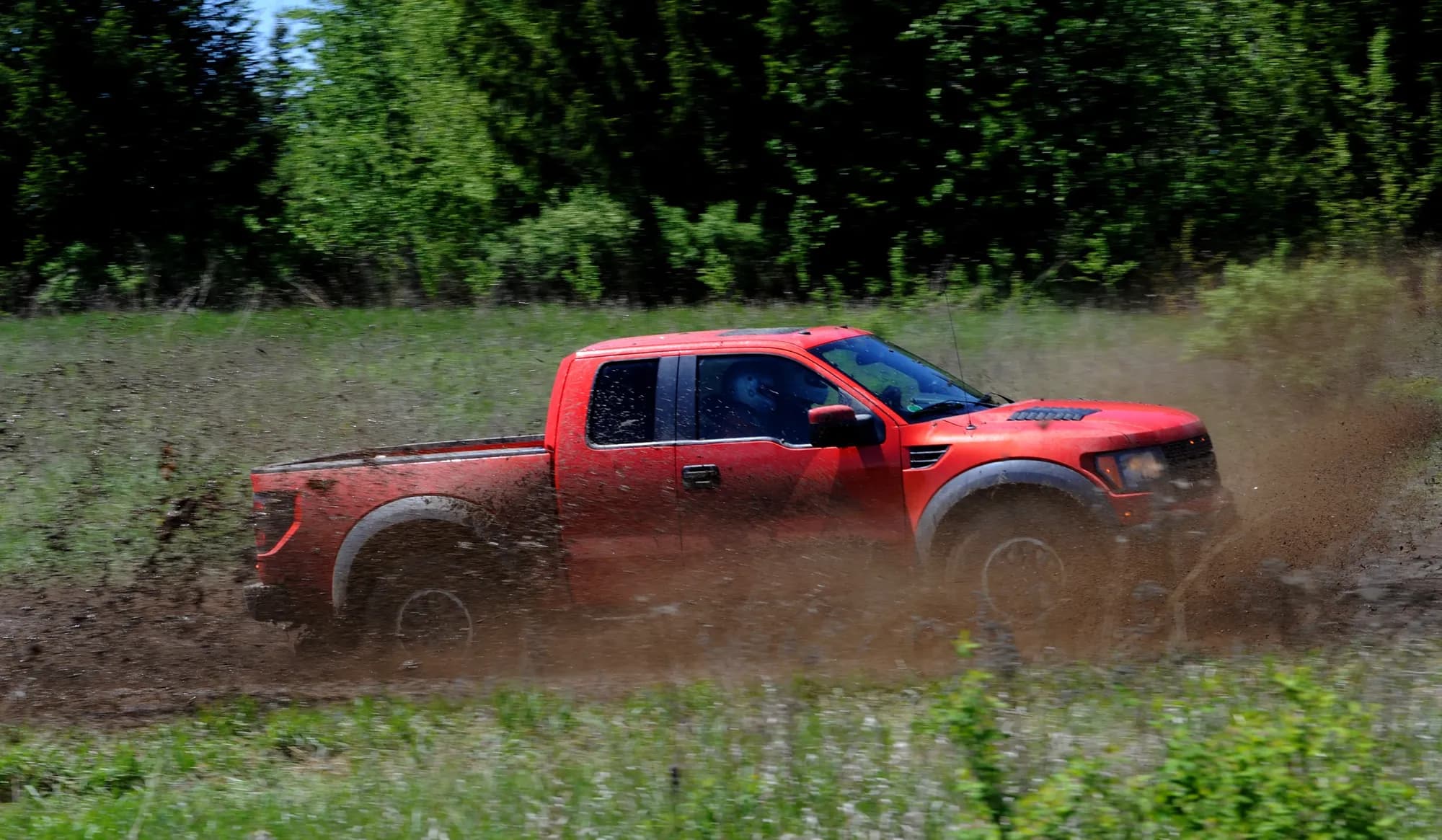
Photo: Sam VarnHagen for Ford Motor Company. A first-generation 2010 Ford F-150 SVT Raptor off-road.
Most fast trucks are remembered for an engine. The F-150 Raptor makes more sense when you follow its dampers. Writing for Ford on the truck's 15th anniversary, Ford Performance global director Mark Rushbrook put it plainly: "Raptor's crown jewel is its suspension." Ford's Raptor at 15 retrospective
That framing is useful for anyone shopping a used one or weighing a newer model. Output moved around across three generations, sometimes downward in cylinder count. The steadier thread is how Ford kept adding control at speed over rough ground.
Generation one: SVT's V8 original
Ford revealed the F-150 SVT Raptor at the 2008 SEMA show in Las Vegas and delivered the first trucks to US customers as 2010 models. Ford's anniversary piece credits its 2.5-inch passive internal bypass dampers with setting a new benchmark for off-road capability at the time. Ford's Raptor at 15 retrospective
Power came from V8s. Ford's own account gives the launch engine as a 5.4-liter making 310 horsepower, with an available 6.2-liter rated at 411 horsepower. Ford's 2024 Raptor R announcement That gap of roughly 100 horsepower is the first thing to confirm on any first-generation truck, and the paperwork is a better guide than the seller's memory.
The racing link was there from the beginning. Ford announced a separate Raptor R in Las Vegas in November 2008, developed by SVT and Ford Racing to contest the Tecate SCORE Baja 1000, and says that race truck initially ran external bypass FOX shocks. Ford's Raptor at 15 retrospective
Generation two: twin turbos and smarter shocks
The second generation dropped the V8s for a high-output 3.5-liter twin-turbo EcoBoost V6. Ford's 2018 F-150 specifications list that engine at 450 horsepower and 510 lb-ft, paired with a 10-speed automatic. Ford's 2018 F-150 specifications
The dampers grew to 3 inches. According to Ford, the production shocks became capable enough that its Baja 1000 race truck could run slightly modified versions of them instead of external bypass units. Ford also describes this generation as the point where the suspension went digital, with Live Valve controls managing compression damping according to drive mode and surface. Ford's Raptor at 15 retrospective
Those FOX Live Valve shocks debuted on the Raptor for the 2019 model year. Ford's 2024 F-150 overview That makes the split inside generation two worth checking. The difference is inside the shocks, so confirm which damping system the example in front of you actually has.
Generation three: coil springs, 37s and a V8 again
The headline change was at the back. The five-link rear suspension launched on the Raptor in 2021, with extra-long trailing arms, a Panhard rod and 24-inch coil springs. Ford's 2024 F-150 overview
Ford's 2024 technical specifications show what the layout delivers: 3.1-inch FOX dampers, 14.0 inches of front travel and 15.0 inches of rear travel on the standard LT315/70R17 BFGoodrich KO2 tires. The optional 37-inch tires trim travel to 13.0 inches front and 14.1 rear, raise ground clearance from 12.0 to 13.1 inches and stretch the turning circle from 48 to 50 feet. Ford's 2024 Raptor technical specifications
For 2024, Ford added FOX Dual Live Valve shocks, which combine position-sensitive compression control with continuously variable rebound control. Ford says the earlier Live Valve shocks remained on some configurations. Ford's 2024 F-150 overview
The V8 came back in the Raptor R. Ford took the supercharged 5.2-liter from the Mustang Shelby GT500, retuned it for off-road use and rated it at 700 horsepower and 640 lb-ft for the 2023 model year, with 37-inch tires standard. Ford framed the move as a response to owners who wanted V8 sound and power back in the Raptor. Ford's Raptor R announcement For 2024, lower intake losses and a revised calibration raised the rating to 720 horsepower, with torque unchanged. Ford's 2024 Raptor R announcement
Choosing between them
Start with the work. Ford's 2024 specifications list a maximum payload of 1,400 pounds, with conventional towing of 8,200 pounds for the Raptor and 8,700 pounds for the Raptor R. Ford's 2024 Raptor technical specifications This is a desert truck first. If towing and hauling fill most of your calendar, compare those numbers with a conventional F-150 configured for the job before you commit.
Then decide which suspension you are paying for. Generation one offers V8 character and the original internal-bypass design. Generation two brings the EcoBoost and, from 2019, electronic damping. Generation three adds the coil-sprung rear and the option of 37s, plus the Raptor R's supercharged V8.
Whatever the year, confirm the exact engine, shock system and tire size on the specific truck, and ask for the damper service history. Electronically controlled shocks add capability and complexity at the same time, so have an inspection done by someone who knows that system.
Read a Raptor from the bottom up: suspension first, engine second, graphics last.