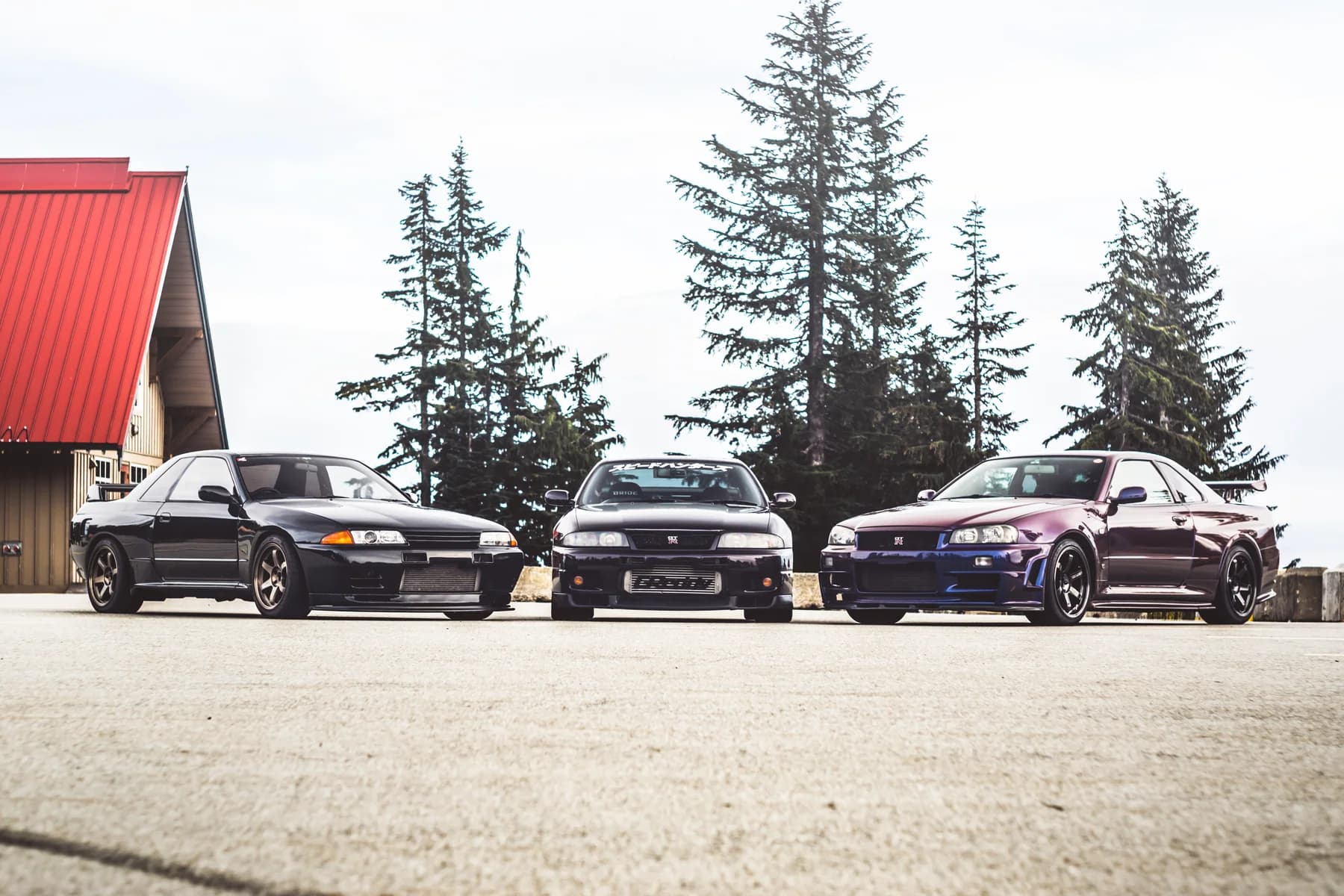
A Skyline can anchor the whole visual identity of a build. The R32 brings a compact, restrained shape; the R33 has broad, flowing bodywork; the R34 makes its edges and rear wing part of the statement. Our order for a TUNERS street-build moodboard is R34, R32, then R33. That is an editorial preference for styling and build character, not a timed comparison or a claim about today's used prices.
First: R34 — the visual centerpiece
The R34 would lead our moodboard for its squared-off shape and the contrast it creates beside a G80 or G82. We would begin with a complete car, make the wheel and body choices together, and let the finished proportions set the direction before adding more parts.
Nissan dates the R34 GT-R's arrival to 1999. Its heritage record describes the V-spec's aero, suspension and active differential, while the V-spec II added in 2000 received a carbon hood with a NACA duct. The collection's V-spec II has a 2,665 mm wheelbase. Those details identify a particular version; a wing or badge on another car does not establish the same specification. Nissan's R34 V-spec II record.
Second: R32 — a restrained starting point
For our R32, the brief would be simple bodywork, carefully chosen wheels and an interior that still feels like one coherent car. Its shape gives an owner room to make a statement with relatively few visual changes. That is a design preference, not a claim that stock examples are automatically better buys.
Nissan's 1989 collection car uses the 2,568 cc RB26DETT, a five-speed transmission and ATTESA E-TS four-wheel drive. The listed wheelbase is 2,615 mm. Nissan also records the model's 29 unbeaten Japanese Touring Car Championship races from 1990 through 1993, explaining the competition history behind its appeal. Nissan's R32 GT-R record.
Third: R33 — build around its own proportions
Third on this particular moodboard still earns a place in the lineup. We would give the R33 its own wheel and ride-height study, with photographs from the side and three-quarter angles before deciding on aero. Copying another generation's setup would miss the reason to choose this one.
Nissan lists a 2,720 mm wheelbase for its 1997 R33 V-spec and documents the move to ATTESA E-TS PRO with the R33 GT-R V-spec generation in 1995. The same collection entry identifies the RB26DETT and a factory rating of 280 PS. It is useful evidence of the version being discussed, not proof of the equipment or output of a modified survivor. Nissan's R33 V-spec record.
The actual car can change the order
For a purchase, we would put body condition, identity, service records and the quality of existing work ahead of this styling ranking. Ask a specialist to inspect the structure and drivetrain, compare installed parts with the seller's description, and explain unresolved findings in writing.
Build a separate worksheet for purchase, transport, immediate repairs and the proposed modifications. Obtain quotes for the actual car. This article does not establish current market values, import eligibility or a predictable RB26 failure sequence.
Bring the same standard to a finished feature: exact variant, measured setup, current photographs and a component list that belongs to that chassis. All three generations deserve that level of attention.
An editorial styling/build ranking based on manufacturer records, not a TUNERS road test. Updated September 8, 2026.