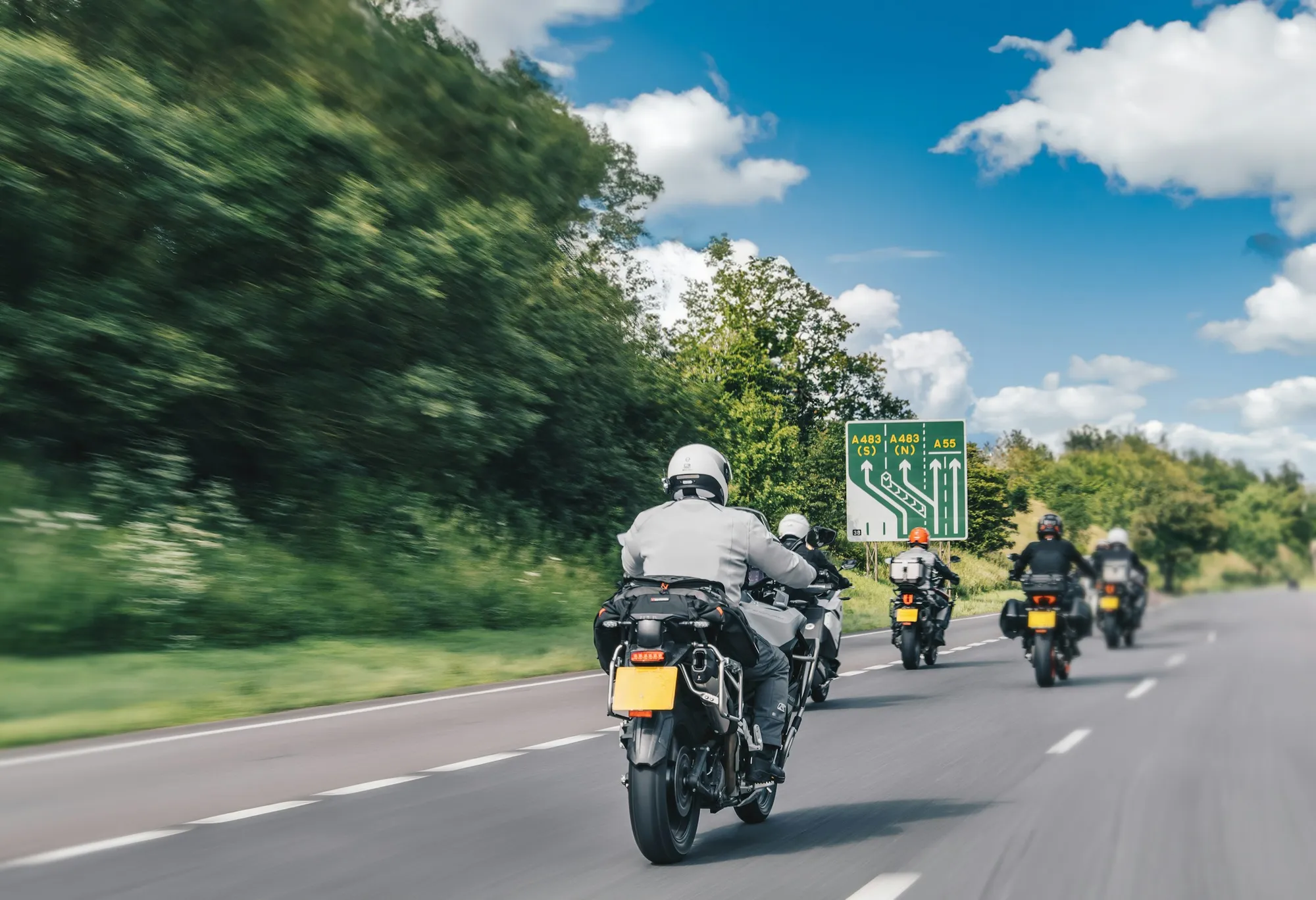
Photo: Rick Barrett / Unsplash. A group ride on an open road.
For many riders, the group ride is the local scene: a Sunday loop, a bike-night run, a fall ride to somewhere with good coffee. It also puts riders of different skill, on different bikes and with different habits, into one moving line in traffic. The Motorcycle Safety Foundation's guidance on doing that well comes down to one quality: being predictable to everyone around you.
Start before the engines do
The MSF's group riding tips begin in the parking lot. Show up on time and already fueled. Hold a riders' meeting to cover the route, rest and fuel stops, and hand signals. Pick a lead and a sweep rider, both experienced with group procedures, and make sure the leader knows each rider's skill level before setting off. At least one rider in each group should carry a first-aid kit and a full tool kit, and everyone should carry a phone. MSF's group riding tips
The MSF's Motorcycle Operator Manual adds two details that make the rest easier. Everyone should know the route, so a rider who gets separated has no reason to hurry. And inexperienced riders belong just behind the leader, where they will not have to chase the group and the more experienced riders can watch them from behind. MSF's Motorcycle Operator Manual
Size and formation
The MSF suggests five to seven riders as a manageable group. Larger rides can split into sub-groups a few seconds apart, each with its own lead and sweep. MSF's group riding tips
On open road, the staggered formation keeps the group compact while preserving space. The leader rides in the left side of the lane and the second rider in the right side, at least one second behind. The third rider takes the left side at least two seconds behind the leader, the fourth rides at least two seconds behind the second, and so on. MSF's Motorcycle Operator Manual
Single file, with at least two seconds between riders, is the better choice on curvy roads, in poor visibility or on poor surfaces, and when entering or leaving highways. Riding side by side in one lane is out in all conditions, because neither rider has room to swerve. If a rider leaves the group mid-ride, the others should criss-cross into the open position rather than having the rider directly behind move up, since passing within a lane is risky. MSF's group riding tips
The pace belongs to the least experienced rider
The operator manual states the core rules plainly: no competing, no passing within the group and no tailgating. A rider who wants to go faster should ride ahead to an agreed meeting point. Route length and riding segments should suit the least experienced rider, the pace through curves should be set for that rider, and a group with very different speeds can split in two. Regular breaks help prevent fatigue and lapses in concentration. MSF's Motorcycle Operator Manual
During the ride, check your mirrors. If the rider behind you is falling back, slow down so they can catch up; when everyone does this, the group holds a steady speed without anyone feeling pressure to ride faster. If you get separated, use the regrouping plan agreed at the meeting instead of riding illegally or past your ability to close the gap. MSF's group riding tips
Intersections, freeways and passing
Intersections deserve the most care. In NHTSA's 2024 data, there were 3,396 two-vehicle fatal crashes involving a motorcycle and another vehicle, and in 45 percent of them the other vehicle was turning left while the motorcycle was going straight, passing or overtaking. NHTSA's 2024 motorcycle data
The operator manual calls intersections the highest-risk point for a group. At a left turn on a green arrow, tighten up and turn single file. If some riders miss the light, those already through should stop at a safe spot ahead and wait, so nobody feels pressed to speed up or run the red. On freeways, enter single file and form up only after everyone has merged, with the leader moving the group at least one lane away from merging traffic, then leave in single file. MSF's Motorcycle Operator Manual
On a two-lane road, pass one rider at a time. The leader passes when it is safe, returns to the left position and holds passing speed to open space. Each following rider moves to the left position and judges the pass independently, because a safe pass for the leader does not make it safe for the next rider. MSF's Motorcycle Operator Manual Georgia's motorcycle operator manual lays out the same one-at-a-time sequence and tells riders not to pair up side by side. Georgia DDS Motorcycle Operator Manual
Fit to ride
The operator manual's preparation advice starts with the rider: a group ride needs an alert mind, free of alcohol and drugs, and even too much caffeine or some prescription drugs can affect concentration. MSF's Motorcycle Operator Manual NHTSA's figures show why that matters. In 2024, 40 percent of motorcycle riders killed in single-vehicle crashes were alcohol-impaired, and riders killed at night were alcohol-impaired 2.6 times as often as those killed during the day. NHTSA's 2024 motorcycle data
The groups worth riding with make these habits routine. The meeting happens every time, the newest rider sets the pace, and the ride ends at the coffee stop. Look for that culture before you look for the fastest crowd.